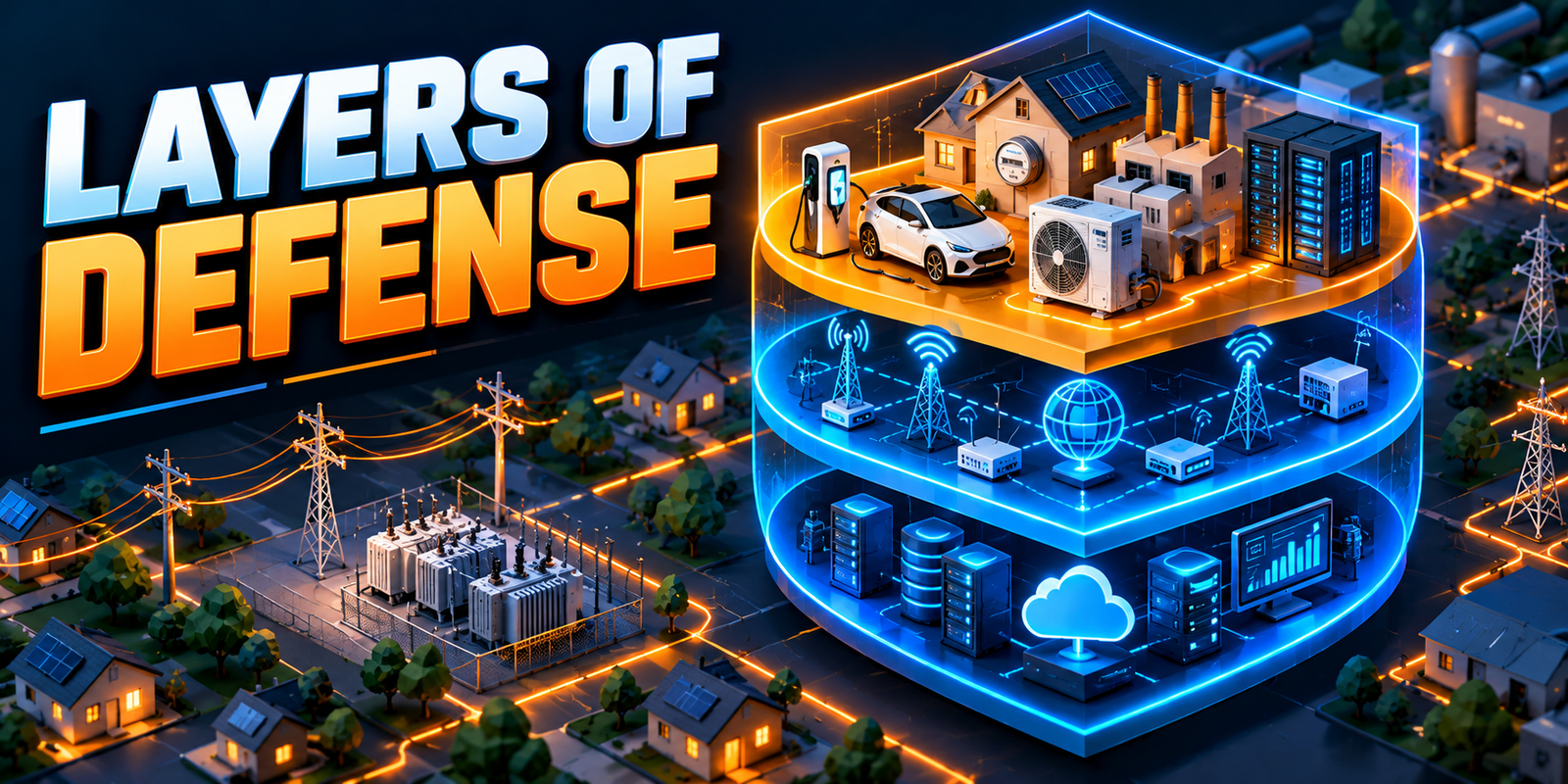
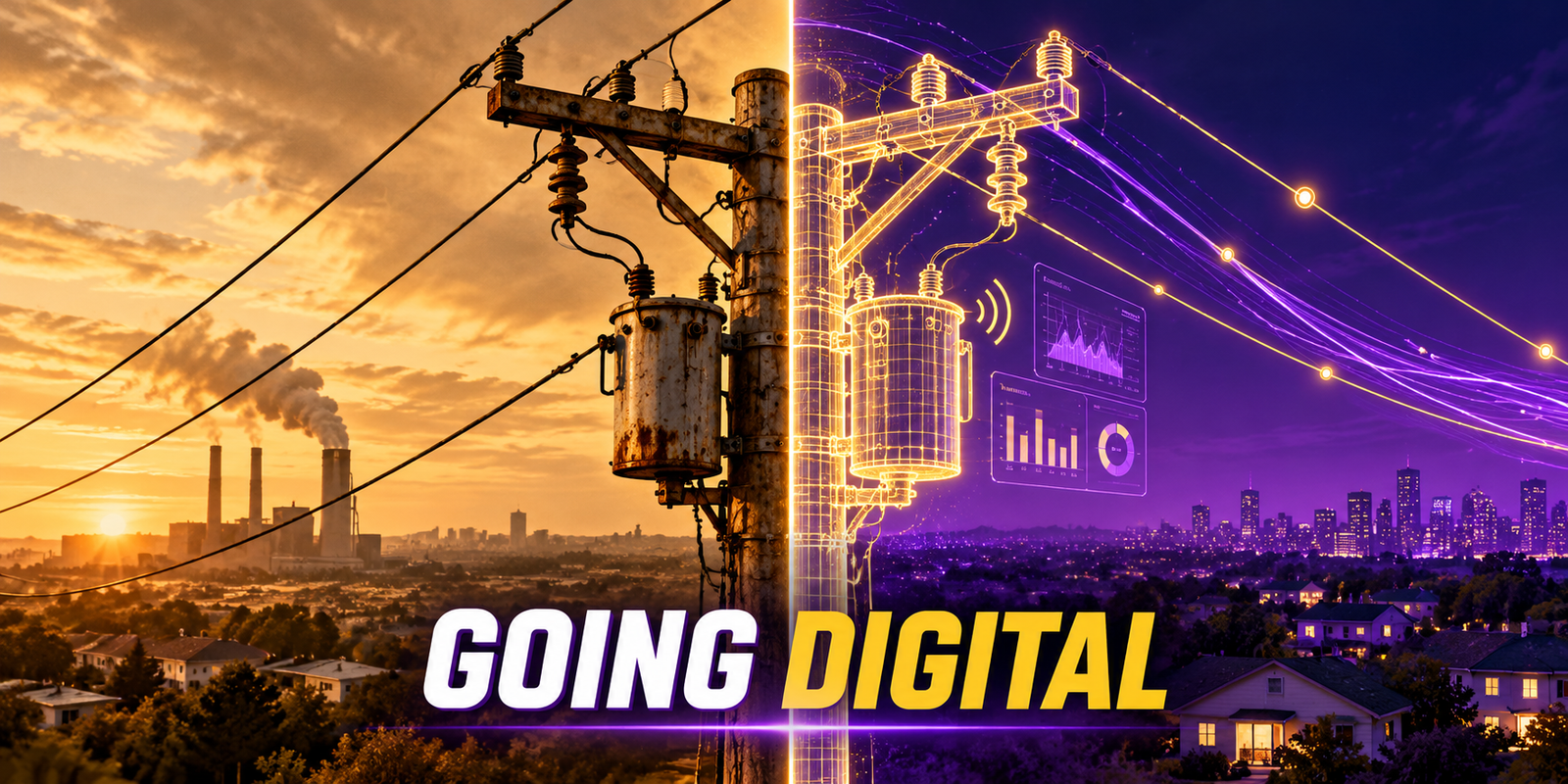
Grid digitalization is the process of adding sensors, communication networks, data platforms, analytics and automated control to the physical power system. Traditional power grids were designed for one-way flow from large power plants to customers, with limited real-time information. Today, rising demand, renewable energy and aging assets are pushing utilities toward a digital power grid that is measured, connected and managed with data.
This guide explains what grid digitalization means, how it works, which technologies are involved and what challenges utilities face. It is written for engineering students and professionals, and it separates technologies already in wide use from those that are still emerging.
Grid digitalization connects physical power infrastructure with sensors, communication networks, data platforms, analytics and automated control to improve grid visibility, reliability and flexibility.
What Is Grid Digitalization?
Grid digitalization is the use of digital sensing, communication, data analytics and control technologies to monitor and operate the electric grid more accurately and more quickly than manual or purely electromechanical methods allow.
Traditional grid vs digital power grid
A traditional grid relies heavily on electromechanical equipment, periodic manual readings and operator experience. Operators often learn about a distribution outage when customers call. A digital electrical grid adds measurement and communication at many more points, so operators see conditions in near real time and can act on them, sometimes automatically.
Why utilities are moving toward data-driven operations
Power systems are becoming more complex. Generation is more variable, loads are less predictable and assets are older. Data helps utilities decide where to invest, when to maintain equipment and how to operate the network within its limits. This shift is often described as digital transformation in utilities.
Grid digitalization and smart grids
The two ideas are closely related. A smart grid is the outcome: an electric grid with two-way communication, monitoring and control. Grid digitalization is the broader process and set of technologies that make this possible. Later sections compare grid digitalization, grid modernization and smart grids in more detail.
Why Are Traditional Power Grids Becoming Digital?
No single factor explains the change. Several pressures arrive together:
- Growing electricity demand: Population, industry and new loads such as data centers increase the need for capacity and better planning.
- Renewable energy integration: Solar and wind output varies with weather, so operators need better forecasts and faster control.
- Distributed energy resources: Rooftop solar, batteries and flexible loads change power flows on networks that were designed for one direction.
- Aging infrastructure: Many assets are decades old, so condition data helps target maintenance and replacement.
- Need for better reliability: Customers and regulators expect fewer and shorter outages.
- Grid resilience: Networks must withstand and recover from storms, heat and other events.
- Operational efficiency: Better visibility reduces unnecessary site visits and helps reduce losses.
- Faster fault detection: Sensors and meters help locate faults sooner.
- Increasing data availability: Smart meters, relays and sensors now produce far more data than older systems did.
- Customer expectations: Customers increasingly expect accurate billing, outage information and usage insight.
- Decarbonization: Clean-energy goals require grids that can host more renewable and flexible resources.
- Electrification of transport and industry: Electric vehicles and electrified processes change when and where power is needed.
Traditional Grid vs Digital Grid
The table compares typical characteristics. Real utilities often sit between the two, with digital tools added in stages.
| Feature | Traditional grid | Digital grid |
|---|---|---|
| Infrastructure | Mainly electromechanical equipment with limited communication | Physical equipment combined with sensors, intelligent devices and communication networks |
| Monitoring | Mostly at substations and key points, often periodic | Wider and more frequent, down to feeders, transformers and meters |
| Data availability | Limited, often manual or delayed | Large volumes of near real-time and historical data |
| Fault detection | Often after protection operates or customers report an outage | Faster, using relay, sensor and meter data |
| Grid control | Largely manual or local, with limited remote control | Remote and increasingly automated control |
| Maintenance | Time-based or after failure | Increasingly condition-based or predictive |
| Customer interaction | One-way supply and periodic billing | Two-way communication, usage data and demand response options |
| Renewable integration | Difficult at scale, because flows and output are hard to see | Better forecasting, monitoring and control of variable and distributed resources |
| Automation | Limited | Widespread switching, restoration and control functions |
| Decision-making | Based on experience and periodic studies | Supported by data, models and analytics, with operator oversight |
| Reliability | Depends on redundancy and manual response | Improved by faster detection, isolation and restoration |
| Operational visibility | Partial, especially on distribution networks | Much broader, with better awareness of network state |
How Does Grid Digitalization Work?
A digital grid works as a chain that turns physical measurements into actions. Each stage depends on the one before it.
Sensors
Sensors, meters and intelligent devices measure quantities such as voltage, current, power, temperature and equipment status.
Communication networks
Fibre, radio, cellular and other links carry the measurements from the field to control systems and data platforms.
Data collection
Gateways and head-end systems gather data from many devices, check it and pass it on in usable form.
Data platforms
Databases, historians and cloud or on-premises platforms store the data so different applications can use it.
Analytics
Software analyses the data to estimate network state, forecast load, detect anomalies or assess asset condition.
Control systems
SCADA, distribution management and energy management systems present results to operators and send commands to equipment.
Utility decisions
Operators and planners use the information to dispatch, switch, schedule maintenance or plan investment.
Automated grid actions
For well-defined cases, such as isolating a fault and restoring supply, control systems can act automatically within set rules.
A simple version of the chain is: sensor, communication, data, analytics, decision and control. The loop then repeats, because the control action changes the measured conditions.
Key Components of Grid Digitalization
- Smart meters: Electronic meters that record usage at short intervals and communicate it to the utility.
- Advanced Metering Infrastructure (AMI): The meters, networks and data systems that collect and manage meter data.
- Intelligent electronic devices (IEDs): Microprocessor-based devices, such as protection relays and controllers, that measure, protect and communicate.
- Sensors: Devices that measure voltage, current, temperature, gas levels or other conditions on assets and lines.
- Digital substations: Substations that use digital communication standards, such as IEC 61850, between devices.
- SCADA: Supervisory control and data acquisition systems that give operators remote monitoring and control.
- Distribution Management Systems (DMS): Software that helps operate distribution networks, including switching and outage management. Advanced versions are often called ADMS.
- Energy Management Systems (EMS): Control-center software for transmission networks, including state estimation and contingency analysis.
- Communication networks: The fibre, wireless and other links that connect devices to control centers.
- IoT devices: Connected low-cost sensors and devices that extend monitoring to more points.
- Cloud platforms: Computing and storage services used for large-scale analytics and data sharing.
- Edge computing: Processing close to the device, which reduces delay and the amount of data sent upstream.
- Data platforms: Systems that organize and store utility data so it can be shared across applications.
- Grid analytics: Applications that turn power system data into forecasts, alerts and recommendations.
- AI and machine learning: Statistical models that learn patterns from data and support tasks such as forecasting and anomaly detection.
The Role of Smart Meters and AMI
What smart meters are
A smart meter is an electronic meter that records energy use at intervals and can send the data to the utility. Many can also record voltage and report events such as power loss.
How AMI works
Advanced Metering Infrastructure combines smart meters, a communication network and a meter data management system. Meters send readings over the network to a head-end system. The data is validated and stored for billing, operations and analysis.
Two-way communication and remote monitoring
Unlike older meters that were read manually, AMI supports communication both ways. The utility can read meters remotely, check their status and, where supported, send commands such as remote connection.
Outage detection, demand response and customer visibility
- Outage detection: Meters can report loss of supply, which helps utilities locate outages sooner.
- Demand response: Interval data and communication support programmes that reduce or shift demand at peak times.
- Customer energy visibility: Customers can see usage patterns and understand what drives their bills.
- Utility analytics: Meter data supports load analysis, loss analysis and transformer loading studies.
AMI is one part of a smart grid, not the whole thing. It covers the metering and customer-edge data. A smart grid also includes monitoring, automation and control across generation, transmission and distribution.
Digital Substations and Intelligent Grid Equipment
Substations are key data points, because so much power flows through them. In a conventional substation, equipment is connected by large numbers of copper cables. A digital substation replaces much of that wiring with digital communication.
- Intelligent electronic devices: Relays, controllers and meters process measurements locally and share them over the network.
- Sensors: Measure current, voltage and equipment conditions, and may output digital signals directly.
- Protection relays: Detect faults and trip breakers. In digital designs, they exchange signals over standard communication protocols.
- Digital communication: Standards such as IEC 61850 allow devices from different suppliers to exchange data in a defined way.
- Remote monitoring: Operators can see equipment status and measurements without visiting the site.
- Automated control: Switching and some control actions can be performed automatically within defined rules.
- Condition monitoring: Sensors track items such as transformer temperature and dissolved gases, which can indicate developing problems.
How Data Is Changing Utility Operations
- Load forecasting: Historical load and weather data help predict short-term demand for operations.
- Demand forecasting: Longer-term analysis of growth and customer behaviour supports investment planning.
- Asset monitoring: Measurements show how heavily and how hot equipment is running.
- Predictive maintenance: Condition data helps identify equipment that may be deteriorating, so work can be planned.
- Fault detection: Relay, sensor and meter data help locate faults sooner.
- Outage management: Meter alerts and network models help find outage extents and prioritize crews.
- Voltage optimization: Voltage measurements allow tighter control within allowed limits, which can reduce energy use in some networks.
- Power quality analysis: Recorded disturbances, harmonics and voltage events help find causes of poor supply quality.
- Renewable forecasting: Weather-based forecasts of solar and wind output help operators plan reserves and flows.
- Customer demand analysis: Interval data shows usage patterns, which supports tariffs and demand response design.
Data is only useful if it is accurate, timely and connected to a decision. Many utilities spend as much effort on data quality and integration as on the sensors themselves.
AI and Machine Learning in Grid Digitalization
AI and machine learning are tools for finding patterns in large data sets. In power systems they support engineers and operators. They do not replace protection systems, safety rules or engineering judgment.
Practical applications in use today
- Load forecasting: Models trained on past load, weather and calendar data forecast demand.
- Fault detection: Pattern recognition helps classify and locate disturbances and faults.
- Predictive maintenance: Models estimate equipment condition from sensor and inspection data.
- Anomaly detection: Algorithms flag unusual meter or sensor behaviour, which may point to faults, data errors or losses.
- Renewable generation forecasting: Weather and plant data are used to predict solar and wind output.
- Asset health monitoring: Combined data gives a health score to support maintenance prioritization.
Emerging and developing uses
- Demand response optimization: Models can help decide when and how to call on flexible demand, although approaches vary and are still evolving.
- Grid planning: Analytics can help evaluate scenarios for new load and distributed generation. Results depend heavily on data quality and assumptions.
Results depend on good data, careful validation and human oversight. Models can be wrong, especially in conditions that differ from their training data.
How Grid Digitalization Supports Renewable Energy
- Solar and wind power: Output varies with weather. Forecasting and monitoring help operators plan reserves and manage flows.
- Distributed generation: Rooftop and small-scale generation connects to distribution networks, where monitoring has traditionally been limited. Sensors and meter data improve visibility.
- Battery storage: Digital control allows batteries to charge and discharge in response to prices, voltage or grid needs.
- Electric vehicles: Smart charging can shift demand to periods of lower network stress.
- Distributed energy resources: Together, these resources can be monitored and coordinated using control platforms.
- Bidirectional power flows: When local generation exceeds local demand, power can flow back toward the substation. Monitoring and control help manage voltage and protection in this situation.
- Forecasting: Better forecasts of both generation and load reduce uncertainty.
- Grid flexibility: Digital control makes it easier to use flexible demand, storage and generation to balance the system.
For more on how the grid is evolving, see our guide to the modern electric grid and its digital architecture.
Grid Automation and Real-Time Monitoring
- Distribution automation: Remote-controlled switches, reclosers and sensors on feeders allow faster network reconfiguration.
- Remote switching: Operators can open and close devices from the control center without sending a crew.
- Fault isolation: Automated schemes identify the faulted section and open the devices around it.
- Automated restoration: After isolation, supply to healthy sections can be restored by closing normally open tie switches.
- SCADA: Collects status and measurements and sends control commands.
- Real-time monitoring: Operators view loading, voltage and alarms as they change.
- Control centers: Operators combine SCADA and other applications to run the network.
- Digital protection: Microprocessor relays offer more functions, event records and communication than older electromechanical designs.
Automation works best for clear, repeatable situations. Complex events still need operators, who stay responsible for safe operation.
Benefits of Grid Digitalization
- Improved reliability: Faster detection and automated switching reduce the number of customers affected.
- Faster outage detection: Meters and sensors can signal problems without waiting for customer calls.
- Faster restoration: Remote switching and better fault location reduce outage duration.
- Better asset utilization: Measured loading shows where spare capacity exists, so assets can be used more fully within safe limits.
- Predictive maintenance: Maintenance can be targeted based on condition.
- Reduced operational costs: Fewer manual readings and site visits can lower costs, although digital systems add their own costs.
- Better renewable integration: Visibility and control help the network host more variable and distributed generation.
- Improved visibility: Operators see network state more completely.
- Better customer service: Accurate billing, outage updates and usage information improve the customer experience.
- Improved planning: Measured data replaces many assumptions in network planning.
- More efficient grid operation: Voltage management, loss analysis and balanced loading can reduce waste.
Challenges of Grid Digitalization
- Cybersecurity: More connected devices increase the number of points to protect.
- Data privacy: Detailed meter data can reveal customer behaviour and must be handled carefully.
- Legacy infrastructure: Older equipment may lack communication or measurement capability and may need upgrades.
- Interoperability: Devices and systems from different suppliers must exchange data reliably.
- High implementation costs: Devices, networks, software and integration require significant investment.
- Skilled workforce requirements: Utilities need staff who understand both power systems and data or communication technology.
- Communication reliability: Digital functions depend on communication links being available and fast enough.
- Data quality: Missing, delayed or wrong data can lead to poor decisions.
- System integration: Connecting many separate systems into one consistent workflow is complex.
- Vendor dependency: Proprietary systems can make later changes difficult and costly.
- Regulatory requirements: Rules on investment recovery, data use and security differ by region.
- Digital resilience: Utilities must be able to keep operating, or recover quickly, if digital systems fail.
Cybersecurity in the Digital Power Grid
When devices are connected, they can be attacked as well as used. The following focuses on defensive practice used by utilities.
Why connected grids create new cyber risks
Older systems were often isolated. Connected sensors, meters and control systems expand the attack surface. Because electricity supports hospitals, transport and communication, power grids are considered critical infrastructure.
IT and OT environments
Information technology (IT) covers business systems such as billing and email. Operational technology (OT) covers the systems that monitor and control physical equipment, such as SCADA and relays. OT systems prioritize safety and availability, so they often need different security approaches from IT systems, and the boundary between them needs careful design.
Defensive measures
- Access control: Limit who and what can reach systems, and use strong authentication.
- Network segmentation: Separate OT networks from IT and from each other, so a problem in one area is contained.
- Monitoring: Watch network traffic and device behaviour for unusual activity.
- Incident response: Plan, practise and document how to detect, contain and recover from incidents.
- Security updates: Maintain and patch systems in a controlled way that respects operational constraints.
- Data protection: Protect customer and operational data in storage and in transit.
Many utilities follow recognised frameworks, such as IEC 62443 for industrial control systems, and regulatory requirements that vary by country.
Real-World Example: From Traditional Grid to Digital Grid
This example is a simplified illustration, not a description of any specific utility.
Traditional grid
In a traditional chain, power flows from the power plant through transmission lines to a substation, then through distribution lines to the customer. Information flows mostly one way and slowly. A utility may only learn of a distribution fault when customers call, and meters are read manually. For the physical side of this chain, see our explanation of how power moves from generation to consumption.
Digitalized grid
In a digitalized grid, the same physical path is supported by a parallel flow of data.
Power plant
Generation data, including output and availability, is shared with system operators.
Transmission monitoring
Sensors and measurement units report line loading and voltage to the control center.
Digital substation
Intelligent devices share status and measurements over digital communication, and support remote operation.
Distribution automation
Remote switches and reclosers on feeders can isolate faults and reconfigure supply.
Smart meter and AMI
Meters report usage and events, including loss of supply, from the customer edge.
Data platform
Data from many sources is collected, validated and stored in one environment.
Analytics
Applications forecast load, flag anomalies and assess equipment condition.
Utility control
Operators review results and act, or approved automated functions respond.
Customer
The customer receives a more reliable supply, quicker restoration and access to usage information.
The key difference is the feedback loop. Measurements lead to analysis, analysis leads to action, and the result of the action is measured again.
Grid Digitalization vs Grid Modernization vs Smart Grid
These terms overlap and are sometimes used interchangeably, but they are not identical.
| Concept | Main focus | Typical scope |
|---|---|---|
| Grid digitalization | Adding sensing, communication, data and analytics to power system operation | Digital technologies and the data and control flows they create |
| Grid modernization | Upgrading the grid overall to meet new needs | Physical upgrades, digital technologies, market and policy changes, and new operating practices |
| Smart grid | A grid with two-way communication, monitoring and control | The resulting system, including AMI, automation, distributed resources and analytics |
One way to see the relationship is as a progression. Digital monitoring is added to a traditional grid. Combined with communication and control, it forms a smart grid. Utilities then use the data to run the network in a more data-driven way. Grid modernization is the wider programme that may include all of this, plus stronger lines, new transformers and updated rules. Our article on grid modernization and the evolution from traditional power systems covers this wider context.
We also compare the physical networks in more detail in our upcoming comparison of transmission vs distribution, which explains why monitoring and control needs differ between them.
What Does the Future of the Digital Power Grid Look Like?
Some of the following are already in use, while others are emerging. Adoption varies widely between utilities and countries.
Widely deployed or growing quickly
- More distributed energy resources: Rooftop solar, batteries and flexible loads continue to grow in many regions.
- Advanced forecasting: Weather and load forecasting methods continue to improve.
- Flexible demand: Demand response and smart charging are increasingly used.
- Battery storage: Utility-scale and distributed batteries are being deployed for balancing and local support.
- EV integration: Managed charging and vehicle-grid interaction are developing.
- More connected assets: Utilities continue to add monitoring to more equipment.
- Advanced sensors: Lower-cost sensors extend visibility into distribution networks.
Emerging and developing
- AI-assisted grid operations: Decision-support tools are being tested and introduced, with human operators remaining in charge.
- Digital twins: Virtual models of grid assets or networks are used in some applications, but broad use is still developing.
- Autonomous grid functions: Limited autonomous control exists for specific tasks such as fault isolation and restoration. Wider autonomy is still at an early stage.
- Edge computing: Local processing in substations and field devices is growing, particularly where fast response matters.
Grid Digitalization: Quick Summary
| Topic | Summary |
|---|---|
| What it is | Connecting physical grid assets with sensing, communication, data, analytics and control |
| Why it matters | Supports reliability, renewable integration, resilience and efficient operation as demand and complexity grow |
| Main technologies | Smart meters and AMI, IEDs, sensors, digital substations, SCADA, DMS and EMS, communication networks, data platforms, analytics |
| Benefits | Faster outage detection and restoration, better visibility, predictive maintenance, improved planning |
| Challenges | Cybersecurity, data privacy, legacy equipment, interoperability, cost, skills and data quality |
| Future direction | More distributed resources, better forecasting, more automation and decision support, with human oversight |
Conclusion
Traditional power grids are becoming digital and data-driven because modern power systems are more complex than the ones they were built for. Variable renewable generation, distributed resources, new loads and aging assets all need better visibility and faster, more precise control.
Grid digitalization is not simply about adding software. It connects physical grid infrastructure with sensing, communication, data, analytics and control, so measurements can lead to decisions and actions. Done well, with strong cybersecurity and good data, it helps utilities deliver a more reliable, flexible and efficient electric grid.
Frequently Asked Questions
What is grid digitalization?
Grid digitalization is the use of digital sensors, communication networks, data analytics and automated control to monitor and operate the electric grid. It adds a layer of information and control on top of physical infrastructure such as lines, transformers and substations. The goal is better visibility, reliability and flexibility, especially as renewable energy and new loads increase complexity.
How does grid digitalization work?
Grid digitalization works by turning measurements into actions. Sensors, smart meters and intelligent devices collect data, and communication networks carry it to control systems and data platforms. Analytics then process the data, and operators or automated functions use the results to switch equipment, balance the network or schedule maintenance. The results are measured again, forming a continuous loop.
Why is grid digitalization important?
Grid digitalization is important because modern grids face more variable generation, distributed resources, new demand and aging equipment. Digital tools give utilities better visibility and faster response, which helps reduce outage duration, integrate renewables and plan investment. It also supports customer services such as accurate billing and outage information, although its benefits depend on good implementation and data quality.
What are the main components of grid digitalization?
The main components are sensors, smart meters and AMI, intelligent electronic devices, digital substations, SCADA, distribution and energy management systems, and communication networks. Data platforms, cloud and edge computing, grid analytics and AI or machine learning tools process the data. Together they connect physical equipment with monitoring, analysis and control.
What are the challenges of grid digitalization?
The main challenges are cybersecurity, data privacy, legacy infrastructure, interoperability between systems and high implementation costs. Utilities also need skilled staff, reliable communications and high-quality data, and they must manage vendor dependency and regulatory requirements. Digital resilience matters too, because power systems must keep operating safely if digital systems fail.
Where is grid digitalization used?
Grid digitalization is used across the power system. In generation it supports monitoring and forecasting. In transmission it supports control centers and real-time monitoring, and in distribution it supports automation, outage management and smart metering. It also helps connect renewable energy, battery storage and electric vehicle charging, and it reaches customers through AMI and demand response programmes.

I share real stories, practical ideas and honest perspectives on business, marketing and life. This blog is a space to learn, grow and connect.