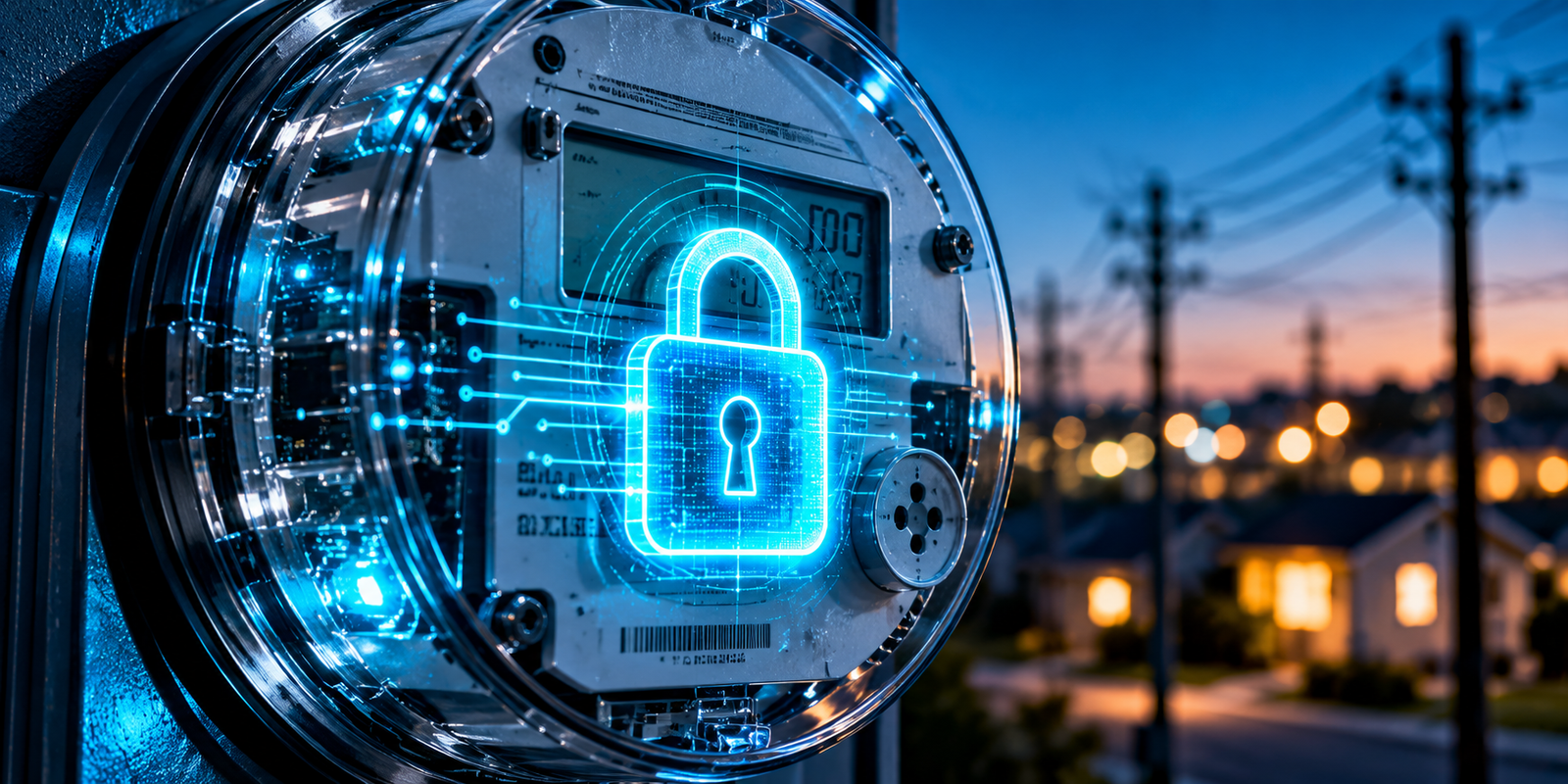
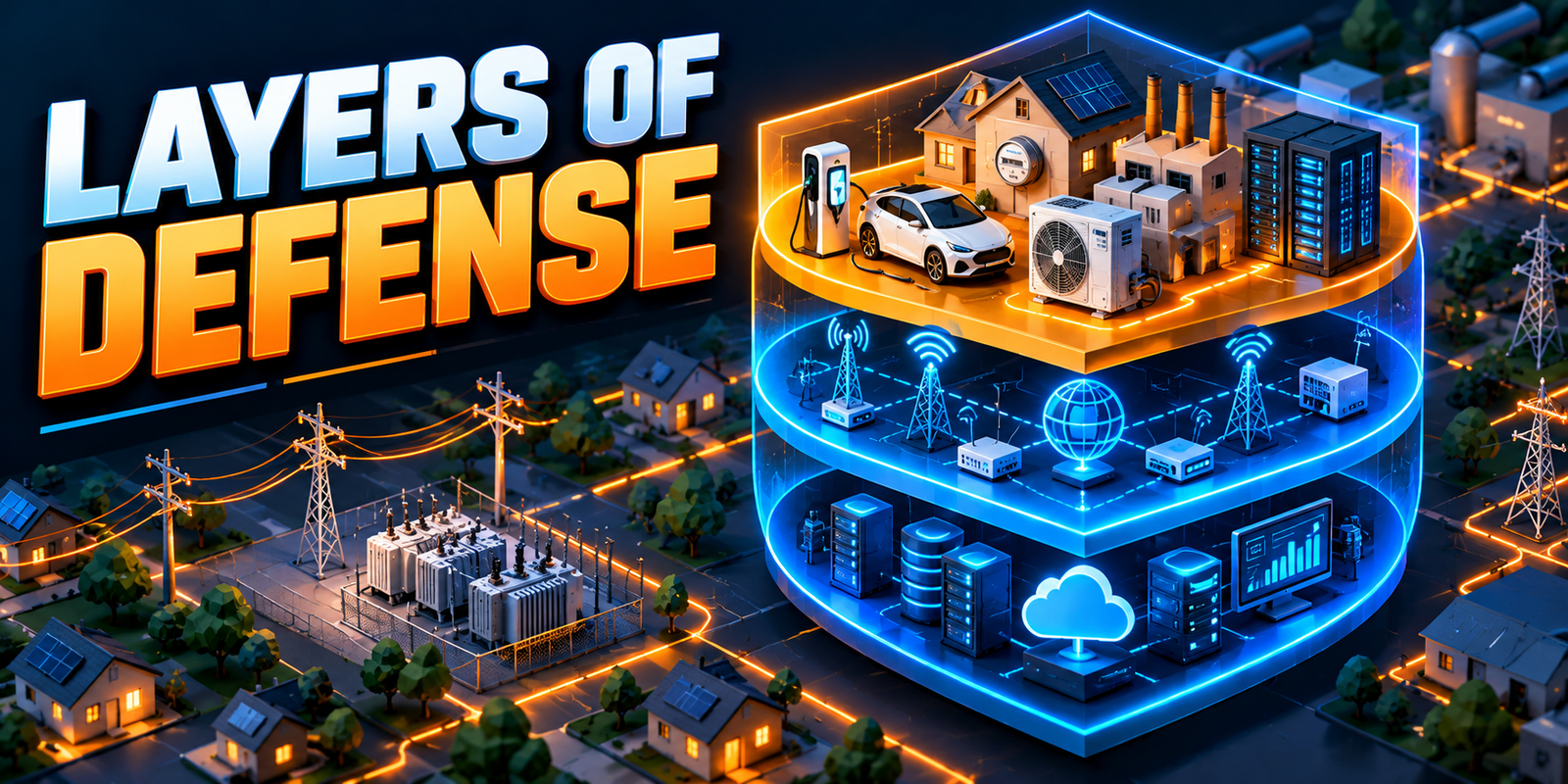
Smart grid cybersecurity is the protection of the digital systems, networks and data that run a modern electricity network from unauthorized access, misuse and disruption.
Electricity networks are becoming more connected, automated and data-driven. Sensors, intelligent field devices, smart meters, remote monitoring and cloud-connected analytics help utilities see and manage the grid in far greater detail than before. The same connections mean that a weakness in one digital system can, depending on the design, affect others. Smart grid security is the practice of protecting the devices, networks, data, people and operational processes that make a modern grid work, so that utilities can keep operating reliably and safely.
This guide explains how smart grid security works, what its main components are, how IT and OT security differ in electric utilities, and how governance, monitoring, supplier oversight and recovery planning fit together. It is written for utility cybersecurity teams, OT security professionals, engineers and critical-infrastructure leaders. The discussion is deliberately defensive and conceptual. It contains no attack instructions, no statistics or incident claims, and no assertions about any particular utility, vendor or product. Controls always need to be adapted to each utility’s architecture, risk profile, operating requirements and regulatory obligations.
Key Takeaway
- Smart grid security covers devices, communications, data, people and processes, and it sits alongside physical security, safety, reliability and resilience without being identical to them.
- A useful mental model is a continuous cycle: identify, assess, protect, monitor, respond and recover.
- IT and OT need different handling, because OT changes can affect physical processes, safety and continuity.
- Cybersecurity can reduce risk but cannot guarantee uninterrupted supply or complete protection.
- Risk-based, layered controls that are reviewed regularly work better than any single tool.
What Is Smart Grid Security?
Smart grid security is the broader protection of smart grid systems, devices, communications, data and operational processes, so that electricity networks remain trustworthy, available and safe to operate.
Its scope is wider than any one technology. It includes the cybersecurity of information technology (IT) and operational technology (OT), and it also draws on physical security, operational safety practices, reliability engineering and resilience planning.
Smart grid security and smart grid cybersecurity
The two terms are closely related and often used interchangeably, but they are not identical. Smart grid cybersecurity focuses on protecting digital systems, networks and data from unauthorized access, misuse and disruption. Smart grid security is the umbrella: it includes cybersecurity and also considers physical protection of sites and equipment, safe operating procedures, workforce practices and the ability to recover. The rest of this guide covers the cyber side in depth, and the background on how a smart grid is structured helps place it in context.
How security differs from safety, reliability and resilience
- Security concerns protection against deliberate or accidental misuse of systems and information.
- Safety concerns protecting people and equipment from harm, for example through protection systems and safe working procedures.
- Reliability concerns how consistently the system delivers electricity when needed.
- Resilience concerns the ability to withstand, adapt to and recover from disruption.
These concepts overlap. A security measure can support reliability, and a poorly planned security change can undermine it. For the distinction between the last two, see grid reliability vs grid resilience.
How Does Smart Grid Security Work?
Security works best as a repeating cycle and not a one-time project. At a conceptual level, the cycle has six stages.
- Identify assets. Know which systems, devices, data and connections exist, who owns them and what they support. Without this, later stages rest on guesswork.
- Assess risk. Consider what could go wrong, how likely it is and what the operational consequences would be, so that effort goes to the most important systems first.
- Apply protective controls. Choose proportionate measures such as segmentation, access control, secure configuration, supplier requirements and staff training.
- Monitor activity. Collect and review information that shows whether systems are behaving as expected, and define who acts on unusual signals.
- Respond to incidents. Follow prepared, authorized procedures that coordinate security and operations personnel.
- Recover operations. Restore systems in a validated way, confirm their integrity, and feed lessons back into the first stage.
Where responsibilities sit
Security responsibilities are spread across the utility, and they do not all belong to one team. Typical areas include:
- Control centers, where operators monitor and manage the network.
- Substations, where protection, control and communication equipment coordinate locally.
- Field equipment, often distributed across large and remote areas.
- Communication networks that link all of these.
- Metering infrastructure, connecting customer premises to utility systems.
- Enterprise systems, such as billing, customer and business applications.
Each area has different owners, technologies and constraints, so effective programs define clear accountability and build bridges between the teams involved.
The Main Components of Smart Grid Security
Not every utility uses the same architecture or technology stack, so the components below should be read as common building blocks and not a universal blueprint.
IT systems and enterprise applications
These include business applications, customer systems, email and corporate networks. They hold information such as customer and billing data and often connect to operational systems for data exchange. Their security considerations are the familiar ones, such as protecting accounts, endpoints and data, with extra care at any point where they connect to operational environments.
OT systems, SCADA and industrial control systems
Operational technology monitors and controls physical processes. In many utilities this includes Supervisory Control and Data Acquisition (SCADA) systems, which give operators visibility and control, and other industrial control systems where used. Security here must preserve both the integrity of the information operators rely on and the availability of control functions.
Intelligent electronic devices, sensors and controllers
Field equipment measures conditions, executes protection logic and carries out control actions. Considerations include secure configuration, firmware management, access to configuration interfaces and the long service lives of many devices. See digital substations and their communications for engineering background.
Communication networks and protocols
Communications carry measurements, status and commands between systems. Security considerations include which systems may talk to each other, how identities are verified, whether data is protected in transit where the technology supports it, and how well traffic can be observed. Many industrial protocols were designed for reliability in closed environments, so protective measures often have to be added around them.
Advanced Metering Infrastructure and smart meters
AMI links meters, communications and back-end systems. It is covered in more detail in its own section below.
Operational data, customer information and analytics platforms
Grid operation produces large volumes of data, from interval consumption to equipment measurements. This data feeds analytics and planning. It needs protection for confidentiality where it concerns customers, for integrity where decisions rely on it, and for availability where operations depend on it.
Identity, access management and remote-access systems
These systems decide who or what may reach which resources. They are central because many security outcomes depend on knowing and controlling access, including access from outside the organization.
Monitoring, incident response, backup and recovery capabilities
These are the capabilities that make the other controls testable and recoverable. Monitoring shows what is happening, response procedures turn alerts into coordinated action, and backups and recovery plans determine how fast and how safely operations can return to normal.
IT Security vs OT Security in Electric Utilities
Information technology and operational technology both need protection, but their purposes and constraints differ.
| Aspect | IT security | OT security |
|---|---|---|
| Main purpose | Protect business information and services | Protect systems that monitor and control physical processes |
| Operating environment | Office, data center and cloud environments, frequently refreshed | Control rooms, substations and field sites, often with long-lived equipment |
| Availability requirements | Important, but short interruptions are often tolerable | Often critical, with some functions needing continuous operation |
| Maintenance constraints | Frequent updates and restarts are common | Changes may need scheduled windows, testing and operational approval |
| Consequences of disruption | Mainly data, business and service impact | Can also involve safety, equipment and electricity delivery |
| Vendor and lifecycle factors | Broad vendor choice, short support cycles | Specialized vendors, long support and qualification cycles |
Conventional IT practices cannot always be applied directly to OT. Active scanning, automatic updates or strict lockouts can be appropriate in an office and disruptive near a control function. A change may also invalidate vendor support or an equipment qualification, or interfere with timing-sensitive communications. The sound approach is to adapt IT practices to OT conditions in cooperation with engineers and operators, and to test before deploying. The two domains still share concerns such as identity, remote access, logging and supplier risk, so coordination between teams is essential.
Smart Grid Attack Surface: Devices, Networks and Data
The attack surface is the set of places where a system could be reached or influenced by someone who should not have that ability. Discussing it defensively means asking where connections and trust exist and whether they are governed. How large or exposed it is depends on each utility’s design, configuration and operating practices.
At a high level, the main areas utilities examine are:
- Connected field devices distributed across wide, sometimes remote, areas.
- Remote maintenance arrangements used by staff and contractors.
- Communication links between field sites, control centers and other facilities.
- Enterprise-to-OT connections where business and operational systems exchange data.
- Third-party services and externally managed systems.
- Cloud platforms, where utilities use them for data, analytics or operations support.
- Software dependencies, including libraries, firmware and update mechanisms.
A smaller, well-documented and well-monitored surface is generally easier to defend than a large, poorly understood one, which is why asset visibility and connection governance come first. This section intentionally avoids describing how any of these areas could be exploited.
Why Is Smart Grid Security Important?
Electricity supports homes, businesses, healthcare, transport and communications, so the way the grid is protected matters well beyond the utility. The main reasons include the following.
- Reliability and continuity of service. Security helps reduce the chance that cyber events interfere with the operations that deliver electricity. It cannot guarantee uninterrupted supply, which also depends on equipment, weather and many other factors.
- Operational safety and equipment protection. Control systems influence physical equipment, so protecting them contributes to safe operation.
- Integrity and availability of monitoring and control data. Operators and automation rely on accurate, timely information. Inaccurate or missing data can lead to poor decisions.
- Protection of customer and operational information. Consumption data and system information are sensitive and are often subject to privacy and confidentiality requirements.
- Business continuity and recovery. Prepared organizations can restore functions in a more orderly way.
- Public confidence and critical-infrastructure resilience. Trust in electricity services depends partly on visible, credible protection.
No particular incident or outcome is inevitable. The aim of security work is to reduce likelihood and limit consequences. For the wider connection between data, visibility and modern grids, see why grid modernization depends on better electricity data and real-time visibility.
AMI and Smart Meter Security
Advanced Metering Infrastructure typically includes smart meters, a communications layer and back-end systems that collect and manage meter data. Deployments differ widely in design and communication technology, so no universal architecture is assumed here. For the engineering background, see advanced metering infrastructure: architecture, components and data flow.
At a conceptual level, AMI security objectives include:
- Device identity. Meters and other endpoints should be identifiable and verifiable so that systems can trust what they receive.
- Access control. Management and data systems should be accessible only to authorized roles, with changes logged.
- Secure configuration. Devices and systems should be set up from documented, reviewed baselines.
- Data protection. Consumption data and meter data should be protected in line with privacy and confidentiality requirements, in transit and at rest where appropriate.
- Monitoring. Unexpected changes, communication patterns or data anomalies should be visible and investigated.
- Lifecycle management. Commissioning, updates, support periods and retirement of devices should be planned and recorded.
- Vendor coordination. Suppliers should be engaged on support, updates and the handling of reported weaknesses.
Programs that deploy AMI often meet security alongside other implementation issues, as discussed in AMI implementation challenges. Analytics can also help detect unusual data behavior, as described in AI anomaly detection in electric utilities. This article does not describe access paths or weaknesses of any metering system.
Network Segmentation and Secure Communications
Segmentation means dividing systems into zones according to function and risk, and controlling what may pass between them. If one zone is compromised, a well-segmented design can limit how far the effect spreads and can make suspicious activity easier to notice.
Useful principles include:
- Group systems by function and criticality, so that business, control and field systems are distinct.
- Define controlled communication paths, allowing only documented, necessary connections between zones.
- Secure remote access, through governed, monitored and, where possible, time-limited channels.
- Maintain network visibility, so teams know what normally communicates with what.
- Validate changes in operational environments, because a network change that looks harmless can affect timing, availability or protection functions.
The effectiveness of segmentation depends on keeping documentation and rules current as systems change. This article does not include network diagrams or configuration detail, because those depend on each utility and are sensitive.
Identity, Access and Remote Maintenance
Many controls come down to a simple question: who or what can do what, and who is accountable? Good practice includes:
- Least privilege, giving each account only the access its role requires.
- Role-based access, so permissions follow job functions and change when roles change.
- Multifactor authentication where technically appropriate, especially for remote and privileged access, with alternatives or compensating measures where it cannot be applied safely.
- Controlled vendor access, approved for a purpose, supervised or logged, and removed when no longer needed.
- Account lifecycle management, including prompt removal of unused or departed accounts.
- Privileged access oversight, with additional approval and logging for powerful accounts.
- Periodic access reviews, to confirm that permissions remain appropriate.
Controls must be balanced against operational and safety needs. For example, a login mechanism that delays an operator in an emergency would be unsuitable, so access design for operational positions should be agreed with operations teams and tested.
Monitoring, Detection and Vulnerability Management
A utility cannot protect or investigate what it cannot see. The foundations are:
- Asset inventory, recording what exists, where, who owns it and which software or firmware versions it runs.
- Security logging and monitoring, collected centrally where appropriate and reviewed against defined alert-handling procedures.
- Vulnerability prioritization, assessing advisories against the utility’s own exposure and the consequences of failure.
- Patch planning, scheduling updates with testing and operational coordination.
- Secure configuration, maintaining reviewed baselines and detecting drift from them.
- Change management, recording, reviewing and approving changes so that unexpected ones stand out.
In OT environments, patching and intrusive testing need special care. An update may require downtime or retesting, and some testing methods can disturb sensitive equipment. Immediate patching is not always safe or practical, so utilities document compensating controls, such as stronger isolation or tighter monitoring, where updates must wait. Monitoring methods should be chosen with engineers so they do not interfere with operations.
Supply Chain and Third-Party Security
Utilities depend on equipment manufacturers, software providers, system integrators, maintenance contractors and service providers. Their products and practices affect the utility’s risk, so third-party security belongs inside the overall program. Defensive practices, stated without any claim about specific suppliers, include:
- Vendor assessment, proportionate to the supplier’s access, role and importance.
- Support lifecycle visibility, understanding how long products will receive updates and when end of support arrives.
- Software integrity, verifying that software and firmware come from expected sources and are unaltered.
- Access restrictions, limiting supplier access to what is needed, when needed.
- Coordinated vulnerability handling, agreeing how weaknesses will be reported, assessed and addressed.
- Clear contractual responsibilities, including incident notification and support commitments.
AI, Automation and Smart Grid Security
AI and analytics may support defenders in several ways: prioritizing large numbers of alerts, detecting anomalies in measurements and network behavior, summarizing log data and offering decision support to analysts and operators. Those uses are promising when carefully scoped.
The limitations are just as important.
- False positives and missed detections. Both occur, and neither can be eliminated.
- Incomplete or poor data. Models reflect the data they receive, and gaps reduce reliability.
- Model drift. As systems and behavior change, models can lose accuracy unless they are reviewed and updated.
- Explainability. Analysts need to understand why something was flagged before acting on it.
- Data protection. Operational and customer data used by AI tools must be protected, and the tools themselves need security assessment.
- Human oversight. Qualified operators and security professionals remain accountable for decisions.
AI cannot reliably identify every attack and does not replace skilled people. Governance questions are explored further in generative AI in electric utilities: applications, risks and governance.
Incident Response, Backup and Recovery
Preparation determines how well a utility handles an incident. Defensive readiness typically includes:
- Preparedness, with defined roles, approved procedures and contact lists maintained in advance.
- Escalation, with clear criteria for who is informed and when, including management and, where applicable, external authorities or partners.
- IT and OT coordination, so that actions on operational systems are taken with, or approved by, authorized operational personnel.
- Preservation of evidence where appropriate, balanced against the need to restore service safely.
- Continuity planning, including manual or alternative procedures if digital services are unavailable.
- Recovery validation, confirming that restored systems are accurate, trustworthy and available before returning them to normal use.
- Post-incident improvement, recording lessons and feeding them into controls, training and plans.
Backups are valuable but not sufficient on their own. They should be protected, tested through actual restoration exercises, and combined with documented dependencies and recovery priorities. This section describes organizational readiness only and does not address any method of causing disruption.
Governance, Standards and Risk Management
Technology controls last only when governance supports them. Risk-based governance means assigning accountability, setting policies, assessing risk regularly, training staff, auditing practice and improving continuously.
Utilities and OT teams frequently evaluate the following recognized resources. Each was checked against published descriptions when this article was prepared, and readers should confirm current versions with the issuing bodies.
- NIST Cybersecurity Framework. Version 2.0 was released on 26 February 2024 and adds a Govern function to its core functions. It is a voluntary framework.
- NIST guidance for OT and industrial control systems. NIST SP 800-82 Rev. 3, Guide to Operational Technology (OT) Security, published in September 2023, addresses OT security while taking performance, reliability and safety requirements into account.
- IEC 62443 series. A series of standards on the security of industrial automation and control systems across their lifecycle, produced with the ISA99 committee. It applies where relevant to the industrial automation and control environment.
It helps to distinguish three things: voluntary guidance that an organization chooses to adopt, internal policies that an organization sets for itself, and legally binding requirements set by laws or regulators. Whether any standard or regulation applies to a given utility depends on its jurisdiction, sector and context, and no framework guarantees security. Utilities should consult official sources and their regulators.
Challenges in Implementing Smart Grid Security
Most utilities face a combination of the following obstacles:
- Legacy equipment with limited security features and long expected service lives.
- Limited maintenance windows, which slow patching and change.
- Interoperability, since many products and protocols must work together.
- Asset visibility gaps, including devices and connections that were never fully documented.
- Resource constraints, including budgets and scarce staff who understand both security and power systems.
- Vendor dependencies, where support, updates and fixes rely on suppliers.
- Remote locations, where physical access and connectivity are difficult.
- Balancing security with safety and reliability, since a control that harms operations defeats its purpose.
A realistic response is risk-based and incremental: improve visibility first, protect the most consequential systems, use compensating controls where change is hard, and measure progress over time. Broader deployment themes are discussed in smart grid deployment challenges.
Hypothetical Defensive Scenario
Hypothetical example. This scenario is fictional. It does not describe a real utility or incident and contains no intrusion details or sensitive configurations.
Suppose a utility’s monitoring flags unusual communication behavior from a non-critical data-collection system that exchanges information with operational systems. The utility could respond as follows.
- Identify unusual activity. Security analysts confirm the alert against logs and the asset inventory to judge whether it reflects a real change or a benign event.
- Assess operational context. They determine what the system supports, what depends on it and which operational processes could be affected.
- Coordinate IT and OT personnel. Security staff brief the control room and engineering contacts so that decisions reflect both cyber and operational knowledge.
- Apply authorized containment. Any restriction, such as limiting a connection, is chosen from approved options and carried out with operational authorization, so that safety and reliability are not put at risk.
- Preserve relevant records. Logs and configuration states are retained according to policy to support investigation.
- Validate recovery. Before normal operation resumes, the team checks the integrity and availability of affected systems and confirms that data feeding operations is accurate.
- Improve. The utility reviews what worked, updates procedures, monitoring and access rules, and records follow-up actions.
The scenario shows a pattern, not a prescription: verify before acting, understand operational impact, coordinate across teams, act within authorization and confirm recovery.
Smart Grid Security Checklist
Use this checklist as a set of considerations to evaluate. It is not a guarantee of compliance or of complete security.
- Asset inventory and ownership: Is there a current inventory of IT and OT assets with named owners?
- IT/OT risk assessment: Have risks been assessed jointly by security and operations, and revisited as systems change?
- Identity and access reviews: Are permissions reviewed on a schedule and are unused accounts removed?
- Remote-access governance: Is remote access approved, monitored and limited in scope and duration?
- Network segmentation: Are zones defined by function and risk, with documented, reviewed connections?
- Device and software lifecycle management: Are versions, support periods and retirement plans tracked?
- Monitoring and alert handling: Are logs collected, alerts owned and escalation paths clear?
- Vendor and supply-chain risk: Are supplier requirements, access terms and vulnerability-handling arrangements agreed?
- Incident response exercises: Do security and operations teams rehearse together?
- Backup and recovery validation: Are backups protected and restoration tested?
- Staff training and governance reviews: Are staff trained and are policies and results reviewed regularly?
The Future of Smart Grid Security
Several developments may change what utilities need to protect. Greater connectivity, more distributed energy resources, wider smart metering, increasing automation, cloud-connected services and AI-enabled operations could expand the number of systems, owners and data flows involved. Equipment at the grid edge may be owned and managed by customers or third parties, which complicates accountability. These are possibilities, not certainties, and their effects will vary by utility. For related context, see future smart grid technology.
Whatever the technology, the useful habits stay the same: continuous risk assessment, secure design from the start, coordinated governance across IT, OT and suppliers, and steady improvement based on testing and experience.
Conclusion: Smart Grid Security Takes a Whole-System View
Smart grid security has to address devices, networks, data, people, processes and operational technology together, because weaknesses can appear wherever they meet. The strongest programs are risk-based, layered and reviewed continuously. They know their assets, separate and govern access, monitor with operational awareness, manage suppliers and vulnerabilities carefully, and practice response and recovery. Cybersecurity can reduce risk and limit consequences, but it cannot guarantee uninterrupted supply or complete protection, so it works best alongside physical security, safety practices, reliability engineering and resilience planning, adapted to each utility’s circumstances and obligations.
Frequently Asked Questions About Smart Grid Security
What is smart grid security?
Smart grid security is the protection of smart grid systems, devices, communications, data and operational processes. It includes cybersecurity for IT and OT and also draws on physical security, safety practices, reliability engineering and resilience planning.
How does smart grid security work?
It works as a continuing cycle: identify assets, assess risk, apply protective controls, monitor activity, respond to incidents and recover operations. Responsibilities span control centers, substations, field equipment, communication networks, metering infrastructure and enterprise systems.
Why is smart grid security important?
Electricity supports essential services, and connected grid systems link digital events to physical operations. Security helps protect service continuity, operational safety, data integrity and availability, customer information and public confidence, although it cannot guarantee uninterrupted supply.
What are the main components of smart grid security?
Common components are IT systems, OT and SCADA, field devices and sensors, communication networks, AMI and smart meters, operational and customer data, identity and remote-access systems, and monitoring, incident response, backup and recovery. Architectures vary between utilities.
What are the challenges of smart grid security?
Typical challenges include legacy equipment, limited maintenance windows, interoperability, asset visibility gaps, resource constraints, vendor dependencies, remote locations and the need to balance security with operational safety and reliability.
Where is smart grid security used?
It is used by electric utilities and grid operators across control centers, substations, field equipment, communication networks, metering infrastructure and enterprise systems, and by the suppliers and service providers who support them.

I share real stories, practical ideas and honest perspectives on business, marketing and life. This blog is a space to learn, grow and connect.