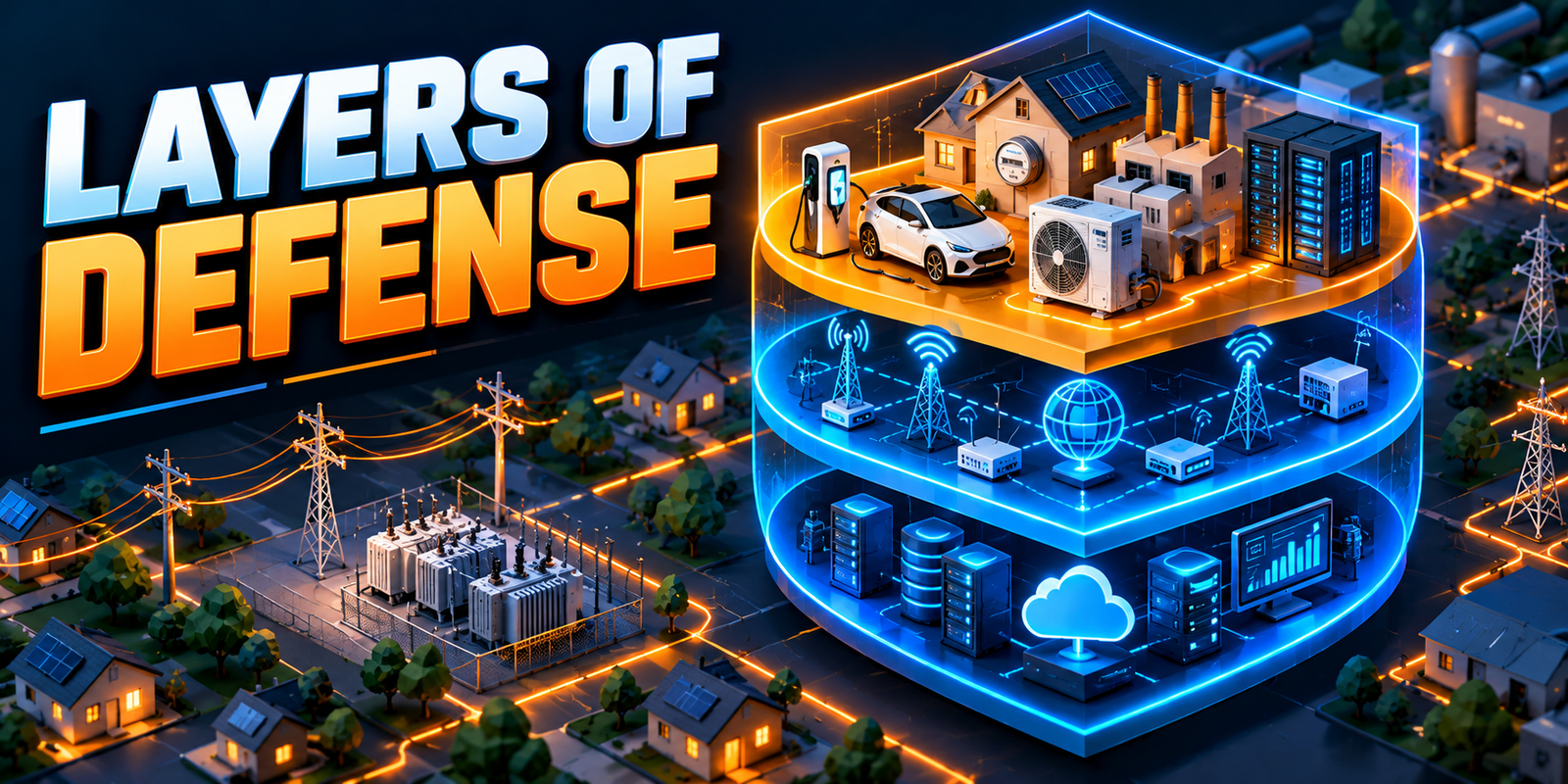

IT vs OT cybersecurity in electric utilities is the practice of protecting two kinds of technology: information technology that handles business activity, and operational technology that monitors and controls the physical power system.
Electric utilities run two kinds of technology side by side. Information technology (IT) handles business activity such as billing, customer service, email, planning and data analysis. Operational technology (OT) monitors and controls the physical power system, from substation equipment to the control room displays that operators rely on. For years the two were largely separate. Today they exchange data constantly, share suppliers and increasingly share networks, which is why people searching for “IT OT cybersecurity utilities” are really asking how two different security disciplines can work together without harming each other.
This article explains IT and OT cybersecurity in electric utilities in practical terms: what each domain does, how they differ, where they overlap, what risks each faces and which priorities help utilities coordinate them. It is written for utility cybersecurity teams, OT security professionals, engineers and critical-infrastructure leaders. The content stays defensive and conceptual. It includes no attack instructions, no incident statistics, no sensitive configurations and no claims about any specific utility or supplier. Every utility has a different architecture and risk profile, so the ideas below are starting points for local assessment and not a universal design.
Key Takeaway
- Confidentiality, integrity and availability matter in both IT and OT. What differs is their relative priority and how controls can be implemented.
- OT security must also account for physical processes, safety and continuous operation, which makes many routine IT practices unsuitable without adaptation.
- The boundary between IT and OT varies between utilities, so documenting where it sits is itself a security task.
- Connectivity is not automatically unsafe. The goal is to understand each connection, justify it and control it according to risk.
- Coordination between IT, OT, engineering and operations teams matters as much as any tool.
What Is IT and OT Cybersecurity in Electric Utilities?
IT and OT cybersecurity in electric utilities is the combined practice of protecting business information systems (IT) and the systems that monitor and control physical grid operations (OT), including the data, communications and people that connect them.
Information technology
IT covers the systems that manage information for the business: enterprise applications, customer and billing platforms, collaboration tools, corporate networks and the data centers or cloud services behind them. These systems are generally refreshed on regular cycles and are managed with common IT security tooling.
Operational technology
OT covers the hardware and software that detect or cause changes in physical equipment. In a utility this typically includes supervisory control and data acquisition (SCADA) systems, other industrial control systems, substation automation, protection and control devices, and the field communications that link them.
Where they intersect
The two meet wherever data or access crosses between them: operational data feeding business analytics, enterprise identity systems reaching operational interfaces, suppliers maintaining both, and shared networks or services. Where the boundary sits depends on the utility. A metering platform, for example, might be managed by IT in one organization and by operations in another, and not every organization runs identical systems. The first step in any coordinated program is therefore to define, in writing, which systems belong to which domain and who is accountable for them.
How IT and OT Systems Work in Electric Utilities
Understanding security starts with understanding what each system is for. The following roles are described generally, and real architectures differ.
- Enterprise IT and business applications support finance, customer care, workforce management, procurement and reporting.
- Control centers and operational applications give operators a view of the network and tools to manage it. See how a smart grid is structured for the wider picture.
- SCADA and industrial control systems, where used, collect measurements and status and allow authorized control actions.
- Substation automation and intelligent electronic devices (IEDs) perform local protection, control and monitoring. For engineering context, see digital substation architecture and communications.
- Field sensors, controllers and communication infrastructure extend monitoring and control across the network.
- Advanced Metering Infrastructure (AMI) and smart meters collect consumption and event data and sit between customer premises and utility systems.
- Data platforms, analytics and authorized remote maintenance turn operational data into insight and allow staff and suppliers to support systems without being on site.
At a conceptual level, information flows in both directions. Measurements and events move from the field toward control and data systems. Instructions, configuration and software updates move the other way. Selected operational data is shared with enterprise systems for planning, billing and analysis. Each of those flows is a point where trust, authorization and integrity matter. This article does not describe how any real utility implements them.
IT vs OT Cybersecurity: Key Differences
Both domains aim to protect information, systems and people, but the context changes how each aim is pursued. The table summarizes common differences. It describes tendencies and not rules, because individual systems vary.
| Aspect | IT cybersecurity | OT cybersecurity |
|---|---|---|
| Primary purpose | Protect business information, applications and services | Protect the safe, reliable monitoring and control of physical processes |
| Typical systems and assets | Servers, workstations, enterprise software, cloud services, corporate networks | SCADA, controllers, protection and control devices, field equipment, industrial networks |
| CIA priorities | Confidentiality and integrity of data are often foremost, with availability also important | Availability and integrity of control and measurement data are often foremost, with confidentiality still important |
| Uptime and safety | Planned downtime is usually tolerable | Some functions need continuous operation, and safety is a design constraint |
| Change and patch management | Frequent updates and restarts are routine | Changes may need testing, scheduled windows and operational approval |
| Access control and monitoring | Mature, widely available tooling | Tooling must suit specialized protocols and must not disturb real-time functions |
| Incident response and recovery | Isolate, investigate and restore from backup is a common pattern | Actions must be coordinated with operations, since containment can affect the process itself |
| Vendor support and lifecycle | Short refresh cycles, broad vendor choice | Long service lives, specialized vendors and qualification requirements |
| Consequences of disruption | Mainly data, business and service impact | Can also involve safety, equipment and electricity delivery |
Avoiding oversimplification
It is tempting to summarize the difference as “IT protects data, OT protects uptime.” That is too simple. IT systems can be critical to operations, and OT data can be confidential or commercially sensitive. Integrity matters in both, because decisions in either world depend on information being accurate. The honest summary is that all three properties apply everywhere, while the weighting and the practical limits on controls shift. OT security must additionally account for physical processes, safety and continuous operation.
Why IT and OT Cybersecurity Matter for Electric Utilities
Protecting both domains supports several outcomes that utilities and their communities care about.
- Electricity service reliability. Security reduces the chance that cyber events interfere with the operations that deliver power. It cannot guarantee uninterrupted supply, which depends on many other factors.
- Operational safety and equipment protection. Control systems influence physical equipment, so protecting them contributes to safe operation.
- Accuracy and availability of monitoring and control data. Operators and automation depend on information that is correct and timely.
- Customer and business information. Billing, consumption and operational data require protection and are often subject to privacy and confidentiality duties.
- Regulatory and contractual obligations where applicable. Requirements differ by jurisdiction and agreement, so utilities should confirm what applies to them.
- Business continuity and critical-infrastructure resilience. Prepared utilities can limit the effect of problems and recover in an orderly way. For the relationship between reliability and resilience, see grid reliability vs grid resilience.
A cybersecurity incident does not always lead to a power outage or equipment damage. Many incidents affect only business systems or visibility, and well-run operations keep manual and fallback procedures. The consequences depend on what is affected, how far it spreads and how well the utility is prepared.
Common IT Cybersecurity Risks in Utilities
Utility IT environments share many risks with other large organizations. The categories below are described defensively.
- Compromised accounts. Stolen or misused credentials can give unwanted access to systems and data. Strong authentication and monitoring of account behavior help reduce this.
- Phishing and social engineering. Deceptive messages try to persuade staff to reveal information or take harmful actions. Training, mail protections and a culture that encourages reporting are the main defenses.
- Exposed services. Systems reachable from the internet that do not need to be create unnecessary exposure. Regular review of what is exposed, and why, is the countermeasure.
- Insecure configurations. Default or inconsistent settings can leave systems weaker than intended. Secure baselines and configuration management address this.
- Data loss. Information may be lost, altered or disclosed through error, malicious activity or failure. Backups, access controls and data handling rules reduce the effect.
- Third-party access. Suppliers and contractors often need access, and their security practices affect the utility. Scoped, logged and time-limited access is a common principle.
- Weaknesses in enterprise systems. Unpatched software and unsupported applications can be a path into the wider environment, which is why inventory and maintenance matter.
IT risks matter beyond business impact because enterprise systems are frequently connected to operational ones. The way they are connected determines how far a problem could spread.
Common OT Cybersecurity Risks in Utilities
OT risks stem from the way operational environments were built and are maintained. The impact of each depends on the system’s role, configuration, exposure and operational context.
- Asset visibility gaps. Devices installed long ago may be undocumented, so they are neither protected nor monitored.
- Legacy equipment. Older devices may lack modern security features and may remain in service for many years.
- Constrained patching. Updates may need testing, downtime or vendor involvement, so known weaknesses can remain open longer than in IT.
- Insecure remote maintenance. Remote access that is poorly governed can be a point of unwanted entry and makes accountability difficult.
- Inadequate separation between systems. Flat or loosely controlled networks allow problems to spread more easily.
- Unsupported devices. When a supplier no longer provides updates, the utility must rely on compensating controls.
- Limited monitoring. Without suitable visibility, unusual behavior in operational networks may go unnoticed.
A weakness in a low-consequence monitoring device is very different from one in a function that protects equipment. That is why risk assessment, and not a flat list of findings, should drive priorities.
IT/OT Convergence and the Expanding Attack Surface
Convergence describes the growing exchange of data and shared infrastructure between IT and OT. It is driven by benefits utilities want: better visibility, remote operation, analytics, smart metering and integration of distributed energy resources. Each of these adds dependencies:
- Data exchange between operational and enterprise platforms creates paths that must be governed.
- Remote operations and maintenance depend on secure access arrangements.
- Cloud-connected services introduce external providers and new trust relationships.
- Smart metering adds large numbers of connected devices and supporting systems.
- Distributed energy resources add equipment that may be owned and managed by others.
- Analytics increase demand for operational data to be shared and stored.
The attack surface is the sum of such connections and the systems behind them. It is more useful to evaluate each connection by risk than to treat all connectivity as inherently unsafe. A well-justified, well-controlled and well-monitored connection can be safer than an undocumented one, and removing every connection is rarely compatible with modern operations. The broader context is covered in why grid modernization depends on better data and real-time visibility.
Network Segmentation and Controlled Communication
Segmentation divides systems into zones according to function and risk, and controls what may pass between them. In IT and OT cybersecurity in electric utilities, its main value is limiting how far a problem can spread and creating places where traffic can be observed and managed.
- Security zoning. Group systems with similar function and criticality, so business, control and field systems are not treated alike.
- Controlled communication paths. Allow only documented and justified communication between zones, and review those paths regularly.
- Separation of business and operational functions. Keep enterprise services from having unnecessary reach into operational systems, and the reverse.
- Secure remote access. Provide remote access through governed, monitored routes and not through ad hoc arrangements.
- Validated change. Test and approve network changes before they are applied, because a change that seems harmless can affect timing-sensitive or protection-related communication.
Segmentation is not a one-time design. It stays effective only when documentation and rules are maintained as the environment changes. Details such as diagrams and rule sets are specific to each utility and sensitive, so this article leaves them out.
Identity, Access and Remote-Access Security
Controlling who and what can access which systems is one of the most effective foundations in both domains. Key practices include:
- Least privilege and role-based access, so people receive only the access their roles need.
- Multifactor authentication where technically appropriate, particularly for remote and privileged access, with compensating measures where it cannot be deployed safely.
- Privileged account oversight, including approval, logging and review of powerful accounts.
- Contractor and vendor access control, limited by purpose and duration and removed when the work ends.
- Account lifecycle management, so accounts are created, changed and removed promptly as people join, move and leave.
- Periodic access reviews to confirm permissions remain appropriate.
Access policies must consider operational availability, safety and what systems actually support. A control-room workstation that must be usable immediately in an emergency may need a different authentication approach than an office laptop, and older devices may not support modern methods at all. These decisions should be made jointly by security and operations staff and tested before they are relied on.
Monitoring and Threat Detection Across IT and OT
Detection depends on knowing what normal looks like and being able to see departures from it. Useful building blocks are:
- Asset inventory, because monitoring needs a reference for what should be present.
- Centralized visibility where appropriate, so events from different systems can be correlated.
- Relevant logging, chosen for the questions investigators will need to answer.
- Alert triage, with defined owners and criteria so alerts are neither ignored nor overwhelming.
- Coordination between IT and OT teams, because the meaning of an alert often depends on operational context.
- Anomaly detection, which can highlight unusual behavior but needs tuning to the environment.
- Escalation processes, so serious findings reach decision makers quickly.
Monitoring capabilities differ between environments. Approaches that suit an office network can be unsuitable for sensitive operational equipment, where passive methods and engineering review are often preferred. Alerts require contextual analysis, and no tool or model can detect every threat. Programs should expect both false alarms and missed events, and plan for both.
Vulnerability, Patch and Configuration Management
Managing weaknesses begins with knowing what is deployed. A sound process usually includes:
- Maintain asset inventories, including software and firmware versions and ownership.
- Evaluate vulnerabilities by checking supplier advisories and other information against the utility’s own systems.
- Prioritize by risk, weighing exposure, the function the system performs and the consequence of failure.
- Manage vendor advisories through a defined route, so notices reach the right people.
- Validate patches in a suitable test setting before deployment where possible.
- Coordinate maintenance windows with operations, so updates do not conflict with operational needs.
- Control configuration and change, recording approved baselines and reviewing deviations.
In OT, patching and testing need extra validation because of safety, uptime, compatibility and vendor-support considerations. An update that is routine on an office server might require retesting of a protection function, or might void a support arrangement. Where an update cannot be applied promptly, utilities document compensating controls, such as stronger isolation and closer monitoring, and plan for eventual replacement of unsupported equipment.
AMI and Smart Meter Security
Advanced Metering Infrastructure shows clearly why IT and OT concerns intersect. Meters and field communications resemble operational equipment, while head-end and meter data management systems often resemble enterprise applications, and billing connects the whole to the business. Deployments differ in architecture, communication technology and operating model, so no single design is assumed here. For the underlying engineering, see advanced metering infrastructure: architecture, components and data flow.
- Device identity, so systems can trust which devices they are communicating with.
- Data integrity, because billing and operations depend on accurate readings and events.
- Access governance, limiting who can configure devices or reach meter data systems.
- Communication security, using protections suited to the chosen technology.
- Lifecycle management, covering commissioning, updates, support periods and retirement.
- Monitoring, to see unexpected device or data behavior.
- Third-party coordination, since vendors and service providers often operate part of the chain.
Implementation issues, including security, are discussed in AMI implementation challenges. This article does not describe access paths or weaknesses in any metering system.
AI, Automation and IT/OT Security
Analytics and AI may help defenders by prioritizing alerts, spotting anomalies in data or network behavior, and supporting analyst and operator decisions. Used carefully, they can reduce the volume of routine review. For related analytics, see AI anomaly detection in electric utilities.
Limitations deserve equal attention:
- Data quality. Models are only as dependable as the data they receive.
- False positives and missed detections. Neither can be eliminated.
- Model drift. Changes in systems and behavior can reduce accuracy over time.
- Explainability. Analysts need enough insight to judge and act on a result.
- Privacy and data protection. Operational and customer data used by AI tools needs the same protection as any sensitive asset, and the tools themselves need security review.
- Human oversight. Qualified security personnel and operators remain accountable.
AI is an aid, not a replacement for skilled people. Related governance questions are explored in generative AI in electric utilities: applications, risks and governance.
Incident Response and Recovery
Coordinated response depends on preparation made before anything goes wrong. Important elements are:
- Coordinated response plans that cover both IT and OT and are kept current.
- Defined responsibilities, so everyone knows who decides, who acts and who communicates.
- IT/OT escalation procedures, including clear routes into operations for decisions affecting operational systems.
- Continuity planning, including manual or alternative ways to operate if digital services are unavailable.
- Recovery validation, confirming that restored systems and data are accurate and trustworthy before returning to normal use.
- Post-incident learning, recording what happened and improving plans, controls and training.
The central difference from a purely IT response is that actions on operational systems can have physical consequences, so they must be agreed with authorized operational personnel. The guidance here concerns authorized defensive readiness only.
Governance, Standards and Risk Management
Technology controls last only when management supports them. Effective governance includes regular risk assessments, clear ownership of systems and risks, staff training, vendor management, documented procedures and continuous improvement. Utilities commonly evaluate the following resources, which were checked against published descriptions when this article was prepared. Readers should confirm current versions with the issuing bodies.
- NIST Cybersecurity Framework. Version 2.0, released on 26 February 2024, adds a Govern function to the framework’s core functions and is voluntary guidance.
- NIST guidance for OT and industrial control system security. NIST SP 800-82 Rev. 3, Guide to Operational Technology (OT) Security, published in September 2023, covers OT security while accounting for performance, reliability and safety requirements.
- IEC 62443 series. A set of standards on the security of industrial automation and control systems, relevant where a utility operates such an environment.
It is important to separate voluntary frameworks and guidance, organizational policies, and legally binding requirements. A framework does not become mandatory merely because it is well known, and no standard applies universally. Applicability depends on jurisdiction, sector, contracts and the specific environment, and utilities should consult official publications and their regulators. Using a framework does not guarantee security.
Challenges of IT/OT Cybersecurity in Utilities
Utilities typically face several obstacles at the same time:
- Legacy assets that cannot easily be updated or replaced.
- Limited maintenance windows that restrict how often changes can be made.
- Interoperability, since many systems and protocols must continue working together.
- Incomplete inventories, which make protection and monitoring uneven.
- Skills gaps, especially for staff who understand both security and power systems.
- Resource constraints, including budgets and competing priorities.
- Vendor dependencies, where fixes and support rely on suppliers.
- The need to balance security with safety and continuity, because a control that harms operations defeats its purpose.
A practical response is incremental and risk-based. Improve visibility first, protect the most consequential systems, use compensating controls where change is hard, and build shared understanding between teams. Wider deployment themes appear in smart grid deployment challenges.
Hypothetical Defensive Scenario
Hypothetical example. This scenario is fictional. It does not describe a real utility or incident and contains no attack details, credentials or sensitive configurations.
Imagine a utility’s IT security team notices an unusual pattern of activity involving an account that has access to an application used by both business and operations staff. The utility could coordinate its response as follows.
- Detect and verify. IT security reviews logs and account records to decide whether the activity is genuine, expected or an error.
- Assess operational context. Using inventory and dependency records, the team identifies which operational functions rely on the application and what could be affected.
- Bring in OT. IT security contacts the operations and engineering representatives named in the escalation plan, so the response draws on both cyber and operational knowledge.
- Agree authorized protective measures. Together they choose proportionate steps from approved options, such as restricting the account, and operations confirms that those steps will not create safety or reliability concerns.
- Preserve records. Relevant logs and states are kept according to policy for later investigation.
- Validate recovery. Before normal use resumes, the team confirms that systems and data are accurate and available, and that access has been reviewed.
- Learn and improve. The utility reviews the handling, updates procedures and access rules, and records follow-up actions.
The example illustrates good coordination habits and not a script. The right steps always depend on the utility’s own plans and authorizations.
IT/OT Cybersecurity Checklist for Electric Utilities
Treat this checklist as a set of practices to assess. It is not a guarantee of complete security or regulatory compliance.
- Asset inventory and ownership: Is there a current inventory of IT and OT assets with named owners?
- IT/OT risk assessment: Are risks assessed jointly and revisited when systems change?
- System separation and controlled communication: Are zones defined and are inter-zone paths documented and reviewed?
- Identity and access reviews: Is access reviewed on a schedule and are unused accounts removed?
- Remote maintenance governance: Is remote access approved, logged and limited in scope and time?
- Monitoring and incident escalation: Are alerts owned and are escalation routes between IT and OT clear?
- Vulnerability and patch management: Is there a risk-based process that includes testing and compensating controls?
- Vendor and supply-chain risk: Are supplier expectations, access and notification arrangements agreed?
- Incident response exercises: Do IT, OT and management teams rehearse together?
- Backup and recovery validation: Are backups protected and restoration tested?
- Staff training and governance reviews: Are people trained and policies reviewed on a regular basis?
The Future of IT/OT Cybersecurity in Electric Utilities
The environment that security programs protect is changing. Smart grids, connected devices, distributed energy resources, advanced metering, cloud-connected services and AI-enabled operations may all increase data exchange and add parties who own or manage parts of the system. These developments are possibilities and will unfold differently in each utility. For related technology context, see future smart grid technology.
As architectures evolve, the line between IT and OT may move further, and security programs must evolve with it. That means reassessing risk regularly, updating inventories and connection records, building skills that span both domains and keeping operational requirements at the center of design decisions.
Conclusion: IT and OT Cybersecurity in Electric Utilities Work Best Together
IT and OT security serve the same purpose of keeping utilities trustworthy and dependable, but they work under different constraints. IT often leads on data protection and mature tooling, while OT adds the demands of physical processes, safety and continuous operation. Their responsibilities overlap in identity, remote access, monitoring, supplier management and response, so the strongest results come from coordinated teams that share inventories, risk views and escalation routes. Risk-based controls, operational awareness and continuous improvement matter more than any single product, and no program can promise complete protection. Utilities that treat IT and OT cybersecurity as a joint discipline are better placed to adapt as their systems change.
Frequently Asked Questions About IT and OT Cybersecurity in Utilities
What is IT OT cybersecurity utilities?
It is the combined practice of protecting a utility’s business information systems (IT) and the systems that monitor and control physical grid operations (OT), along with the data, communications and people that connect them.
How does IT OT cybersecurity utilities work?
Utilities identify assets, assess risk, separate systems into controlled zones, govern access, monitor activity, manage vulnerabilities and prepare coordinated response and recovery. IT and OT teams share information and agree actions that affect operational systems.
Why is IT OT cybersecurity utilities important?
Utilities connect business and operational systems, so a weakness in one can affect the other. Protecting both supports reliable service, safe operation, accurate data, customer information and recovery, although it cannot guarantee uninterrupted supply.
What are the main components of IT OT cybersecurity utilities?
Main components include asset inventory, risk assessment, network segmentation, identity and remote-access control, monitoring, vulnerability and patch management, supplier oversight, incident response, backup and recovery, and governance and training.
What are the challenges of IT OT cybersecurity utilities?
Common challenges are legacy equipment, limited maintenance windows, interoperability, incomplete inventories, skills gaps, limited resources, vendor dependencies and the need to balance security with safety and continuity.
Where is IT OT cybersecurity utilities used?
It is used across electric utilities and grid operators, including enterprise systems, control centers, substations, field equipment, communication networks and metering infrastructure, and with the suppliers and service providers that support them.

I share real stories, practical ideas and honest perspectives on business, marketing and life. This blog is a space to learn, grow and connect.