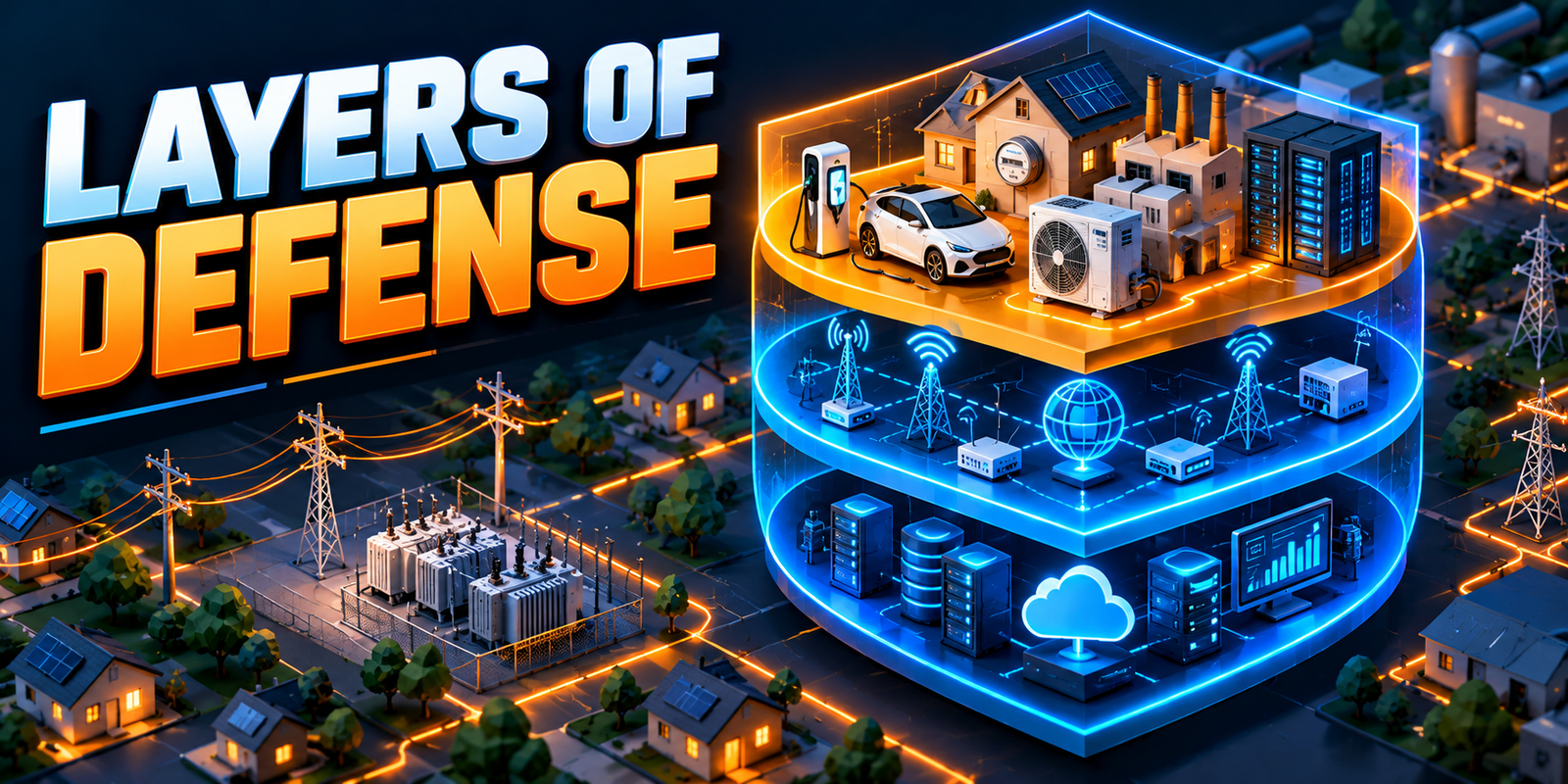
Smart meter cybersecurity is the protection of smart meters, their communications and the data they produce so that meter data and commands stay accurate, private and available.
Smart meters have changed how electricity is measured. Instead of a device that is read occasionally and only records total consumption, a smart meter can record usage at frequent intervals, report events, communicate with utility systems and, in some designs, receive instructions. That capability supports billing, outage management, planning and customer services. It also means that a meter is no longer an isolated piece of equipment but an endpoint in a connected system. Smart meter cybersecurity is the practice of protecting those endpoints, the communications that link them, the systems that manage them and the data they produce.
This article explains how smart meter cybersecurity works across devices, communications, authentication and data protection, and how it fits within the wider Advanced Metering Infrastructure (AMI). It is written for utility cybersecurity teams, OT security professionals, engineers and critical-infrastructure leaders. The discussion is deliberately defensive. It contains no exploit details, no default credentials, no statistics or incident examples and no claims about specific products. AMI architecture, communication technology, device capabilities and operating practices vary widely between utilities, so every control described here should be read as something to evaluate against local conditions and not as a fixed recipe.
Key Takeaway
- Smart meter cybersecurity covers the device, its communications, the systems that manage it and the data it generates.
- Device-level protection is necessary but not sufficient. The security of AMI, utility networks and enterprise systems matters as well.
- Authentication has two sides: devices proving their identity to systems, and people and services proving theirs to management tools.
- Meter fleets are large, long-lived and mixed in age, so lifecycle management and visibility are central challenges.
- Controls depend on what the equipment supports. Utilities should understand their fleet’s actual capabilities and limits.
What Is Smart Meter Cybersecurity?
Smart meter cybersecurity is the set of practices and controls that protect smart meters, their communications, the supporting systems that manage them and the meter data they generate, so that metering remains accurate, available and appropriately private.
Its aims follow the familiar security properties. Meter data and commands should stay accurate (integrity), be visible only to those who are authorized (confidentiality) and be available when billing and operations need them (availability). Because meters are installed at customer premises, physical protection and privacy also feature more prominently than in many other utility systems.
Device security and the wider system
It helps to separate two levels. Device-level security concerns the meter itself: its identity, configuration, embedded software and physical protection. System-level security concerns everything around it: the communication networks, head-end and data management systems, utility networks and enterprise applications that depend on meter data. A well-protected meter connected to a weakly governed management system still leaves risk, and the reverse is also true. Effective programs address both levels together. For background on how the pieces fit, see advanced metering infrastructure: architecture, components and data flow.
How Does Smart Meter Cybersecurity Work?
Security can be understood as a lifecycle of seven connected activities. The specific controls used in each depend on the equipment, deployment model, supported features and utility requirements.
- Identify meters and supporting assets. Maintain an inventory of meters, communication modules, collection systems and management platforms, with ownership and version information.
- Establish trusted device identities. Make sure each meter can be recognized and verified by the systems it communicates with, and that identity is managed over the device’s life.
- Protect communications and data. Apply protections suited to the communication technology to preserve integrity and, where appropriate, confidentiality.
- Control access. Limit who and what can configure meters or reach management systems, and record what they do.
- Monitor for unusual activity. Watch device, communication and data behavior against expected patterns.
- Manage vulnerabilities and updates. Track advisories, assess exposure and plan tested updates.
- Respond and recover safely. Investigate suspicious activity through authorized processes, maintain service and validate recovery.
The cycle repeats. Lessons from monitoring and incidents feed back into inventory, identity and control design.
Understanding Smart Meter and AMI Architecture
The following are common components, not a universal design. Some utilities combine or omit certain elements, and technology choices differ.
- Smart meters and embedded software. The meter measures consumption and events and runs firmware that governs its behavior.
- Communication modules and networks. A module, built in or separate, connects the meter to the utility’s communication network, which may use various technologies.
- Meter data collection and management systems. These gather readings and events from the field and prepare them for use.
- Head-end systems and meter data management platforms, where applicable. A head-end typically manages communication with meters, while a meter data management platform stores, validates and processes the data.
- Utility operational and enterprise systems. Billing, customer systems, outage management and analytics consume meter data and may send requests back.
- Authorized service tools and vendor support. Technicians and suppliers use tools to commission, configure, diagnose and update devices.
Each component has its own security considerations, and each interface between components is a place where trust should be explicit. This article avoids network diagrams and deployment-specific detail because those are sensitive and differ by utility. For a broader view of how metering relates to the rest of the grid, see what a smart grid is and how its architecture works.
Main Smart Meter Cybersecurity Risks
The risk categories below are described conceptually. The actual level of risk depends on the architecture, how exposed each component is, which controls are in place and what would be affected if something went wrong.
- Weak device identity or authentication. If systems cannot reliably tell genuine devices from others, data and commands become harder to trust.
- Insecure device configuration. Settings that are inconsistent, left at defaults or poorly documented can leave devices more exposed than intended.
- Unauthorized physical or logical access. Meters sit in places that are not under constant utility control, and management interfaces can be misused if access is not governed.
- Communication interception or manipulation risks. Where communications are not adequately protected, the confidentiality or integrity of data in transit may be at stake.
- Exposure of meter data. Consumption data can reveal patterns of daily life, so unauthorized disclosure has privacy implications.
- Vulnerabilities in firmware and supporting software. Weaknesses can exist in embedded software and in the systems that manage it.
- Inadequately governed remote access. Remote management is valuable but must be controlled, logged and limited.
- Third-party and supply-chain dependencies. Manufacturers, providers and contractors influence the utility’s exposure.
- Insufficient monitoring and asset visibility. Problems are harder to notice when the utility lacks a clear picture of its fleet and its normal behavior.
- Unsupported equipment and end-of-life risks. Devices that no longer receive updates may need compensating controls or replacement.
The same category can matter very differently from one deployment to another. A risk that is significant for one communication design may be minor in another, which is why assessment must be specific to the utility.
Device Security and Firmware Protection
Because meters are numerous and long-lived, device security needs systematic management. Important practices include:
- Secure configuration, using documented, reviewed baselines and detecting deviations.
- Device identity, with a clear way to establish, manage and eventually retire each device’s identity.
- Software integrity, so that firmware is verified as coming from an expected source and unaltered, where the device supports it.
- Controlled updates, using approved processes that record what was installed and when.
- Vulnerability management, assessing advisories against the actual fleet.
- Lifecycle support, knowing how long each model will be supported.
- Inventory management, tracking models, firmware versions and locations.
Utilities should understand the security capabilities and update limitations of their own meter fleets. Not all meters support the same features. Older generations may lack capabilities that newer ones have, and some models may offer limited ways to be updated. Decisions should be based on documented knowledge of each device type, not on assumptions.
Communication Security
Meters and supporting systems exchange readings, events, configuration and, in some designs, commands. Protecting these communications serves several purposes:
- Confidentiality, so that sensitive data is not exposed in transit where protection is appropriate.
- Integrity, so that data and commands cannot be altered unnoticed.
- Endpoint authentication, so each side can confirm it is communicating with the expected counterpart.
- Secure configuration, so that protections the technology offers are actually enabled and maintained.
Utilities need to evaluate the communication technology they use, their deployment architecture and the capabilities their vendors document, because what can be protected, and how, differs between technologies. Questions worth asking include what protections are supported, how identities and keys are managed over time and how the utility will see problems. This section intentionally does not discuss protocol-specific weaknesses or how traffic might be intercepted or manipulated.
Authentication, Authorization and Access Control
These two terms are often confused. Authentication establishes who or what is making a request. Authorization decides what that authenticated party is allowed to do. Both are required: a verified identity with excessive permissions is still a risk.
It is also useful to distinguish two kinds of authentication:
- Device-to-system authentication, in which meters and communication components establish trust with head-end and management systems.
- Human and service access, in which staff, vendors and automated services sign in to management tools.
Good practice for access includes:
- Least privilege and role-based access, so each role holds only the permissions it needs.
- Management of user and service accounts, including prompt removal when no longer required.
- Multifactor authentication where appropriate, especially for remote and privileged access.
- Credential lifecycle management, including issuing, rotating and revoking credentials and keys in an orderly way.
- Controlled vendor access, approved for a purpose and limited in duration.
This article does not list any default credentials or describe how authentication might be bypassed. Utilities should ensure, as a matter of routine, that no factory defaults remain in use and that credentials are unique and managed.
Meter Data Privacy and Integrity
Meter data includes readings, event information and associated customer details. Protecting it means preventing unauthorized access, alteration and loss.
- Data minimization. Collect and keep only what is needed for defined purposes.
- Appropriate access restrictions. Limit who can see detailed data, and log access to it.
- Retention policies. Keep data only as long as needed and dispose of it securely.
- Secure transmission and storage. Protect data in transit and at rest in ways suited to its sensitivity.
- Integrity checks. Validate readings and detect gaps or inconsistencies, since billing and operations depend on accuracy.
- Governance. Define ownership, permitted uses and review processes, in line with applicable laws and organizational policies.
Data quality and security are linked, because corrupted or missing data can be a signal of a technical fault or of something more serious. See why smart meter data quality matters for the operational side. Privacy and data-protection requirements differ between jurisdictions, and this article does not make legal claims about any of them. Utilities should confirm what applies to them with legal and regulatory advisers.
Physical Security and Tamper Awareness
Because meters are installed at customer premises, physical protection is part of the picture. Practices include:
- Physical protection, such as enclosures and seals suited to the installation.
- Authorized inspection, so that only approved personnel handle devices.
- Tamper-event monitoring where supported, using the event information some meters can report.
- Secure installation, following documented commissioning steps.
- Controlled maintenance, with records of who serviced what and when.
Physical tamper indicators are not a complete cybersecurity solution. A tamper event can have innocent causes, and the absence of one does not prove a device is untouched. Such signals should be interpreted alongside other evidence and in line with operational procedures, not treated as conclusive on their own.
Firmware Updates and Vulnerability Management
Updates are one of the most important and most delicate activities in a meter fleet. A sound approach includes:
- Software inventory, recording models and firmware versions across the fleet.
- Tracking vendor advisories, through a defined route to the right people.
- Vulnerability assessment, judging how an advisory applies to the utility’s own deployment.
- Risk prioritization, weighing exposure and potential impact.
- Update validation, testing in a suitable environment before wide deployment.
- Deployment planning, staging updates and having a recovery plan if something does not go as expected.
- Support lifecycle management, planning for end of support before it arrives.
Updates across a large fleet can have unintended effects on communications, data flows and billing processes, so testing and coordination of maintenance are essential. Where an update cannot be applied promptly, documented compensating controls, such as tighter monitoring or access restrictions, help manage the interim risk.
Network Segmentation and Secure Integration
Segmentation means separating systems by function and risk and controlling the paths between them. For metering, that typically means limiting communication between AMI components and other utility or enterprise environments to what is required.
- Controlled interfaces. Use defined, documented points where metering systems exchange data with billing, analytics, operational and enterprise systems.
- Access governance. Decide who may use those interfaces and review that regularly.
- Monitoring. Observe traffic across boundaries so unexpected patterns are noticed.
- Separation according to risk. Keep more sensitive functions further apart from less trusted environments.
The aim is to limit how far a problem in one place can spread. As with other utility systems, segmentation works only when documentation and rules are kept current. Wider architectural principles are discussed in why grid modernization depends on better data and real-time visibility. This article gives no network diagrams or configuration detail.
Monitoring and Incident Detection
Detection depends on knowing what normal looks like. Useful elements are:
- Asset visibility, so the utility knows which devices and systems should be present.
- Relevant logs, from management systems, access tools and communication components.
- Security alerts, with defined owners and triage criteria.
- Device-health signals, such as communication status and event reports.
- Anomaly analysis, comparing behavior with expected patterns across the fleet.
- Coordinated response between metering, IT and OT teams.
Unusual meter activity often has benign operational causes, such as maintenance, communication problems or genuine changes in consumption. Contextual assessment is therefore necessary before drawing conclusions. No monitoring tool can detect every incident, so programs should plan for both false alarms and missed events.
Supply Chain and Third-Party Security
Metering depends on manufacturers, communication providers, software vendors, system integrators and maintenance contractors. Their products and practices affect the utility’s security, so third-party management belongs in the program. Defensive practices, stated without any claim about a specific supplier, include:
- Vendor security assessment, proportionate to the supplier’s role and access.
- Support commitments, including how long updates will be provided.
- Software integrity, meaning ways to verify that delivered software and firmware are genuine.
- Access restrictions, limiting supplier access to what is needed and for as long as needed.
- Vulnerability disclosure processes, agreeing how weaknesses are reported and handled.
- Coordinated incident handling, defining who does what when an issue involves both utility and supplier.
Implementation programs often meet these issues alongside other deployment concerns, as discussed in AMI implementation challenges.
AI and Analytics in Smart Meter Cybersecurity
Large meter fleets generate data at a scale that is hard to review manually, so analytics and AI may help defenders. Potential applications include anomaly detection, alert prioritization and the identification of unusual patterns across many meters. For analytical background, see AI anomaly detection in electric utilities and AI-based anomaly detection for smart meter data.
The limitations are significant:
- False positives, because genuine changes in behavior can look unusual.
- Incomplete data, since gaps in readings weaken analysis.
- Model drift, as consumption patterns and fleet composition change over time.
- Explainability, because analysts need to understand why something was flagged.
- Privacy, since analysis of detailed consumption data must respect data-protection duties.
- Human review, which remains necessary for judging and acting on results.
AI cannot reliably detect every attack and does not replace established controls such as identity management, segmentation and patching. It works best as one supporting layer.
Incident Response and Recovery
Utilities can prepare for suspicious device activity before it happens. Defensive readiness includes:
- Preparing procedures for suspicious meter or system activity, with defined roles.
- Determining operational significance, by understanding what the affected devices and systems support, such as billing, outage detection or customer services.
- Coordinating authorized investigation, involving metering, IT, OT and, where relevant, suppliers.
- Maintaining service continuity, using fallback methods such as estimated billing procedures where policy allows.
- Validating recovery, confirming that devices, systems and data are accurate and trustworthy before resuming normal use.
- Documenting lessons learned, and improving controls, plans and training.
Actions that affect many devices at once can themselves cause disruption, so they should be authorized, planned and, where possible, staged. This section addresses organizational readiness only.
Governance, Standards and Risk Management
Technical controls are durable only when governance supports them. That includes regular risk assessments, clear security ownership, asset lifecycle management, workforce training, vendor oversight and periodic reviews. Several resources are commonly evaluated and were checked against published descriptions when this article was prepared. Readers should confirm current versions with the issuing bodies.
- NIST Cybersecurity Framework. Version 2.0, released on 26 February 2024, adds a Govern function and is voluntary guidance.
- NIST guidance for OT and industrial control system security. NIST SP 800-82 Rev. 3, Guide to Operational Technology (OT) Security, published in September 2023, addresses security for operational technology with attention to performance, reliability and safety.
- IEC 62443 series. Standards for the security of industrial automation and control systems, which may be relevant where a utility’s environment falls within that scope.
- Privacy, metering and utility requirements. These vary by jurisdiction and are not described here. Utilities should confirm which laws, regulations and metering rules apply to them.
Voluntary frameworks and guidance differ from organizational policy, which in turn differs from binding legal or regulatory requirements. No standard applies to every smart meter deployment, and using a framework does not guarantee security or compliance.
Challenges of Smart Meter Cybersecurity
Securing meter fleets involves distinctive difficulties:
- Large, geographically distributed fleets, which make hands-on work slow and costly.
- Legacy devices and mixed generations, with differing capabilities.
- Limited visibility into field assets, particularly where records are incomplete.
- Connectivity and interoperability differences, since fleets may use more than one technology.
- Firmware and maintenance constraints, including limited ways to update some devices.
- Vendor dependencies, for fixes, support and interoperability.
- Privacy expectations, which shape what data can be collected and analyzed.
- Resource and skills limitations, particularly for staff who understand metering and security.
- Balancing security with reliable utility operations, since measures that disrupt billing or service defeat their purpose.
A realistic response is to improve inventory and visibility first, focus on the highest-impact systems and device groups, use compensating controls where devices cannot be changed, and plan replacement of unsupported equipment. Broader themes are covered in smart grid deployment challenges.
Hypothetical Defensive Scenario
Hypothetical example. This scenario is fictional. It does not describe a real utility or incident and contains no exploit steps, credentials, vulnerable device details or sensitive configurations.
Imagine a utility’s monitoring flags an unusual pattern in device-health reports from a group of meters served by one communication area. The utility could respond as follows.
- Validate the alert. Analysts check whether the pattern is real, for example by comparing several data sources and looking for a data-quality or reporting fault.
- Check device and system context. They review firmware versions, recent maintenance, recent changes to management systems and the known behavior of that device group.
- Coordinate authorized personnel. Metering, IT and OT contacts named in the escalation plan are informed, and the supplier is engaged if the plan calls for it.
- Apply appropriate protective measures. If the evidence points to a real concern, the team chooses proportionate steps from approved options, such as tighter access to the affected management function, and confirms that these will not disrupt billing or operations more than necessary.
- Preserve records. Relevant logs and configuration information are kept in line with policy.
- Confirm recovery. The utility checks that the devices and systems are behaving normally, that data is accurate and that access has been reviewed before returning to routine operation.
- Learn. Findings are recorded, and monitoring rules, procedures and supplier arrangements are updated.
The scenario illustrates habits of verification, context, coordination and validation. It is not a procedure, and real steps depend on the utility’s own plans and authorizations.
Smart Meter Cybersecurity Checklist
Use this checklist as a set of practices to evaluate. It is not a guarantee of complete security or regulatory compliance.
- Meter and supporting-system inventory: Do you know your models, firmware versions, communication modules and management systems?
- Device identity and authentication: Can systems verify devices, and are identities and credentials managed through their life?
- Access-control reviews: Are user, service and vendor permissions reviewed on a schedule?
- Communication protection: Are the protections your technology supports enabled and maintained?
- Firmware and vulnerability management: Is there a tested, risk-based process for advisories and updates?
- Meter data privacy and integrity: Are minimization, retention, access rules and integrity checks defined?
- Physical protection and authorized maintenance: Are installation and servicing controlled and recorded?
- Remote-access governance: Is remote access approved, logged and limited?
- Vendor and supply-chain risk: Are support periods, disclosure processes and access terms agreed?
- Monitoring and incident escalation: Are alerts owned and escalation routes clear between teams?
- Recovery planning: Are continuity and restoration plans written and tested?
- Periodic security reviews and workforce training: Are reviews scheduled and staff trained?
The Future of Smart Meter Cybersecurity
Metering is likely to become more connected and more capable. Expanding AMI deployments, connected utility services, distributed energy resources, advanced analytics and AI-enabled monitoring may all increase the amount of data and the number of parties and systems involved. These developments are possibilities and will differ between utilities. For related context, see the future of advanced metering infrastructure and how smart meters differ from traditional meters.
As meters become more capable, lifecycle management, secure design and risk-based governance stay important. Devices installed today may remain in service for many years, so decisions about identity, update capability and supplier support made at purchase can affect security for a long time.
Conclusion: Smart Meter Cybersecurity Is a System-Wide Effort
Smart meter cybersecurity depends on several layers working together. Device security and firmware management protect the endpoint. Authentication and authorization establish who and what can be trusted. Communication protection and segmentation limit exposure between components. Data protection addresses privacy and integrity. Monitoring and response provide visibility and prepared action. Governance ties these together and keeps them current as fleets and technologies change. No single measure is enough, and no program can promise complete protection, but risk-based, layered and regularly reviewed practices reduce risk and support dependable metering. Utilities that understand the real capabilities of their fleets and keep teams and suppliers coordinated are best placed to do this.
Frequently Asked Questions About Smart Meter Cybersecurity
What is smart meter cybersecurity?
Smart meter cybersecurity is the set of practices and controls that protect smart meters, their communications, the systems that manage them and the data they generate, so that metering stays accurate, available and appropriately private.
How does smart meter cybersecurity work?
It works as a lifecycle: identify devices and supporting assets, establish trusted identities, protect communications and data, control access, monitor activity, manage vulnerabilities and updates, and respond to and recover from incidents. Specific controls depend on the equipment and deployment.
Why is smart meter cybersecurity important?
Smart meters are connected endpoints that support billing, operations and customer services, and they generate personal consumption data. Protecting them helps preserve data accuracy, privacy and service continuity, although it cannot remove all risk.
What are the main components of smart meter cybersecurity?
Main components include device security and firmware management, authentication and access control, communication protection, data privacy and integrity, physical protection, network segmentation, monitoring and incident response, vendor oversight and governance.
What are the challenges of smart meter cybersecurity?
Challenges include large distributed fleets, mixed generations of devices, limited field visibility, differing communication technologies, firmware and maintenance constraints, vendor dependencies, privacy expectations and limited skills and resources.
Where is smart meter cybersecurity used?
It is used by electric utilities and metering operators across Advanced Metering Infrastructure, including meters, communication networks, data collection and management systems, and the billing and operational systems that use meter data, along with their suppliers.

I share real stories, practical ideas and honest perspectives on business, marketing and life. This blog is a space to learn, grow and connect.