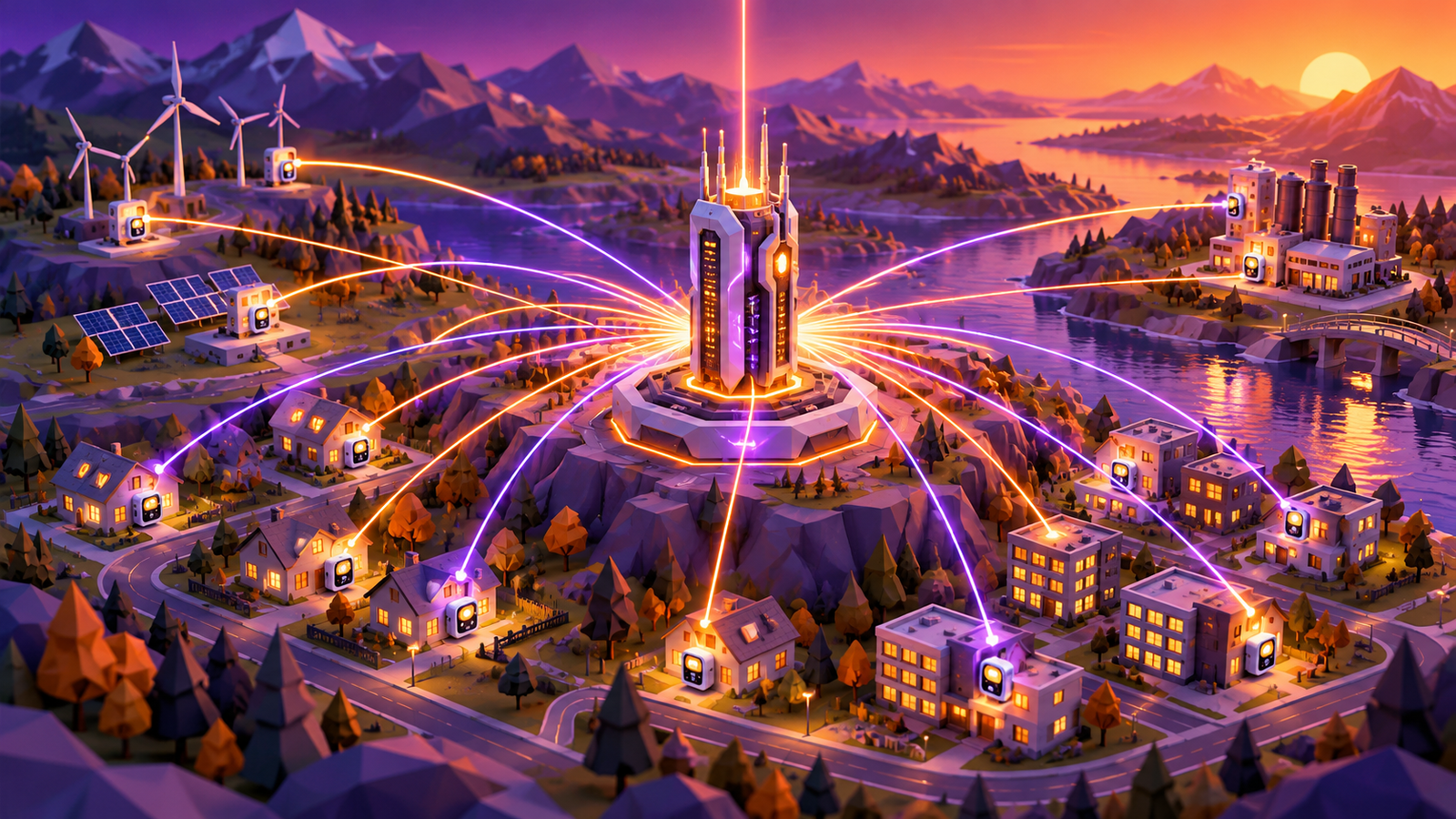
A head-end system (HES) is the AMI software layer that manages communication with smart meters, collects meter data and events, and exchanges information with downstream systems such as a meter data management system (MDMS). In advanced metering infrastructure (AMI), the data path runs from the smart meter through a communication network to the head-end system, then to the MDMS and on to utility applications.
The HES is primarily responsible for talking to field meters and acquiring their data. The MDMS performs deeper meter-data management, such as validation, estimation and editing. They are related but separate systems, although some vendor products combine or overlap their functions. This article explains where the head-end system sits, how it works internally, how it communicates with meters, and how it connects to other utility systems. Exact behavior varies by meter technology, network design and vendor implementation.
- A head-end system is the AMI layer that manages communication with smart meters and acquires their data and events.
- It sits between the communication network and the MDMS.
- It communicates with meters, gateways or concentrators, and downstream utility systems.
- Its major functions are data collection, device and command management, event handling, scheduling, monitoring and data forwarding.
- It passes acquired data to the MDMS, which validates, estimates, edits and manages it.
- Reliability, scalability, security and interoperability matter because the HES connects to very large device populations.
What Is a Head-End System in AMI?
A head-end system (HES) is the AMI software layer that communicates with field meters, collects their data and events, manages devices and commands, and forwards information to downstream systems.
The term “head-end” comes from communications engineering, where it describes the central point that originates and receives signals. In AMI, the HES is the central point for meter communication. It is often described as the communication and data acquisition layer, and also as a device-management layer, because it configures meters and tracks their status.
The roles in the AMI chain are:
- Smart meter: the field device that measures, stores and reports.
- Communication network: the connectivity layer.
- HES: meter communication, data acquisition and device management.
- MDMS: meter data management.
- Utility applications: business and operational systems, such as billing and outage management.
The HES works in two directions. Inbound traffic is data and events coming from meters. Outbound traffic is configuration, requests and commands going to meters, where the meter supports them. Communication can be scheduled, such as daily interval collection, or event-driven, such as an outage notification. The HES also collects events and alarms and records communication status.
Where Does the Head-End System Fit in AMI Architecture?
The typical architecture runs top to bottom:
Customer premises
Where electricity is used.
Smart meter
Measures and stores data.
Access or neighborhood communication network
Connects meters to the utility network.
Head-end system (HES)
Manages communication and acquires data.
MDMS
Manages and prepares meter data.
Utility applications
Use the processed information.
Many deployments add gateways, data concentrators or backhaul links between the access network and the HES. Others connect meters straight to a wide-area network. The layers can be described as:
- Field layer: meters and, where used, local devices.
- Communication layer: access networks, gateways and backhaul.
- HES layer: communication management and data acquisition.
- Meter-data management layer: the MDMS.
- Enterprise and application layer: billing, outage management, analytics and others.
Head-End System Architecture
An HES is built from several cooperating components. Names and boundaries differ between products.
- Communication interfaces: connect to networks, gateways and meters.
- Meter and device adapters: translate between the HES and specific meter types.
- Protocol handling: implements the message exchange used by meters.
- Device management: keeps a registry of meters, configuration and status.
- Command processing: sends and tracks commands.
- Data acquisition: requests and receives readings and logs.
- Event and alarm handling: receives, classifies and forwards events.
- Scheduling engine: runs collection tasks at set times.
- Session management: opens, maintains and closes communication sessions.
- Message queues, where applicable: decouple incoming traffic from processing.
- Data buffering: holds data while downstream systems are busy.
- Retry and error handling: repeats failed requests and records failures.
- Logging and audit trails: record activity for support and accountability.
- Monitoring: tracks system and communication health.
- Security controls: authentication, authorization and encryption.
- Integration APIs and interfaces: exchange data with other systems.
Together, the scheduler creates tasks, the session and protocol components carry them out through adapters, the acquisition and event components receive results, the queues and buffers smooth the load, and the integration layer passes data on. Logging and monitoring wrap around all of it.
How Does a Head-End System Work?
A simplified operating workflow:
- The smart meter measures electrical parameters.
- The meter stores measurements and events.
- The communication network provides connectivity.
- The HES establishes or manages communication.
- The HES requests or receives meter data.
- The HES checks communication-level responses, such as completeness and acknowledgement.
- The HES handles retries and errors where required.
- The HES stores or forwards the acquired data.
- Meter data moves toward the MDMS.
- The MDMS performs meter-data management functions.
- Utility applications consume the processed information.
Scheduled collection asks meters for data at planned times, such as daily interval reads, and spreads load across collection windows. Event-driven communication lets a meter or network element report something as it happens, such as an outage event. Most AMI systems use both.
Meter-to-HES Communication
Communication between meters and the HES typically involves:
- Two-way communication: data flows to the HES and requests or commands flow to meters, where supported.
- Polling: the HES contacts meters in turn to ask for data.
- Scheduled reads: routine collection on a timetable.
- On-demand reads: a user or application asks for a specific reading.
- Event reporting: meters send events without being asked, where supported.
- Remote commands: the HES sends instructions that the meter can carry out.
- Acknowledgements: confirmations that a message or command was received or executed.
- Retries and timeout handling: repeat attempts after a failure or after waiting too long.
- Communication failures and device availability: tracked so operators know which meters are reachable.
Exact behavior depends on the meter technology, the network architecture and the HES implementation. Not every meter supports every command or reporting mode.
Communication Technologies Used by AMI Head-End Systems
The HES is largely independent of the network used to reach meters, but each technology affects how it must behave.
RF Mesh
Meters form a neighborhood radio network and forward each other’s messages over multiple hops. Strengths include extended coverage and route redundancy in dense areas. Limitations include dependence on the radio environment, device density and network planning.
Cellular
Meters connect directly to a mobile network, which can include LTE, 4G or 5G where applicable. This gives wide coverage and can reduce the need for a utility-owned access network. Coverage at the meter, carrier dependence, service management and technology lifecycle are the main trade-offs.
PLC
Power line communication uses electrical conductors as the medium. It can be useful where the electrical network provides a natural path to a concentrator. Noise, signal quality and network topology affect results.
Fiber and Ethernet
These usually serve high-bandwidth backhaul and utility facilities rather than individual meters. They connect gateways, concentrators and data centers to the HES.
Private Utility Networks
Utility-controlled networks offer control over reliability and security, but the utility takes on build and maintenance responsibility.
Other Technologies
LPWAN, microwave and satellite have specialized roles, such as low-data-rate reporting, backhaul where fiber is not available, or very remote locations.
| Technology | Typical AMI Role | Coverage | Strength | Main Limitation | HES Consideration |
|---|---|---|---|---|---|
| RF mesh | Access network | Extended by multi-hop paths | Dense-area coverage and redundancy | RF environment and planning | Often reached through gateways or collectors |
| Cellular | Access or backhaul | Wide, where carrier coverage exists | Broad reach | Carrier dependence and lifecycle | Device identity and many direct sessions |
| PLC | Access network | Follows the electrical network | Uses existing lines | Noise and signal quality | Concentrator-based communication |
| Fiber and Ethernet | Backhaul and facilities | Along installed routes | Capacity and reliability | Build cost and route availability | Reliable links between gateways and HES |
| Private utility networks | Access or backhaul | Within utility-controlled areas | Control and security | Ownership and maintenance | Integration with utility network policies |
| LPWAN, microwave, satellite | Specialized | Varies | Reach or low power | Capacity, latency or cost | Support for limited data rates and delays |
Protocols and Interfaces
Four concepts are often confused:
- Communication technology: the medium, such as RF, cellular or fiber.
- Network protocol: how data is addressed and carried, such as IP.
- Application protocol: the rules for exchanging meter messages.
- Data model: how meter data and functions are named and structured.
Examples include DLMS/COSEM and the IEC 62056 family for meter data exchange, IP-based communication as a network layer, MQTT in some IoT-style data architectures, and DNP3 in some utility systems where applicable. Not every AMI deployment uses all of these.
DLMS/COSEM is especially relevant. DLMS describes how devices exchange messages, and COSEM describes how meter data is modeled as objects with attributes and methods. A client, such as an HES, reads or sets values on a server, which is the meter. Standards help, but implementations still differ.
To work with different meters, the HES uses protocol adapters or drivers, or an equivalent interface, so that each meter type is reached in the way it supports while the rest of the HES sees a consistent view.
Major Functions of a Head-End System
Meter Data Collection
Periodic reads, interval data, register reads and load-profile data are collected on schedule or on demand.
Device Management
The HES maintains meter registration, configuration, communication settings and status, and handles firmware-related functions where supported.
Command Management
Remote commands are issued, acknowledged and tracked. Status and failure handling show whether a command succeeded, is pending or needs a retry.
Event and Alarm Management
Outage and restoration events, tamper events, communication failures, device alarms and voltage-related or other events are received where meters support them.
Scheduling
Scheduled reads, configurable collection windows and prioritization let the HES balance routine collection against urgent requests.
Communication Monitoring
The HES tracks connectivity, failed communications, retries, timeouts and device availability.
Data Forwarding
Collected data and events are passed to downstream systems, most often the MDMS, through defined interfaces.
Head-End System and MDMS: What Is the Difference?
The HES gets data from meters. The MDMS manages and prepares that data. Boundaries vary by vendor and deployment.
| Aspect | HES | MDMS |
|---|---|---|
| Primary purpose | Communicate with meters and acquire data | Manage and prepare meter data |
| Communication responsibility | High | Low, mostly with the HES and applications |
| Device interaction | Direct, through networks | Generally indirect |
| Data acquisition | Yes | Receives data from the HES |
| Data validation | Communication-level checks | Business-level validation |
| Estimation | Generally no | Yes, commonly |
| Editing | Generally no | Yes, with audit trail |
| Aggregation | Limited | Yes |
| Long-term meter-data management | Limited, mainly buffering | Yes |
| Downstream integration | Passes data to the MDMS and others | Delivers processed data to applications |
| Operational role | Communication and device operations | Data quality and data services |
The relationship is smart meter, then HES, then MDMS, then utility applications.
Head-End System Data Flow
Meter measurement
Data is produced in the field.
Communication network
Carries it to the utility.
HES
Receives it.
Data processing and communication handling
Checks, buffers and queues it.
MDMS
Manages it.
Utility applications
Use it.
The HES handles several kinds of information: interval data, register data, instantaneous values, meter events, alarms, status information, communication diagnostics and command responses. Upstream flow carries data from meters toward utility systems. Downstream flow carries configuration, requests and commands from utility systems toward meters.
HES Integration With Other Utility Systems
The HES usually exchanges data with the MDMS first. Depending on architecture, it may also connect to:
- Customer information and billing systems, often through the MDMS.
- Outage management systems (OMS), for outage and restoration events.
- Distribution management systems (DMS), where meter data supports operations.
- Analytics platforms and data warehouses.
- Customer portals, where implemented.
- Demand-response systems.
- Enterprise integration platforms that route data between systems.
Not every HES connects directly to every system. Standardized interfaces and reliable data exchange matter because they reduce custom work and prevent data loss between layers.
HES and Smart Meter Operations
The HES supports automated meter reading, interval data collection, remote meter access, remote commands where supported, event collection, outage awareness, restoration information, meter diagnostics and operational visibility. It enables these functions but does not perform all of them alone. For the meter-level background, read key components of a smart grid, which places smart meters and AMI in the wider grid.
HES and AMI Architecture
The HES is one layer of a larger AMI system. The full chain of meters, networks, head-end, MDMS and applications is covered in the AMI architecture article, and this article concentrates on the head-end layer. Meter-side differences between smart and conventional meters are covered in the smart meter comparison article. Links to those articles can be added once they are published.
HES, Smart Meter Communication and Communication Networks
A related article on smart meter communication looks broadly at technologies, protocols and data flow from meter to utility. This article looks at the specific layer that manages that communication and interacts with devices. Together they cover the transport side and the management side of the same path.
Reliability and Performance Considerations
Key considerations include:
- Communication success rate and latency.
- Availability of the HES and its interfaces.
- Retry behavior and timeout handling.
- Message queues and data buffering to absorb bursts.
- Concurrent meter sessions the system can manage.
- Fault tolerance, redundancy and high availability.
- Disaster recovery.
- Monitoring, logging and capacity planning.
No fixed numerical benchmarks apply to every system. Requirements depend on utility scale, communication technology, meter population and operational objectives.
HES Scalability
An HES must support large meter populations, concurrent communication, growing data volumes, different meter models, multiple communication technologies and protocols, geographically distributed deployments and future device additions.
Conceptually, vertical scaling adds capacity to existing servers, while horizontal scaling adds more nodes that share the work. Horizontal designs can spread sessions and queues across nodes, but they need careful state and failover handling. Specific architectures differ by product.
HES Security and Cybersecurity
The HES is an important security boundary because it communicates with a very large population of field devices and passes data to enterprise systems. Defensive concepts include:
- Authentication of meters, users and systems.
- Authorization and role-based access.
- Encryption and secure communication.
- Certificate and key management where applicable.
- Audit logs.
- Network segmentation.
- Secure APIs.
- Firmware security through controlled, verified updates.
- Monitoring and incident response.
- Secure handling of remote commands, with strong approval and traceability.
Data Quality and Reliability
The HES contributes to reliable acquisition by handling missing reads, duplicate messages, delayed data, communication failures and corrupted or incomplete responses. It uses retries, timestamps and, where supported, device time synchronization to improve completeness.
The distinction matters. The HES deals with communication-level handling: did the data arrive, is it complete, was it received twice. The MDMS deals with data-level validation, estimation and editing: is the value plausible, how should a gap be filled, how should a record be corrected.
Implementation Challenges
Common challenges include:
- Legacy meter integration and migration from legacy AMR systems.
- Multi-vendor environments and protocol compatibility.
- Communication reliability and network coverage.
- Large-scale device onboarding.
- System integration and data volume.
- Scalability and high availability.
- Cybersecurity and monitoring.
- Vendor dependency and firmware and device lifecycle.
- Operational workforce skills.
Costs and outcomes depend on each utility, so none are given here.
HES Deployment Approaches
| Architecture | Strengths | Considerations |
|---|---|---|
| Centralized | Single point of management and simpler operations | Capacity limits and a larger failure domain unless made redundant |
| Distributed | Regional capacity and resilience | More complex coordination and consistency |
| Cloud-hosted | Flexible capacity and managed infrastructure | Connectivity, data governance and security responsibilities |
| Hybrid | Combines on-premise control with cloud flexibility | Integration and operating complexity |
No approach is best for every utility. The choice depends on policy, scale, network design and skills.
HES vs Traditional Meter Reading
| Aspect | Traditional Meter Reading | AMI + HES |
|---|---|---|
| Data collection | Manual or local | Automated through networks |
| Communication | Little or none | Managed by the HES |
| Reading frequency | Periodic | More frequent, depending on configuration |
| Remote access | Limited | Possible where supported |
| Event collection | Limited | Events can be collected |
| Operational visibility | Limited | Greater, depending on the system |
| Manual effort | High for field reading | Lower for reading, higher for system operation |
| Scalability | Grows with staff | Grows with system capacity |
| Integration | Manual transfer to billing | Interfaces to MDMS and other systems |
Practical Utility Applications
The HES helps enable automated meter reading, billing data acquisition, outage and restoration awareness, meter diagnostics, remote operations, demand-response support, customer data services, grid analytics support, load-profile collection and, where supported, power-quality-related data. It is an enabling system. Billing, outage management, analytics and other applications still depend on the MDMS and their own systems.
Illustrative Example
Illustrative Example — not a real utility case study.
A utility has a large population of smart meters. In this simplified scenario:
- Meters record interval measurements.
- Communication networks connect the meters to the utility.
- The HES manages scheduled collection in defined windows.
- Communications that fail are retried, and persistent failures are flagged.
- Events such as outage notifications are received.
- Data is forwarded to the MDMS.
- The MDMS performs validation, estimation and editing.
- Downstream systems use the processed data.
No utility name, project size, cost or result is implied.
HES Technology Selection Considerations
| Consideration | What to Check |
|---|---|
| Meter population | Current size, growth and meter model mix |
| Communication technologies | Support for the networks in use or planned |
| Protocols | Supported protocols and adapters |
| Vendor ecosystem | Meter, network and MDMS compatibility |
| Interoperability | Open interfaces and standards support |
| Scalability | Concurrent sessions and growth approach |
| Availability | Redundancy and recovery design |
| Cybersecurity | Authentication, encryption, audit and update processes |
| Integration requirements | Interfaces to MDMS and other systems |
| Cloud or on-premise strategy | Policy, data governance and operating model |
| Operational support | Skills, monitoring tools and vendor support |
| Lifecycle management | Upgrade path, device lifecycle and exit options |
Current Technology Trends
Trends seen in some deployments include cloud and hybrid HES hosting, API-driven integration, containerized architectures where applicable, improved interoperability, advanced monitoring, edge or network intelligence where relevant, stronger cybersecurity, higher data volumes and integration with analytics and modern utility platforms. These are not universally adopted. Many utilities run established on-premise systems.
Future of Head-End Systems in AMI
- Current practice: scheduled collection, event handling and command management across mixed meter and network populations.
- Emerging direction: greater interoperability, more flexible communication architectures, cloud and hybrid adoption, stronger cybersecurity and deeper integration with the MDMS and grid systems.
- Potential future development: larger device populations, more frequent data, advanced event processing and support for evolving smart-grid requirements.
These directions depend on utility strategy, regulation and technology, and none is certain.
HES vs MDMS vs Smart Meter
| Component | Role |
|---|---|
| Smart meter | Field device that measures, stores and reports data and events |
| HES | Communicates with meters, acquires data, manages devices and commands, and forwards data |
| MDMS | Validates, estimates, edits, stores and delivers meter data to applications |
Key Takeaways
- The head-end system manages communication with smart meters and acquires their data.
- It sits between the communication network and the MDMS.
- It supports scheduled and event-driven communication, and outbound commands where supported.
- The HES and MDMS are separate roles, although some products overlap them.
- Reliability, scalability and interoperability shape HES design.
- Security is critical because the HES connects to many field devices.
- Capabilities vary by meter, network and vendor.
Conclusion
A head-end system is the AMI layer that communicates with smart meters, collects their data and events, and passes information to the MDMS. It manages scheduled and event-driven communication, commands where supported, device status and data forwarding. The MDMS then manages and prepares the data for utility applications. Reliability, scalability, interoperability and cybersecurity matter because the head-end system serves very large device populations across varied networks.
Frequently Asked Questions About Head-End Systems
What is a head-end system in AMI?
A head-end system is the AMI software layer that manages communication with smart meters, collects data and events, and exchanges information with downstream systems such as an MDMS.
Products and architectures vary by vendor and deployment.
How does a head-end system work?
The head-end system schedules or receives communication with meters, collects readings and events, handles retries and errors, and forwards the data toward the MDMS. It can also send supported commands and configuration to meters.
Exact behavior depends on the meter, network and implementation.
Why is a head-end system important for AMI?
It is the layer that connects field meters to utility systems. Without it, meter data would not be collected, monitored and delivered in an organized way.
Its value also depends on the network, the MDMS and the applications that use the data.
What are the main functions of a head-end system?
The main functions are data collection, device management, command management, event and alarm handling, scheduling, communication monitoring and data forwarding.
Which functions are available depends on the meters and the product.
What are the main components of a head-end system?
Typical components include communication interfaces, device adapters, protocol handling, a scheduling engine, session management, event handling, queues and buffers, retry handling, logging, monitoring, security controls and integration interfaces.
Names and boundaries differ between products.
What are the challenges of implementing a head-end system?
Common challenges are legacy meter integration, multi-vendor protocol compatibility, communication reliability, device onboarding, scalability, cybersecurity and high availability.
Lifecycle management and workforce skills also matter. The mix depends on the utility.
What is the difference between a head-end system and an MDMS?
The head-end system communicates with meters and acquires data, while the MDMS validates, estimates, edits, stores and delivers that data to applications.
Boundaries can vary by vendor and deployment.
How does a head-end system communicate with smart meters?
It communicates through communication networks, sometimes via gateways or concentrators, using protocols and adapters suited to each meter type. It can poll meters, run scheduled and on-demand reads, receive events and send supported commands.
The technology and protocols used vary by deployment.

I share real stories, practical ideas and honest perspectives on business, marketing and life. This blog is a space to learn, grow and connect.