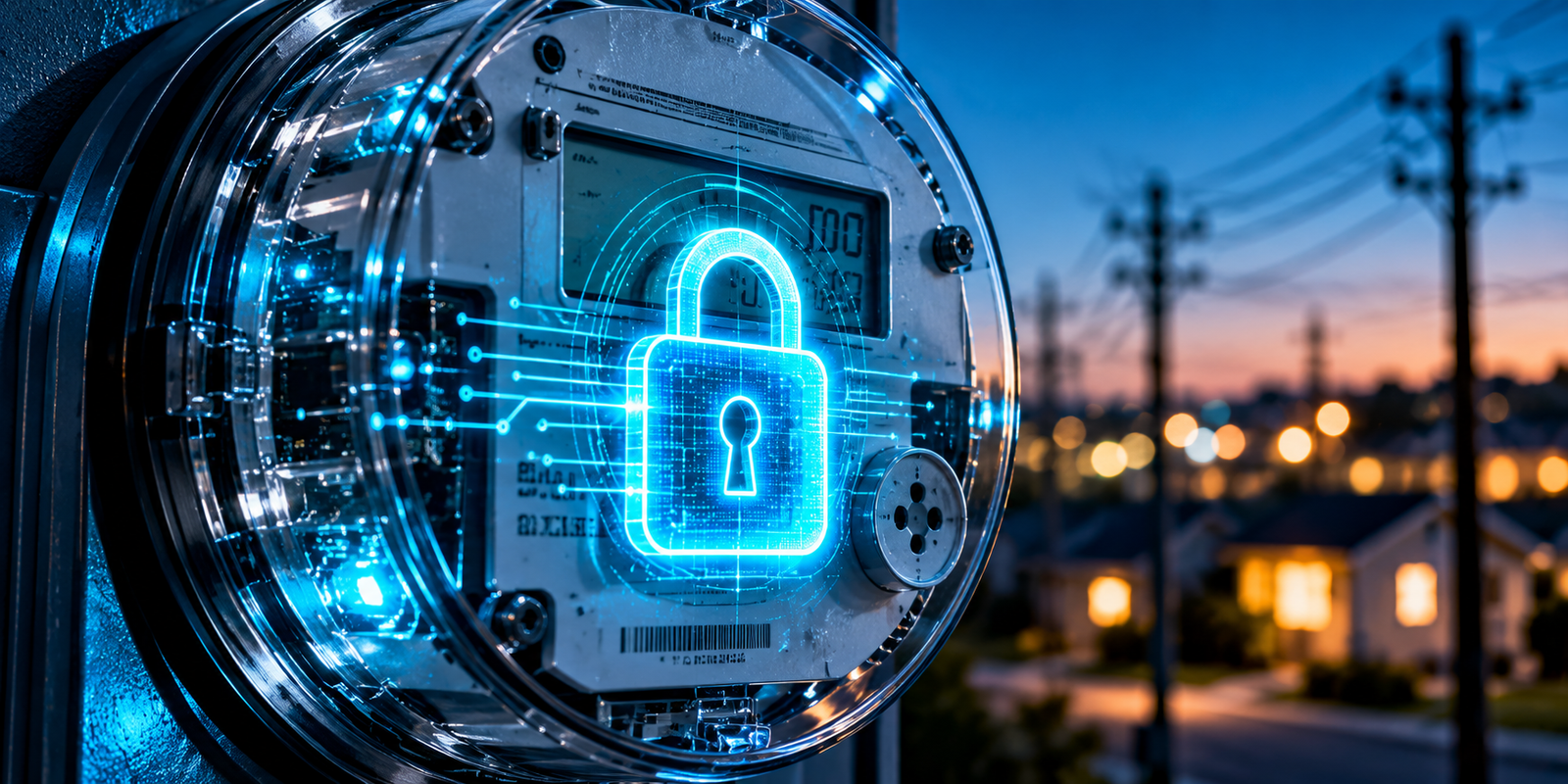

AMI data flow is the movement of meter measurements and related information from smart meters through communication networks, the head-end system (HES) and the meter data management system (MDMS) to utility applications. In sequence, it runs from the smart meter to the communication network, then the HES, then the MDMS, then utility applications such as billing and analytics.
Understanding this flow matters because advanced metering infrastructure (AMI) does not simply collect meter readings. It creates a connected information chain that involves measurement, communication, acquisition, validation, storage, processing, integration, analytics and utility decision-making. A problem at any step can affect everything after it. Real deployments may add data concentrators, gateways, integration platforms, message brokers, APIs, enterprise service buses or data platforms, and not every AMI system uses every component. The descriptions here are general and vary by utility implementation.
- AMI data starts at the smart meter, which measures and records electrical information.
- Communication networks move the information between field devices and utility systems.
- The HES manages meter communication and acquires meter data and events.
- The MDMS manages and processes meter data, including validation, estimation and editing.
- Data quality matters before data reaches downstream systems.
- Utility applications consume managed data for billing, analytics, planning and other uses.
- Two-way communication can support commands and device interaction where meters allow it.
- The exact architecture varies by utility implementation.
What Is AMI Data Flow?
AMI data flow is the end-to-end movement of electricity measurements and meter-related information from smart meters, through communication infrastructure and systems such as the HES and MDMS, to utility applications.
AMI stands for advanced metering infrastructure, the combination of smart meters, communication networks and back-office systems. Upstream data movement carries measurements and events toward the utility. Downstream movement carries requests and commands toward meters. Because many AMI systems support two-way communication, the flow can be bidirectional, and the systems along the path integrate with one another.
Three ideas are related but different:
- Data flow: the overall path and direction of information.
- Communication network: the transport that carries data over part of that path.
- Data processing: what happens to data once it arrives, such as validation and aggregation.
Complete AMI Data Flow Architecture
A full upstream path, with optional elements shown where they apply:
Smart meter
Measures and records data.
Access or neighborhood network
Connects meters to the next point.
Gateway or data concentrator, where applicable
Aggregates and forwards traffic.
Backhaul network
Carries traffic to the utility.
Head-end system
Manages communication and acquires data.
Integration layer, where applicable
Routes data between systems.
MDMS
Manages and processes data.
Utility applications
Use the managed data.
The reverse or control direction runs from a utility application to the HES, through the communication network to the smart meter. Downstream commands may include supported remote operations. What is possible depends on meter capabilities and utility policies.
AMI Data Flow: Step-by-Step
Step 1: Electrical Measurement
The smart meter measures electrical quantities. Where supported, these include energy consumption, interval energy, voltage, current, power, demand and meter events. Not every meter measures every parameter.
Step 2: Local Meter Storage
Meters may store readings and events temporarily before transmission. Local storage lets a meter keep data when a link is unavailable and send it later.
Step 3: Communication From the Meter
Information leaves the meter through technologies such as RF mesh, cellular, PLC, fiber or Ethernet, private utility networks, or other options suited to the location.
Step 4: Network Transport
The access network connects meters to the first aggregation point or a wide-area network. The backhaul carries aggregated traffic to the utility. The two can use different technologies.
Step 5: HES Receives and Collects Data
The HES gathers data through polling, scheduled reads, event collection and on-demand reads. It manages communication sessions, retries failed attempts, handles timeouts and processes acknowledgements.
Step 6: HES Processes Communication-Level Information
The HES handles protocols, identifies devices, tracks communication status, handles messages and events, forwards data and manages errors. This is communication-level handling, not full data management.
Step 7: Data Moves to the MDMS
The HES passes meter data to the MDMS through suitable interfaces, sometimes via an integration layer.
Step 8: MDMS Ingests and Organizes Data
The MDMS ingests the data and organizes it by meter identity, timestamps, channels and units, with quality indicators and metadata.
Step 9: Validation
Validation checks data against rules, such as range, completeness, sequence, timestamp and duplicate checks.
Step 10: Estimation
Where data is missing or incomplete and policy allows, estimation fills gaps with calculated values. Estimates should be flagged.
Step 11: Editing
Authorized users can correct data under controlled workflows, with reason codes and an audit trail.
Step 12: Data Storage
Managed data is stored for later use, usually as time-series records with quality flags and history.
Step 13: Aggregation and Processing
Data can be aggregated or transformed for different uses, such as hourly, daily or monthly views, load profiles or time-of-use calculations.
Step 14: Utility Applications Consume Data
Billing, customer systems, analytics, forecasting, demand response, grid planning and operational analysis use the managed information.
Smart Meter Layer
The smart meter is the starting point of AMI data. It measures, records interval data and registers, logs events and timestamps, stores data locally and reports its own status. What a given meter offers depends on its model and configuration. For a comparison with conventional meters, see the separate article on smart meters versus traditional electricity meters, which can be linked here once it is published.
Communication Network Layer
The communication layer includes the access or neighborhood network, any gateways, and the backhaul. Key concerns are latency, reliability, availability and coverage.
| Technology | AMI Role | Typical Strength | Main Consideration |
|---|---|---|---|
| RF mesh | Access network | Coverage extension and route redundancy | RF environment and planning |
| Cellular | Access or backhaul | Wide coverage | Carrier dependence and lifecycle |
| PLC | Access network | Uses existing power lines | Noise and signal quality |
| Fiber and Ethernet | Backhaul and facilities | Capacity and reliability | Build cost and route availability |
| Private utility networks | Access or backhaul | Control and security | Ownership and maintenance |
| Other technologies, such as LPWAN, microwave and satellite | Specialized roles | Reach or low power | Capacity, latency or cost |
The networks and protocols are covered in more depth in a separate article on smart meter communication, which can be linked here once it is published.
Head-End System Layer
The HES manages meter communication, acquires data, manages devices, collects events, handles commands, monitors communication, retries failures, handles errors and forwards data downstream. A separate article on head-end systems covers it in detail and can be linked here once it is published.
MDMS Layer
The MDMS ingests and organizes data, validates, estimates and edits it, stores it, aggregates it, manages quality and integrates with downstream systems. A separate article on meter data management systems covers it in detail and can be linked here once it is published.
Utility Application Layer
Managed AMI data supports billing, customer information, outage-related analysis, demand response, load forecasting, analytics, grid planning, energy efficiency, distributed energy analysis and reporting. The MDMS is not automatically the billing, OMS, DMS or EMS system itself. Those systems use its data to do their own work. For the wider grid context, see key components of a smart grid.
What Data Flows Through AMI?
Not every meter or deployment provides all of these data types.
| Data Type | Source | Typical Destination | Example Use |
|---|---|---|---|
| Interval energy | Smart meter | HES, then MDMS | Billing, load analysis |
| Register reads | Smart meter | HES, then MDMS | Billing |
| Load-profile data | Smart meter | MDMS, analytics | Forecasting |
| Instantaneous measurements | Smart meter | HES or MDMS | Operational analysis |
| Voltage, current and power, where supported | Smart meter | MDMS, grid applications | Voltage and load studies |
| Meter events | Smart meter | HES, then MDMS or applications | Operational awareness |
| Outage and restoration events | Smart meter | HES, OMS where integrated | Outage awareness |
| Tamper events and alarms | Smart meter | HES, then operations | Investigation |
| Meter status | Smart meter | HES, MDMS | Asset management |
| Communication status, where applicable | HES and network | HES monitoring | Troubleshooting |
| Command responses | Smart meter | HES, requesting application | Confirm command results |
Upstream AMI Data Flow
The upstream path is smart meter, network, HES, MDMS, then utility applications. Data moves in several ways:
- Scheduled reads: routine collection at set times.
- Event-driven information: events sent when they occur, where supported.
- On-demand data: collected when requested.
- Periodic data: regular summaries or logs.
- Delayed data: data that arrives late after a link problem.
- Retry mechanisms: repeat attempts that recover missed data.
Downstream AMI Data Flow
The downstream path is utility or operator, HES, communication network, then smart meter. Possible operations include on-demand reads, configuration requests, remote commands and device management functions. These are supported capabilities only, and not every meter supports every remote command. Permissions, security controls and utility policy determine what is actually allowed.
Bidirectional AMI Communication
Modern AMI can be bidirectional because meters, networks and the HES can exchange messages both ways, where supported.
| Aspect | Traditional Meter Reading | AMI Bidirectional Communication |
|---|---|---|
| Direction | Reading goes one way, from meter to utility | Data and requests can flow both ways |
| Initiation | Field visit or local process | Scheduled, on demand or event-driven |
| Meter interaction | Physical | Remote, where supported |
| Confirmation | None | Acknowledgements and responses |
| Timing | Periodic | Depends on configuration and use case |
Why Data Quality Matters in AMI Data Flow
Quality has several dimensions: completeness, accuracy, timeliness, consistency, uniqueness and traceability. Problems can arise at any layer:
- Meter layer: clock errors or configuration mistakes.
- Communication layer: gaps, delays and interference.
- HES layer: failed sessions or lost messages.
- Integration layer: mapping errors or dropped transfers.
- MDMS layer: rule errors or missing master data.
Validation, Estimation and Editing
VEE stands for validation, estimation and editing. In the AMI flow:
Raw data
As received from the HES.
Validation
Checked against rules.
Estimation, where necessary
Gaps filled and flagged.
Authorized editing, where necessary
Corrected with audit.
Managed data
Ready for applications.
The MDMS commonly performs or coordinates these functions, though the exact architecture varies.
AMI Data Flow Interfaces
Interfaces exist at several points:
- Meter and network: the meter’s communication interface.
- Network and HES: connections to gateways, collectors or direct links.
- HES and MDMS: the hand-off of acquired data.
- MDMS and billing, analytics or grid applications: delivery of managed data.
Common methods include APIs, messaging, file-based interfaces where applicable, event-driven integration and batch interfaces, with agreed data exchange formats. No one method is universal. The choice depends on volume, timing needs and the systems involved.
Protocols in AMI Data Flow
Four concepts are distinct: the communication technology (the medium), the network protocol (how data is addressed and carried), the application protocol (the message rules) and the data model (how data is structured).
Examples include DLMS/COSEM and the IEC 62056 family for meter data exchange, IP networking, MQTT in some IoT-style architectures and DNP3 in some utility systems. Not every AMI system uses all of them.
Timestamps and Time Synchronization
Accurate time underpins AMI data. It affects interval boundaries, event timestamps and the ordering of events. Meter clocks can drift, so synchronization matters. Time zones and daylight-saving changes can create repeated or missing local hours, so many systems store time in a consistent reference and convert for display. Errors in time can make good data look wrong, or the reverse.
Data Latency and Availability
Not all AMI data is real-time. Data may be real-time, near-real-time or scheduled, and it can also be delayed. Latency includes communication latency and processing latency. Availability describes whether each system is operating when needed. Retry behavior affects how soon missed data arrives. The required latency depends on the use case: daily billing data tolerates delay, while some operational uses benefit from faster paths.
Data Completeness
Completeness problems include missing intervals, partial data, communication gaps, delayed transmission, duplicate records and out-of-order records. The HES can detect failed communication and retry. The MDMS can detect gaps, duplicates and ordering issues through validation and then estimate or flag data.
AMI Data Flow for Billing
The billing path is smart meter, HES, MDMS, then the billing system. It supplies billing reads, interval data, register data, quality flags and time-of-use information where applicable. Billing calculations may occur in the downstream billing system, depending on architecture.
AMI Data Flow for Outage and Restoration
Meter events can support outage awareness. A meter may indicate an outage or restoration, the HES collects the event, and data may be aggregated and passed to an OMS where integrated. AMI does not automatically replace an OMS. A meter that loses power may be unable to report immediately, and a network problem can resemble an outage.
AMI Data Flow for Analytics
The analytics path is meter data, MDMS, analytics platform, then insights. Typical uses are load profiles, consumption patterns, anomaly detection, forecasting, customer segmentation where appropriate and energy efficiency analysis. AI and machine learning can build on managed, quality-controlled data, although they are not required for every deployment.
AMI Data Flow for Demand Response
Managed meter data can support consumption monitoring, program measurement, event analysis, load response evaluation and customer usage analysis. Demand response also needs program systems and, in some cases, controllable devices, which are outside the AMI data flow itself.
AMI Data Flow for Grid Modernization
AMI data contributes to grid modernization by supporting visibility into customer-side demand, and by informing work on distributed energy, EVs, storage, demand response and advanced analytics. AMI alone does not create a smart grid. It is one data source among sensors, SCADA, automation and other systems.
Cybersecurity Across AMI Data Flow
Security must cover the whole chain, from meter to network to HES to MDMS to utility applications. Defensive concepts include:
- Device authentication and authorization.
- Encryption and secure communication.
- Certificate and key management where applicable.
- Network segmentation.
- API security and access control.
- Audit logging and monitoring.
- Incident response.
- Secure remote operations, with approval and traceability.
Data Privacy and Governance
Meter data can reveal usage patterns, so governance matters. Topics include access control, data ownership, retention, privacy, auditability, customer data handling and regulatory considerations where applicable. Requirements differ by jurisdiction, so utilities should confirm local rules.
Reliability of AMI Data Flow
Reliability depends on communication reliability, retry mechanisms, fault handling, redundancy, high availability, backup, disaster recovery, monitoring and data integrity. Each layer needs its own recovery approach. Targets depend on the utility, so no figures are given.
Scalability
As meter populations grow, challenges include millions of devices, higher data frequency, event volumes, concurrent communication, storage growth, processing workloads and integration workloads. Conceptual strategies include scalable storage, partitioning, asynchronous processing, queues, distributed processing and horizontal scaling where applicable. No single architecture suits every utility.
Illustrative End-to-End AMI Data Flow Example
Illustrative Example — not a real utility case study.
A utility has smart meters collecting interval energy data.
- A meter records an interval measurement.
- The meter stores the measurement.
- The communication network transports the data.
- The HES receives and acquires the data.
- The HES handles communication and forwards the data.
- The MDMS ingests the data.
- The MDMS validates it.
- Missing data is estimated where appropriate.
- Managed data is stored.
- Billing receives the data it needs.
- Analytics receives managed data.
- Utility teams use the resulting information.
In the reverse direction, a utility user or application sends a supported request to the HES, the HES sends it through the network, and the smart meter receives and acts on it, returning a response. No utility, size, cost or result is implied.
Common AMI Data Flow Problems
| Problem | Possible Layer | Typical Consideration |
|---|---|---|
| Meter not communicating | Meter or network | Check power, signal and network status |
| Missing intervals | Meter, network or HES | Check collection and retry history |
| Duplicate data | HES, integration or MDMS | Check retries and duplicate handling |
| Delayed data | Network or HES | Check latency and queues |
| Incorrect timestamps | Meter or time synchronization | Check clock and time settings |
| Protocol mismatch | HES or meter interface | Check adapter and configuration |
| HES ingestion failure | HES | Check logs and interface status |
| MDMS validation failure | MDMS | Check rules and source data |
| Integration failure | Integration layer | Check interface health and mapping |
| Downstream application issue | Utility application | Check how the application consumes data |
Engineers can isolate the layer logically by working along the chain. First confirm the meter measured and stored data. Then check that it communicated, that the HES received it, that the MDMS ingested and validated it, and that the application received it. The first point where data is missing or wrong narrows the search. Product-specific steps depend on the vendor.
AMI Data Flow Monitoring
Utilities may monitor device connectivity, communication success and failure, data completeness, ingestion status, validation exceptions, processing queues, interface health, application integration and system availability. Monitoring each layer separately makes faults easier to place.
Current AMI Data Flow Technology Trends
Trends seen in some deployments include cloud and hybrid architectures, API-driven integration, event-driven processing, higher-frequency data, advanced analytics, AI and machine learning, improved interoperability, stronger cybersecurity, scalable data platforms and integration with smart-grid systems. Not every utility uses them.
Future AMI Data Flow
- Current: scheduled and event-based collection, VEE and delivery to billing and analytics.
- Emerging: cloud and hybrid data platforms, event-driven processing, wider API integration and AI/ML on managed data.
- Potential future: more granular meter data, faster availability, deeper integration with DERs, EV charging and battery storage, edge processing where appropriate, increased automation and more integrated utility data platforms.
These directions depend on utility strategy, regulation and technology, and none is certain.
AMI Data Flow vs Traditional Meter Data Flow
| Aspect | Traditional Metering | Modern AMI |
|---|---|---|
| Measurement | Cumulative energy | Digital, with interval data where configured |
| Data collection | Manual or local | Automated |
| Communication | Little or none | Network-based |
| Reading frequency | Periodic | More frequent, depending on configuration |
| Two-way communication | Generally not available | Possible where supported |
| Data processing | Largely manual | Automated in HES and MDMS |
| Validation | Manual or at billing | Rule-based in the MDMS |
| Storage | Billing records | Managed time-series storage |
| Analytics | Limited | Broad, depending on data quality |
| Remote operations | Generally none | Possible where supported |
| Scalability | Grows with staff | Grows with system capacity |
| Utility integration | Manual transfer | Interfaces to multiple systems |
Smart Meter vs HES vs MDMS vs Utility Applications
| Component | Primary Role | Main Data Responsibility | Typical Direction |
|---|---|---|---|
| Smart meter | Measure and record | Produces measurements and events | Upstream source, receives supported downstream commands |
| Communication network | Transport | Carries data without managing it | Both directions |
| HES | Meter communication and acquisition | Collects data and events, forwards them | Upstream data, downstream commands |
| MDMS | Meter data management | Validates, stores and delivers data | Upstream to applications |
| Utility applications | Business and operational use | Consume managed data | End of the upstream path, origin of requests |
Key Takeaways
- AMI data starts with measurement at the smart meter.
- Communication networks transport the information.
- The HES handles meter communication and acquisition.
- The MDMS manages and processes meter data.
- Validation improves data quality before downstream use.
- Managed data supports billing, analytics, planning and other utility systems.
- AMI can support bidirectional communication where meters allow it.
- Architecture varies by deployment.
Conclusion
AMI data flow follows one chain: smart meter, communication network, HES, MDMS and utility applications. Each stage has a different job, from measurement and transport to acquisition, data management and use. Seeing the whole AMI data flow helps AMI engineers, utility teams, metering specialists, data teams and smart-grid professionals place problems in the right layer, design interfaces sensibly and judge what each system can and cannot do.
Frequently Asked Questions About AMI Data Flow
What is AMI data flow?
AMI data flow is the movement of meter measurements and related information from smart meters through communication networks, the HES and the MDMS to utility applications.
The exact path varies by deployment.
How does AMI data flow work?
A meter measures and stores data. A communication network carries it to the HES, which collects it and passes it to the MDMS. The MDMS validates and manages it, and utility applications use it.
Where supported, commands and requests travel the other way.
Why is AMI data flow important?
Understanding the flow helps teams design, operate and troubleshoot AMI. Data problems can start at any layer, and knowing the chain makes them easier to locate.
It also clarifies which system is responsible for which function.
What are the main components of AMI data flow?
The main components are smart meters, communication networks, the HES, the MDMS and utility applications. Gateways, concentrators and integration platforms may also be involved.
Not every deployment uses all of them.
What are the challenges of AMI data flow?
Common challenges are communication reliability, data quality, timestamps, scale, interoperability, integration, cybersecurity and governance.
Their weight depends on the utility and its architecture.
Where is AMI data flow used?
It is used by utilities that run AMI to support billing, outage awareness, demand response, analytics, planning and customer services.
Applications vary by utility and region.
What is the role of HES in AMI data flow?
The HES manages communication with meters, acquires data and events, handles retries and errors, and forwards data to the MDMS. It can also send supported commands to meters.
Its exact functions vary by product.
What is the role of MDMS in AMI data flow?
The MDMS receives data from the HES, organizes it, applies validation, estimation and editing, stores it and delivers managed data to utility applications.
Boundaries with the HES can vary by vendor.

I share real stories, practical ideas and honest perspectives on business, marketing and life. This blog is a space to learn, grow and connect.