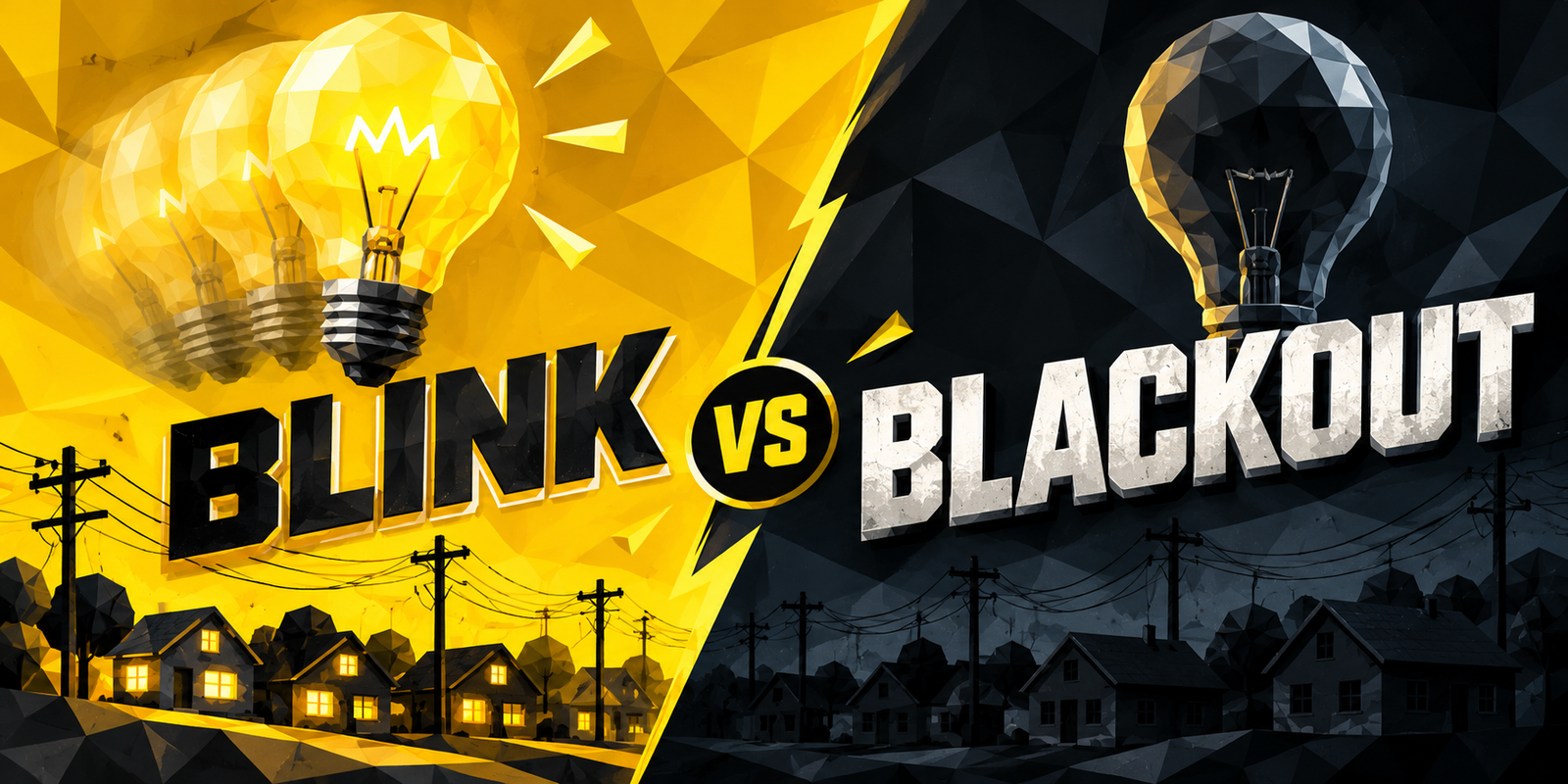
A momentary interruption is a short-duration loss of electric service, often associated with automatic protective-device operation and restoration, while a sustained interruption lasts long enough to be treated as a continuing service interruption under the applicable reliability definition. The momentary vs sustained interruption distinction looks like a matter of seconds versus minutes, but it shapes how events are recorded, counted, investigated and fixed.
The difference affects reliability reporting, customer experience, protection-system analysis, outage management, SAIFI, SAIDI, MAIFI and grid improvement decisions. A feeder with frequent brief interruptions has a different problem from one with a few long outages, and the remedies differ. This article compares the two, explains causes, protection behavior, detection and metrics, and shows how SCADA, OMS and AMI help classify and analyze them. Definitions and reporting thresholds vary by standard, utility practice and regulatory framework, so no single threshold is assumed here.
- Momentary interruptions are brief events.
- Sustained interruptions continue beyond the applicable momentary threshold.
- Protection and automatic reclosing can influence whether an event is momentary.
- SAIFI is associated with sustained interruption frequency in common reliability reporting frameworks.
- MAIFI is used for momentary interruption frequency.
- SAIDI focuses on interruption duration rather than interruption frequency.
What Is a Momentary Interruption?
A momentary interruption is a brief loss of electric service, typically restored automatically by protective equipment, that falls below the applicable threshold for a sustained interruption.
Typical behavior: protection detects a fault, a circuit breaker or recloser opens to clear it and then closes again, and service returns if the fault has gone. Fuse-related behavior can also cause brief interruptions in some schemes, where applicable. Customers often notice flickering lights, a brief blink or equipment that resets.
A momentary event is not necessarily harmless. It can trip or restart sensitive electronic equipment, disturb industrial processes, stop motors, upset automation systems and raise power-quality concerns, even though power returns quickly.
What Is a Sustained Interruption?
A sustained interruption is a loss of electric service that continues long enough to be treated as a continuing interruption under the applicable reliability definition.
Restoration usually needs more than automatic reclosing. It may involve field operations, fault isolation, switching to restore unaffected sections and repair of the failed equipment. Customers experience a longer outage and depend on the utility’s restoration work.
The duration threshold that separates momentary from sustained depends on the applicable definition or standard. One widely referenced methodology, IEEE Std 1366 for distribution reliability indices, uses a five-minute boundary, but other standards, utilities and regulators may differ, so the applicable edition and rule should be confirmed for any reporting use.
Momentary vs Sustained Interruption: Core Differences
| Attribute | Momentary Interruption | Sustained Interruption |
|---|---|---|
| Duration | Short | Longer |
| Typical restoration | Often automatic | Usually requires sustained restoration action |
| Protection operation | Common | May involve protection plus isolation and repair |
| Customer experience | Brief loss or flicker | Longer service outage |
| Reliability metric relevance | Momentary metrics such as MAIFI | SAIFI and SAIDI |
| Operational response | Often automatic | Often requires operational or field intervention |
Exact classifications depend on the applicable definitions.
Why Does Interruption Duration Matter?
Duration affects customer impact, industrial loads, critical facilities, digital systems, protection behavior, utility response, reliability metrics and restoration planning. A one-second loss may reset a controller, while an hour-long loss affects refrigeration, heating, operations and safety in different ways.
Frequency and duration are different dimensions. A customer can experience many short interruptions with little total time off, or one long interruption. This is why SAIFI and SAIDI provide different information, and why neither alone describes the customer experience.
Causes of Momentary Interruptions
Common causes are temporary faults, vegetation contact, lightning, animal contact, wind-related contact, temporary conductor contact, protection operation, automatic reclosing, distribution equipment events and transient faults. Many of these clear themselves once the protective device de-energizes the line briefly, for example when a branch falls away or an arc extinguishes.
Automatic reclosing works like this:
Fault occurs
A temporary short or contact.
Protection detects the fault
Relay or recloser control senses abnormal current.
Breaker or recloser opens
The faulted line is de-energized.
Fault clears
The temporary cause goes away.
Device recloses
Power is reapplied.
Service restored
The interruption is momentary.
This sequence can prevent a temporary fault from becoming a sustained interruption. For wider fault background, see this guide to causes of power grid failures.
Causes of Sustained Interruptions
Typical causes include permanent equipment failures, conductor faults, transformer failures, pole damage, cable failures, severe weather, vegetation damage, vehicle collisions, animal-related equipment damage, protection-system issues, distribution equipment failure and, where applicable, planned switching or maintenance. These conditions generally persist after the first trip, so continued restoration activity is needed.
Protection Systems and Automatic Reclosing
Key elements are circuit breakers and reclosers, which interrupt current, and protection relays and recloser controls, which detect faults and command operation. Trip operation opens the device, reclosing attempts to restore, and lockout stops further attempts when a fault persists.
Temporary fault: fault, detection, trip, reclose attempt, fault cleared, service restored.
Permanent fault: fault, detection, trip, reclose attempt fails, lockout, sustained outage, isolation, repair or switching, restoration.
The number of reclose attempts and the delays between them are settings that vary by utility and equipment. In a permanent fault, repeated attempts do not help, so the device locks out and the interruption becomes sustained. For protection and automation background, see this guide to power system automation, control, monitoring and data.
How Utilities Detect Momentary Interruptions
Detection draws on protection relays, breakers, reclosers, SCADA, distribution automation, intelligent electronic devices (IEDs), sensors, power-quality monitoring and, where supported, smart meters. Relays and IEDs record operations with timestamps, and sequence-of-events information helps show the order of trip and reclose. Power-quality monitors can capture brief voltage loss. Smart meters may record short outages in some configurations.
Not every utility has the same monitoring architecture, and some momentary events may not be captured consistently. They are harder to see than long outages, since customers rarely call about a blink.
How Utilities Detect Sustained Interruptions
Sustained interruptions are detected through OMS records, SCADA alarms, AMI and smart meter events, customer calls, field crews, distribution automation and GIS or network models. The network model links a device or meter to the customers it serves, so affected customers can be identified. Customer-level data, such as meter outage signals, can confirm who is without power and later confirm restoration.
Role of SCADA
SCADA can provide breaker status, recloser status, equipment alarms, fault indications, switching status and event timestamps. This supports operational awareness, because operators can see that a device tripped, reclosed or locked out. SCADA equipment status alone may not give the complete customer interruption picture. It shows device states, not necessarily how many customers lost power or for how long.
Role of AMI and Smart Meters
AMI can provide meter outage signals, restoration signals, last-gasp events where supported, customer-level visibility, event timestamps and communication status. It can complement OMS and SCADA by showing customer-level effects that device data does not.
It does not detect every interruption perfectly. Limits include communication gaps, battery or stored-energy limitations for last-gasp messages, event delivery delays, network availability and data quality. A meter that did not report may or may not have lost power. For related context, see this overview of how smart grid technology works from field devices to control systems.
Role of OMS
An outage management system consolidates outage information, estimates affected customers, tracks outage events, supports restoration, records restoration times, integrates customer information and supports reliability calculations. Sustained interruptions are especially relevant to OMS workflows because they involve crews, restoration tracking and customer communication. The OMS record is often the basis for SAIFI and SAIDI.
Momentary vs Sustained Interruptions and Reliability Metrics
| Metric | Main Dimension |
|---|---|
| SAIFI | Sustained interruption frequency |
| SAIDI | Sustained interruption duration |
| CAIDI | Duration per sustained customer interruption |
| MAIFI | Momentary interruption frequency |
SAIFI is primarily associated with interruption frequency for sustained interruptions under common reliability reporting approaches. SAIDI measures average customer interruption duration. CAIDI measures average duration per customer interruption. MAIFI characterizes momentary interruption frequency. Exact definitions and reporting methodologies, including how momentary events and major events are treated, can vary.
How Momentary Interruptions Affect Reliability
Frequent momentary interruptions can be a significant reliability and power-quality concern even when they do not appear in sustained-interruption metrics. Contributing factors include recloser operations, temporary faults, vegetation, lightning, animal contacts, equipment conditions and feeder design. Utilities may analyze momentary-event frequency separately, for instance by feeder, to find locations where customers see repeated blinks.
How Sustained Interruptions Affect Reliability
Sustained outages contribute to SAIFI, SAIDI, customer interruption records, outage duration and restoration workload. Repeated sustained interruptions on the same feeder may signal a recurring problem, such as aging equipment, exposure to vegetation or weather, or a weak point in the network, and justify investigation beyond restoring service each time.
Customer Impact: Momentary vs Sustained
| Type | Typical Impacts |
|---|---|
| Momentary | Brief loss, flickering, equipment resets, automation interruptions, process disturbances |
| Sustained | Longer loss of service, customer disruption, business interruption, critical-load impact, dependence on restoration |
The effect varies by customer and equipment. No monetary impact figures are given here.
Industrial and Commercial Systems
Industrial and commercial customers may be strongly affected by short interruptions because of motors, PLCs, industrial automation, data systems, manufacturing processes, HVAC, building automation and sensitive electronics. A process may need a restart after a brief loss even when power returned within moments. Sensitivity depends on system design, ride-through capability and protection, so two sites on the same feeder can see very different consequences.
Distribution Networks
These events occur on feeders, at reclosers, distribution transformers, switchgear, overhead lines, underground systems and substations. The chain is fault, protection, isolation and restoration. Overhead lines are more exposed to temporary faults such as contact and lightning, while permanent faults are common in cable and equipment failures. Network configuration, such as sectionalizing switches, affects how many customers a sustained fault affects. For background, see this comparison of transmission and distribution networks.
Reliability Data Flow
Electrical event
A fault or disturbance occurs.
Protection device
Relay, breaker or recloser operates.
SCADA, IED or recloser data
Device operations are recorded.
AMI, meter or sensor data
Customer-level and field evidence.
OMS
Outage records are consolidated.
Event classification
Momentary, sustained, planned or unplanned.
Customer impact analysis
Customers and durations are determined.
Reliability database
Records are stored.
SAIFI, SAIDI and MAIFI analysis
Indices are calculated.
Engineering decision
Corrective actions are prioritized.
Data Quality Challenges
Issues include missing events, duplicate events, incorrect timestamps, incorrect event classification, communication failures, incorrect customer mapping, incomplete restoration information, device clock differences, AMI communication delays, SCADA data gaps and OMS reconciliation issues. They matter because a few seconds of clock difference can change whether an event looks momentary, and a missing restoration time can lengthen an outage on paper. Poor data can distort reliability analysis and send corrective work to the wrong place.
Event Classification Challenges
A utility may need to distinguish momentary interruptions, sustained interruptions, planned and unplanned interruptions, equipment events, protection operations, communication events and restoration events. Classification rules matter because they determine which metric an event enters. Not every system uses identical event categories, so mapping between SCADA, AMI and OMS records needs care.
Momentary vs Sustained and SAIFI
SAIFI is generally used for sustained interruption frequency in common reliability reporting frameworks, and momentary interruptions are generally analyzed with momentary-interruption metrics such as MAIFI. Mixing the categories can distort analysis: counting momentary events in SAIFI would inflate it relative to peers that follow the standard definition, and leaving sustained events out of it would understate it. Utilities should state which methodology they use.
Momentary vs Sustained and SAIDI
SAIDI focuses on customer interruption duration. A momentary event may contribute little or nothing to sustained-interruption duration metrics, depending on the reporting methodology, while sustained interruptions can contribute materially to SAIDI. Treatment of events varies, and no universal regulatory rule is claimed here.
Momentary vs Sustained and Grid Resilience
Reliability describes expected service performance and the interruption experience. Resilience is the ability to prepare for, withstand, adapt to and recover from disruptive events. Momentary and sustained interruption data both provide useful operational information, but neither alone defines resilience, which also depends on preparation, redundancy, recovery capability and response to extreme events.
Role of Grid Modernization
Technologies that can improve visibility and restoration include smart meters, AMI, distribution automation, FLISR (fault location, isolation and service restoration), sensors, digital substations, ADMS, advanced communications and real-time analytics. Automation can sometimes reduce outage duration or the number of customers affected, for example by switching healthy sections back on. This does not mean every technology improves every metric, and results depend on design, settings and conditions. For wider context, see this guide to grid modernization and electricity data.
AI and Analytics for Interruption Analysis
Potential applications include event classification, pattern detection, repeat interruption analysis, fault-location support, reliability trend analysis, weather correlation, asset-risk analysis, feeder prioritization and predictive maintenance. It helps to distinguish four things:
- Detection: noticing that something happened.
- Classification: deciding what type of event it was.
- Prediction: estimating what may happen.
- Root-cause analysis: determining why it happened.
AI is an analytical support tool. It does not replace protection systems or engineering judgment.
Practical Hypothetical Examples
All examples below are hypothetical and illustrate concepts only.
Example 1, momentary: a temporary fault occurs on a feeder, the recloser opens, the fault clears, the recloser recloses and service returns within moments. Customers see a blink, and the event is classified as a momentary interruption under the applicable definition.
Example 2, sustained: a permanent fault occurs, the recloser trips, attempts to reclose, finds the fault still present and locks out. Customers remain without service until crews isolate the faulted section, switch to restore unaffected customers and repair the damage. This is a sustained interruption.
Example 3, repeated momentary events: one feeder shows many momentary events over a period. The utility investigates vegetation, protection settings and equipment conditions, since recurring blinks suggest a persistent cause even though no single event is long.
Engineering Investigation Framework
- Detect: identify the event from device, meter or customer data.
- Classify: momentary or sustained, planned or unplanned.
- Validate: check timestamps, duplicates and mapping.
- Locate: narrow the affected section.
- Identify cause: use field findings, protection records and conditions.
- Assess customer impact: count customers and durations.
- Review reliability metrics: see how the event affects indices.
- Prioritize corrective action: rank by impact and feasibility.
- Monitor recurrence: confirm the fix worked.
Common Mistakes
- Treating all interruptions as the same.
- Assuming a short event is automatically harmless.
- Confusing SAIFI with MAIFI.
- Confusing SAIDI with SAIFI.
- Ignoring automatic reclosing.
- Ignoring event timestamps.
- Ignoring communication failures.
- Assuming AMI detects everything.
- Comparing metrics without understanding methodology.
- Treating every abnormal event as an equipment fault.
Limitations
- Definitions can vary.
- Data quality affects analysis.
- Customer-level visibility is not always complete.
- Momentary events may be harder to capture consistently.
- Communication systems can introduce delays.
- Reliability metrics do not explain root causes by themselves.
- A system-wide average can hide local feeder problems.
Utility Improvement Strategies
For momentary interruptions: vegetation management, protection coordination, recloser settings, equipment maintenance, animal mitigation, feeder design improvements and fault-location improvements.
For sustained interruptions: asset replacement, automation, FLISR, switching improvements, vegetation management, weather hardening, faster restoration and better outage visibility.
No strategy will always work. The right choice depends on local causes, costs and network design.
Current, Emerging and Future Technologies
| Maturity | Technologies |
|---|---|
| Current | SCADA, OMS, AMI, reclosers, protection relays, distribution automation |
| Emerging | AI-assisted event classification, advanced outage analytics, better AMI/OMS integration, real-time reliability dashboards, advanced feeder monitoring |
| Future / potential | More automated event interpretation, integrated grid data platforms, predictive reliability intelligence, more granular customer-level analytics |
Future concepts are potential developments, not guaranteed capabilities.
Comparison Table: Complete Summary
| Factor | Momentary Interruption | Sustained Interruption |
|---|---|---|
| Definition | Short-duration interruption under applicable definition | Longer interruption meeting sustained-event criteria |
| Typical cause | Temporary fault | Permanent or continuing fault |
| Restoration | Often automatic | Usually requires continued restoration action |
| Protection | Reclosing commonly involved | Lockout and isolation may occur |
| Customer impact | Brief disruption | Extended loss of service |
| Reliability metric | MAIFI or related momentary measures | SAIFI, SAIDI, CAIDI |
| Utility response | Automated or limited intervention | Operational and/or field response |
| Analysis focus | Frequency, protection behavior, power quality | Frequency, duration, restoration, root cause |
Exact classification depends on the applicable standard or reporting methodology.
Frequently Asked Questions About Momentary vs Sustained Interruptions
What is momentary vs sustained interruption?
A momentary interruption is a brief loss of service, often cleared by automatic protection and reclosing, while a sustained interruption lasts long enough to count as a continuing outage under the applicable definition.
The exact dividing duration depends on the standard, utility practice and regulatory framework, so it should be confirmed for each use.
How does momentary vs sustained interruption work?
When a fault occurs, protection opens a breaker or recloser. If the fault was temporary and clears, the device recloses and service returns, giving a momentary interruption. If the fault persists, the device locks out and restoration needs isolation, switching or repair, giving a sustained interruption.
The classification then follows the applicable duration threshold.
Why is momentary vs sustained interruption important?
The distinction affects reliability metrics, protection analysis, customer experience and corrective action. Momentary events point to temporary faults and power-quality issues, while sustained events point to restoration and equipment problems.
Mixing them can distort SAIFI, SAIDI and MAIFI and send improvement effort to the wrong place.
What are the main components of momentary vs sustained interruption?
The main components are the fault, protective devices such as breakers, relays and reclosers, detection systems such as SCADA, AMI and OMS, classification rules and reliability metrics. Restoration actions, isolation and switching apply to sustained events.
Network models and customer mapping link events to affected customers.
What are the challenges of momentary vs sustained interruption?
Challenges include varying definitions, missing or duplicate events, timestamp differences between devices, communication delays and incorrect customer mapping. Momentary events are harder to capture consistently, and system-wide averages can hide local feeder problems.
Clear classification rules and data reconciliation across SCADA, AMI and OMS help.
Where is momentary vs sustained interruption used?
The distinction is used in reliability reporting, outage management, protection and reclosing studies, feeder analysis, power-quality assessment, customer impact analysis and improvement planning. It is mainly applied to distribution systems.
Utilities, engineers and regulators use it to compare performance and prioritize reliability work, following the applicable methodology.
What is the difference between SAIFI, SAIDI and MAIFI?
SAIFI measures how often the average customer experiences sustained interruptions, SAIDI measures the average total duration of sustained interruptions, and MAIFI measures how often momentary interruptions occur. CAIDI relates duration to the number of interruptions.
Exact definitions and event treatment vary by standard and reporting methodology.
How do utilities detect and classify momentary and sustained interruptions?
Utilities use protection relays, reclosers, SCADA, IEDs, power-quality monitors, AMI meter events, OMS records, customer calls and field reports, linked through network models. Timestamps and sequence-of-events data help show whether service returned automatically.
Classification applies the utility’s duration criteria and rules, and data quality checks improve accuracy.
Conclusion
Momentary and sustained interruptions are different reliability events. Momentary interruptions are commonly associated with temporary faults and automatic protection and reclosing, while sustained interruptions continue long enough to be treated as sustained under the applicable methodology. SAIFI and SAIDI primarily help analyze sustained interruption frequency and duration, and MAIFI or related measures help analyze momentary interruption frequency.
SCADA, OMS, AMI and modern sensors improve event visibility, and good data quality is essential to using them well. Utilities should analyze both event types when evaluating distribution reliability, because each shows a different side of the customer experience and points to different corrective action.

I share real stories, practical ideas and honest perspectives on business, marketing and life. This blog is a space to learn, grow and connect.