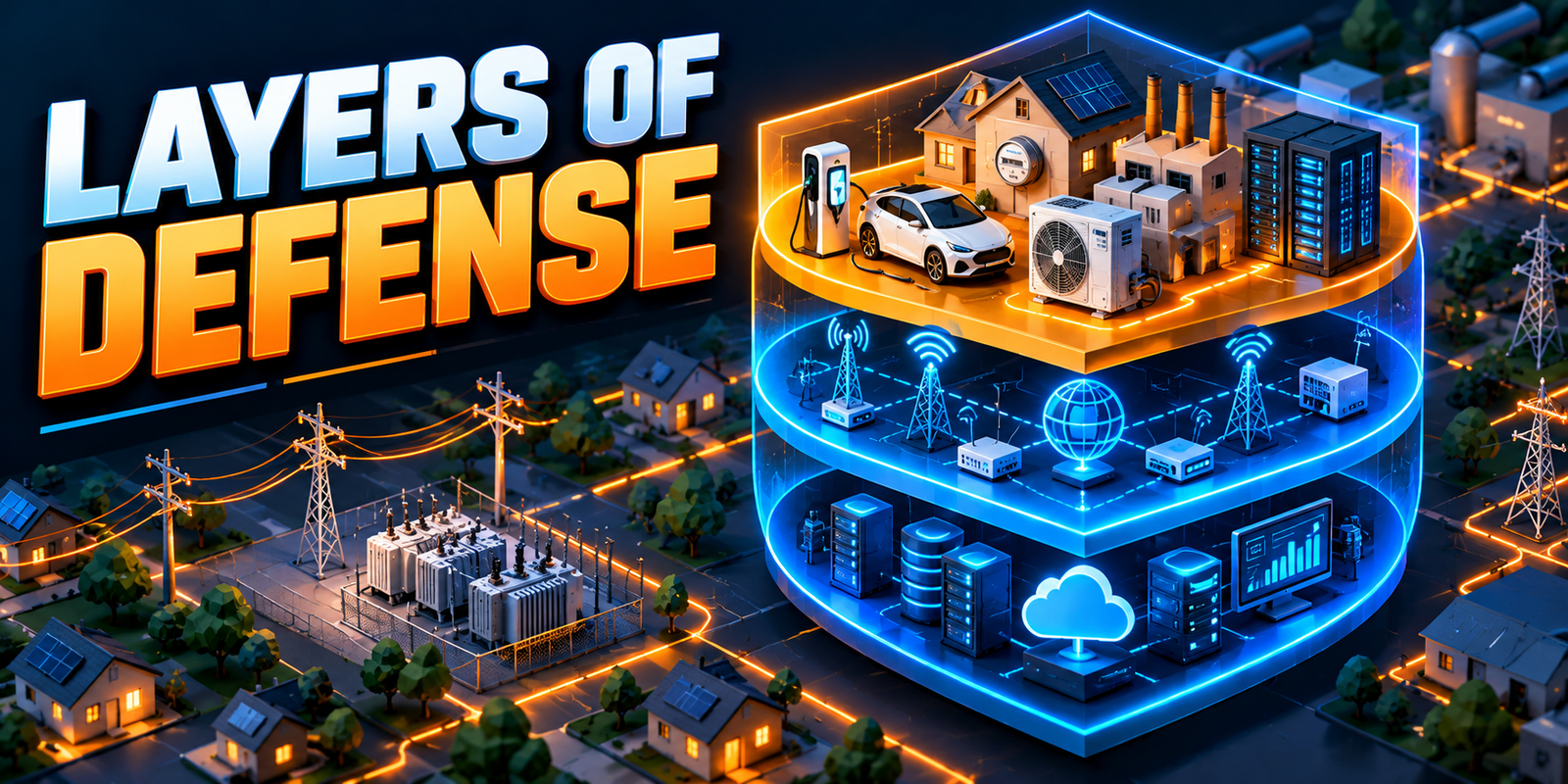

AI in the electricity industry is applied to four broad jobs: forecasting what demand and generation will be, detecting unusual conditions and events, optimizing decisions under constraints, and automating defined workflows where it is safe to do so. The strongest applications involve large datasets, pattern recognition, prediction and optimization. Utilities use them for forecasting, anomaly detection, asset management, planning and decision support.
Maturity varies. Load forecasting and anomaly detection are established, while real-time AI, advanced asset models and closed-loop automation are emerging or limited to controlled uses. Where the companion article on AI in electric utilities explains the broad transformation, this one asks where AI is applied, and what it does in each application.
Key Takeaway
- Forecasting covers load, renewables and EV demand.
- Detection covers anomalies, faults and events.
- Optimization seeks better decisions under constraints.
- Automation executes defined actions, usually with AI as an input.
- AI supports asset management, outage management, renewable integration, smart meter analytics and planning.
- Human-in-the-loop decision support remains the norm.
- Maturity differs by utility, use case and available data.
What Are AI Applications in the Electricity Industry?
AI applications in the electricity industry use algorithms and models to process power-system data and support prediction, classification, anomaly detection, optimization, pattern recognition, decision support and, where appropriate, automation.
Data -> Processing -> AI / ML Model -> Prediction / Detection / Optimization
-> Decision Support -> Utility Workflow
The progression used throughout is: electricity industry data, then AI/ML, then forecasting, detection and optimization, then decision support, then automation where appropriate, with human and engineering oversight.
Why AI Is Important for the Electricity Industry
The drivers include increasing data volumes, complex power systems, renewable integration, DER growth, EV adoption, aging infrastructure, changing demand, extreme weather, operational complexity, predictive maintenance needs and growing planning requirements. No market statistics are given because adoption differs by region and utility.
AI Application Map
| AI Application | Utility Area | Example Data | Typical Output | Primary Value |
|---|---|---|---|---|
| Load forecasting | Operations, planning | Load, weather | Demand forecast | Scheduling and planning |
| Renewable forecasting | Generation, operations | Weather, output | Generation forecast | Balancing |
| Anomaly detection | AMI, operations | Time series, events | Anomaly scores | Prioritized review |
| Fault / event detection | Transmission, distribution | SCADA, IED records | Event class | Faster analysis |
| Predictive maintenance | Assets | Condition, history | Maintenance risk | Work planning |
| Asset health | Assets | Inspection, loading | Health score | Investment prioritization |
| Outage detection | Outage management | AMI, SCADA, OMS | Outage hypothesis | Faster awareness |
| Restoration analysis | Outage management | Restoration events | Verification list | Complete restoration |
| Grid optimization | Operations | Network, load | Recommended settings | Better decisions |
| Voltage optimization | Distribution | Voltage profiles | Control recommendations | Voltage management |
| DER optimization | DER | DER output, load | Schedules | Integration |
| Demand response | Customer programs | Load profiles | Targets, baselines | Peak planning |
| EV load forecasting | Planning | Charging, load | Charging forecast | Feeder planning |
| Customer / load segmentation | Customer analytics | Load shapes | Segments | Program design |
| Smart meter analytics | AMI | Interval data | Patterns, exceptions | Insight |
| Power quality analytics | Distribution | Voltage, harmonics | Disturbance classes | Quality monitoring |
| Vegetation / weather risk | Risk management | Imagery, weather, GIS | Risk maps | Inspection priority |
| Distribution planning | Planning | History, DER, EV | Growth scenarios | Planning input |
Application 1: Load Forecasting
AI supports short-term, medium-term and long-term planning forecasts, peak demand prediction, feeder forecasting and customer-class forecasting. Inputs include historical load, weather, calendar effects, seasonality, customer behavior, DER generation, EV charging, storage and demand response. Model families include regression, time-series models, tree-based models, neural networks and hybrids. No accuracy figures are given, because results depend on data and method. Forecasts are estimates and weaken during unusual events.
Application 2: Renewable Energy Forecasting
AI supports solar forecasting, wind forecasting, generation prediction, net-load forecasting and uncertainty estimation. Inputs include weather forecasts, historical generation, irradiance, wind conditions and seasonal patterns. These forecasts matter because variable output must be balanced in operations and anticipated in planning, and ranges are often more useful than single values.
Application 3: Anomaly Detection
AI can detect unusual behavior in smart meter data, SCADA data, sensor data, equipment measurements, load patterns and communication signals. Methods include statistical detection, unsupervised learning, supervised classification, time-series anomaly detection and hybrid approaches. An anomaly is not a confirmed fault, fraud or equipment failure. It is a prompt for validation and investigation. See AI-based anomaly detection for smart meter data.
Application 4: Fault and Event Detection
AI may assist with fault and event classification, disturbance detection, equipment event analysis, waveform analysis where suitable data exists and event prioritization. It works alongside protection systems, SCADA, PMUs where available, IEDs and DMS/ADMS, using their records after or between operations. AI analytics does not replace protection systems, which act on dedicated devices designed for speed and dependability.
Application 5: Predictive Maintenance
| Aspect | Traditional | Condition-Based | Predictive |
|---|---|---|---|
| Trigger | Fixed schedule | Measured condition | Estimated future risk |
| Data | Basic records | Condition measurements | History, measurements, context |
| Method | Calendar rules | Thresholds and trends | Models and ML |
| Limitation | Over- or under-maintenance | Needs instrumentation | Needs good data, gives estimates |
AI can combine sensor data, operating conditions, asset age, historical failures, maintenance records, environmental data and loading to estimate maintenance risk. It cannot predict failures perfectly.
Application 6: Asset Health Management
AI-supported assessment covers transformers, circuit breakers, switchgear, cables, transmission lines, distribution equipment and generators.
Asset Data -> Features -> AI Model -> Health / Risk Score -> Engineering Review -> Maintenance / Investment Decision
Scores rank assets for attention. Engineers review them against inspection findings before decisions are made.
Application 7: Outage Detection
AI can support detection using AMI events, smart meter data, SCADA events, OMS data, communication patterns and geographic or network information.
Data -> Event Detection -> Pattern Recognition -> Outage Hypothesis -> Validation -> OMS / Operator Workflow
Detection is not outage management or fault clearing. It raises awareness, while crews and operators handle isolation and repair. See how smart meter data supports grid operations.
Application 8: Restoration Analytics
AI can support restoration verification, customer impact analysis, event correlation, identification of unresolved outages and restoration prioritization. Limits include communication delays, incomplete data, meter availability and network failures, so a meter that has not reported does not prove it is still without power.
Application 9: Grid Optimization
Optimization is a core theme. AI and optimization techniques may support load balancing, network operation, voltage management, DER coordination, demand response, storage scheduling, EV charging and renewable integration. Prediction estimates what will happen, while optimization seeks better decisions under constraints such as limits, costs and reliability requirements. A forecast is an input, and an optimized schedule is a recommendation within those limits.
Application 10: Voltage Optimization
Applications consider voltage profiles, load conditions, DER behavior, capacitor control, voltage regulation and inverter-based resources where applicable. AI is best described as decision support or optimization that recommends settings, and not as direct autonomous control, unless a utility has deliberately engineered and approved that.
Application 11: DER Optimization
AI and optimization support rooftop solar, battery storage, distributed generation, flexible loads and demand response through forecasting, scheduling, coordination, net-load management and uncertainty handling. Uncertainty is substantial because output depends on weather and customer behavior, so schedules should allow for forecast error.
Application 12: Demand Response
AI can support demand prediction, customer and load segmentation, event forecasting, load flexibility estimation, program optimization and peak reduction planning. It does not automatically change customer behavior. Participation, incentives and device controls determine actual response.
Application 13: EV Load Forecasting
AI supports charging demand forecasting, charging pattern analysis, peak impact assessment, managed charging and feeder and distribution planning. Not all smart meters can directly identify EV charging. Additional data or inference from load shape may be needed, and inferred results are estimates.
Application 14: Battery Storage Optimization
Potential applications include charge and discharge forecasting, scheduling, peak shaving, load shifting, renewable integration and state-of-charge prediction where suitable data exists. Operational constraints matter: power and energy limits, degradation, safety limits, market or tariff rules and network conditions.
Application 15: Smart Meter Analytics
AI can analyze consumption patterns, interval data, meter events, exceptions, anomalies, load profiles and forecasting inputs. Typical AI roles are clustering load shapes, ranking exceptions, detecting pattern changes and producing consumption forecasts. This article stays on the AI applications. The full picture is in smart meter data analytics and the future of smart meter analytics.
Application 16: Power Quality Analytics
AI may analyze voltage, current, harmonics, frequency, power factor and waveform data to classify disturbances or find recurring problems. Measurement availability varies. Standard smart meters do not always provide high-resolution waveform data, which generally needs dedicated power quality instruments.
Application 17: Vegetation and Weather Risk
AI can use satellite imagery, drone imagery, weather data, GIS, historical outage data and asset location to support vegetation risk analysis, storm impact prediction, wildfire-risk analysis where relevant, asset exposure assessment and inspection prioritization. Outputs are risk indicators whose quality depends on imagery, data currency and local validation.
Application 18: Distribution Planning
AI supports load growth forecasting, feeder analysis, transformer planning, DER, EV and storage planning and scenario analysis. It supports planning but does not replace engineering studies and network constraint checks.
Application 19: Transmission Planning
Possible applications include load forecasting, renewable integration studies, congestion analysis where applicable, asset risk, outage scenario analysis, maintenance planning and system planning support. AI can help screen scenarios and rank risks, and formal planning studies remain the basis for decisions.
Application 20: Generation Operations
Where relevant, AI supports generation forecasting, renewable forecasting, equipment condition monitoring, dispatch decision support, maintenance planning and efficiency analytics. Dispatch remains governed by market rules, operating limits and operator responsibility, and this article makes no claim about autonomous dispatch.
Application 21: Customer and Load Analytics
AI supports customer and load segmentation, consumption forecasting, demand response targeting, program analytics and energy efficiency analytics. Avoid sensitive or intrusive profiling, minimize personal data and use segments for planning rather than judgments about individuals.
Application 22: Operational Decision Support
AI can help operators and engineers prioritize alerts, summarize events, rank risks, compare scenarios, forecast conditions and identify unusual patterns.
Data -> AI -> Insight -> Human Review -> Decision -> Action
Human-in-the-loop design keeps responsibility with qualified staff.
Application 23: Automation
Automation is the fourth core theme, and it comes in levels:
- Level 1, AI-assisted analysis: AI helps people analyze data.
- Level 2, AI-assisted recommendations: AI suggests actions for human approval.
- Level 3, Automated workflow: AI output triggers routine steps such as tickets or notifications.
- Level 4, Closed-loop automation in controlled applications: automated action within narrowly defined, tested limits.
- Level 5, Highly autonomous decision systems: broad autonomous decisions. This is not currently standard.
Higher levels need stronger validation, reliability, cybersecurity, explainability, fail-safe mechanisms, regulatory controls and human oversight.
AI vs Automation
| Aspect | AI | Automation | AI-Assisted Automation |
|---|---|---|---|
| Core idea | Intelligence, prediction, pattern recognition | Executing defined actions | AI provides input to an automated workflow |
| Example | Forecast of tomorrow’s peak | Scheduled switching sequence | Forecast informing an automated schedule |
| Behavior | Learns from data | Follows rules | Combines both |
| Main risk | Wrong or uncertain output | Rigid rules | Errors propagating into action |
AI Model Types Used in Electricity Applications
| Model Type | Common Application | Strength | Limitation |
|---|---|---|---|
| Regression | Load estimation | Simple and interpretable | Limited for complex patterns |
| Classification | Event and fault typing | Clear categories | Needs labeled data |
| Clustering | Load segmentation | No labels needed | Needs interpretation |
| Time-series models | Load and renewable forecasting | Captures seasonality | Sensitive to structural change |
| Tree-based models | Asset risk scoring | Handles mixed data | Can overfit |
| Neural networks | Complex forecasts, imagery | Learn complex patterns | Data-hungry, harder to explain |
| Anomaly detection | Meter and sensor monitoring | Needs few failure labels | Unusual is not faulty |
| Optimization algorithms | Scheduling, DER coordination | Best choice under constraints | Depends on accurate models |
| Hybrid models | Rules plus ML detection | Balance of transparency and flexibility | More to maintain |
No algorithm is universally best.
End-to-End AI Application Architecture
Field Devices / Sensors / Meters
 | SCADA / AMI / IoT / Utility Systems
 | Data Ingestion | Data Quality | Data Platform
 | Feature Engineering | AI / ML
 | Prediction / Detection / Optimization
 | Decision Support
 | Automation / Utility Workflow
 v Human / Operational Oversight
Devices and systems generate data, ingestion and quality layers prepare it, features feed models, outputs reach decision support, and workflows act under human oversight. Designs differ by utility.
Data Requirements
| Application | Main Data Required |
|---|---|
| Forecasting | Historical load, weather, calendar |
| Anomaly detection | Time-series measurements, events |
| Predictive maintenance | Condition, maintenance and failure history |
| Outage detection | AMI, SCADA and OMS events |
| DER optimization | DER output, load, network constraints |
| EV forecasting | Charging or load data, temporal patterns |
| Asset health | Sensor, inspection and maintenance data |
Data Quality and AI
Poor Data -> Unreliable Features -> Unreliable Models -> Unreliable Decisions
Typical problems are missing data, duplicates, timestamp errors, communication gaps, incorrect metadata, sensor errors and changing system configuration. Validation checks and ongoing monitoring catch them early. For meter data, see smart meter data quality.
Model Validation and Performance
- Forecasting: MAE, RMSE and, where appropriate, MAPE.
- Classification: precision, recall and F1.
- Anomaly detection: false positives, false negatives and detection latency.
- Optimization: constraint satisfaction, objective performance and operational feasibility.
No benchmark numbers are given, since targets depend on the use case. Validate on data the model has not seen.
Explainable AI
“Risk score = 0.88” is hard to act on. A better output is: “The model identifies increased asset risk based on recent loading, temperature behavior and condition indicators.” Useful explanations include feature importance, reason codes, confidence, supporting signals and historical comparison.
Model Drift
Models can degrade because of EV adoption, solar growth, storage, new tariffs, changing demand, weather, equipment changes and network changes.
Monitor -> Detect Drift -> Review -> Retrain / Adjust -> Validate
Drift response is a managed process, and models do not adapt on their own.
Challenges of AI Applications in Electricity
Challenges include data quality, data silos, limited labeled data, limited failure history, interoperability, explainability, model drift, false positives and negatives, cybersecurity, privacy, integration, computational requirements, workforce skills, governance, regulatory requirements, vendor dependence and change management. See smart grid deployment challenges.
Current vs Emerging AI Applications
| Application | Current / Established | Emerging | Future / Experimental |
|---|---|---|---|
| Forecasting | Load forecasting with ML | Multi-input, DER-aware | Highly granular integrated forecasts |
| Anomaly detection | Rules and statistical methods | ML, contextual detection | Real-time contextual scoring |
| Predictive maintenance | Pilots, condition monitoring | Advanced asset models | Increasingly autonomous asset management |
| Outage detection | AMI event analysis | AI-assisted outage grouping | Automated outage workflows |
| Optimization | Scheduling tools | AI-assisted optimization | Broad closed-loop optimization |
| Smart meter analytics | Load and event analytics | ML-based exception ranking | Adaptive near-real-time intelligence |
| Renewable forecasting | Established | Probabilistic forecasts | Fully integrated forecasting |
| DER optimization | Basic scheduling | DER-aware AI | Large-scale coordinated optimization |
| EV forecasting | Scenario-based | Data-driven charging models | Fine-grained managed charging |
| Image-based inspection | Established in use | Better automated analysis | Autonomous inspection support |
| Real-time AI | Selective | Expanding | Pervasive |
| Edge AI | Limited | Pilots | Large-scale deployment |
| Autonomous decision support | Rare | Limited pilots | Experimental |
Practical Implementation Roadmap
- Identify the business problem.
- Define a measurable objective.
- Identify available data.
- Assess data quality.
- Establish governance.
- Select the AI method.
- Build a baseline.
- Train the model.
- Validate.
- Pilot.
- Establish human oversight.
- Integrate with utility systems.
- Monitor performance.
- Monitor model drift.
- Scale successful applications.
Start with high-value, measurable use cases, and prove the value of a simple baseline before reaching for a complex model.
Illustrative Example: Forecasting
Hypothetical example. It describes no real utility, accuracy or financial result.
A utility wants to improve short-term demand forecasting.
Historical Load + Weather + Calendar + DER / EV Factors
 -> Feature Engineering -> AI Forecast Model -> Forecast
 -> Validation -> Operator / Planner Decision Support
The forecast is compared with actual load, reviewed by planners and used as an input to scheduling.
Illustrative Example: Asset Management
Hypothetical example. It names no real utility and gives no statistics.
A utility combines transformer condition information with loading and historical maintenance records.
Asset Data -> Feature Engineering -> AI Risk Model -> Risk Score
 -> Engineer Review -> Maintenance Prioritization
Engineers review the highest-ranked transformers and decide what to inspect or maintain first.
Benefits of AI Applications
Potential benefits include faster analysis, better forecasting, earlier detection, better maintenance prioritization, improved planning, improved operational visibility, better use of large datasets and stronger decision support. These are possibilities, not guarantees. AI does not ensure zero outages, perfect predictions, perfect fault detection or automatic cost savings.
Limitations
AI depends on data and can be wrong. Models can drift, unusual conditions can challenge them, explainability can be difficult and integration can be complex. High-impact decisions need human oversight.
Future of AI Applications in the Electricity Industry
Current: forecasting, anomaly detection, image-based inspection and customer analytics.
Emerging: real-time AI, AI-assisted operations, advanced DER optimization and AI-assisted planning.
Future: edge AI at scale, advanced digital twins, multimodal AI, predictive grid intelligence, autonomous inspection and increasingly automated workflows.
These future items are expected directions, not universal deployments. See future smart grid technology and AI in smart grids.
Key Takeaways
- Forecasting, detection, optimization and automation are the four core application pillars.
- Asset management and predictive maintenance rank assets and work using condition data.
- Outage management uses AI for detection and analysis, not fault clearing.
- Renewable and DER integration depend on forecasting and optimization.
- Smart meter analytics and planning benefit from AI at scale.
- Human oversight remains central, and higher automation needs stronger safeguards.
Conclusion
AI’s value in the electricity industry comes from applying the right analytical method to the right utility problem. The strongest application areas are forecasting, detection, optimization, automation, asset management, planning and operational decision support.
AI should complement engineering expertise, established utility systems and safety controls rather than replace them.
Frequently Asked Questions About AI in the Electricity Industry
What is AI in the electricity industry?
AI in the electricity industry is the use of artificial intelligence and machine learning to analyze power-system data and support forecasting, anomaly detection, optimization, asset management and planning.
It generally provides decision support to engineers and operators, with automation limited to controlled applications. It does not replace protection systems or engineering judgment.
How does AI work in the electricity industry?
Data from meters, SCADA and sensors is ingested, quality-checked and turned into features. AI/ML models then produce forecasts, detections or optimized recommendations, which appear in decision-support tools and utility workflows.
Engineers review results, and models are validated and monitored for drift so they stay reliable as conditions change.
Why is AI important in the electricity industry?
Power systems now handle large data volumes, renewable and DER growth, EV load, aging assets and extreme weather. AI can analyze this data at scale to forecast conditions, detect unusual behavior and prioritize maintenance and planning.
Value depends on data quality and validation. AI supports skilled staff and does not guarantee outcomes.
What are the main applications of AI in the electricity industry?
The main applications fall into forecasting, detection, optimization and automation. Examples include load and renewable forecasting, anomaly and event detection, predictive maintenance, asset health scoring, outage analysis, DER and storage optimization, EV forecasting and planning support.
Maturity varies, with forecasting well established and real-time AI and closed-loop automation still emerging.
What are the challenges of using AI in the electricity industry?
Challenges include poor data quality, data silos, limited failure and labeled data, integration, explainability, model drift and false positives and negatives. Cybersecurity, privacy, governance, regulation, workforce skills and vendor dependence also matter.
Careful validation, human oversight and ongoing monitoring help utilities manage these risks.
Where is AI used in the electricity industry?
AI is used across generation, transmission, distribution, grid operations, outage management, asset management, AMI and smart meter analytics, customer analytics, DER and renewable integration, EV planning and storage.
It also supports power quality analysis, weather risk assessment and planning. Actual use depends on each utility’s data, systems and priorities.
How is AI used for electricity forecasting?
AI models learn from historical load or generation together with weather, calendar, seasonal and, increasingly, DER and EV inputs to predict future demand or output. Methods include time-series models, tree-based models, neural networks and hybrids.
Forecasts are estimates with uncertainty and are validated against actual results. Planners and operators use them for decision support.
How is AI used for electricity grid optimization and automation?
Optimization methods use forecasts and network data to recommend better schedules, voltage settings or DER and storage dispatch within constraints. Automation then executes defined actions, sometimes using AI output as an input.
Most uses remain recommendations reviewed by people. Closed-loop automation is limited to controlled applications with strong safeguards, validation and cybersecurity.

I share real stories, practical ideas and honest perspectives on business, marketing and life. This blog is a space to learn, grow and connect.