The future electric grid is the electricity system as it is expected to evolve over the coming decade: more digital, more distributed, more automated and more data-driven than the grid of the past. Today’s grid still follows a familiar pattern, in which large power plants generate electricity, transmission lines carry it at high voltage, and distribution networks deliver it to customers. That model is being stretched by new demands and new technology.
Electricity demand is rising in many regions because of electric vehicles, data centers, heat electrification and industrial change. Renewable energy, rooftop solar and batteries are adding generation at the edges of the network. Digitalization, AI and smart grid technologies give utilities new ways to see and manage these changes, which makes better visibility and automation more important. This article explains how the grid works today, what is changing, and what the electric grid could look like by 2035. It separates technologies already in use from developments that are still expected or emerging. It builds on our overview of electricity transmission and distribution.
The future electric grid is expected to become more digital, flexible, distributed, automated and data-driven as electricity demand grows and more distributed energy resources connect to the network. Many of the underlying technologies, such as smart meters, SCADA and sensors, already exist. The change lies in how widely they are deployed and how well they are integrated. The pace will differ between utilities and regions, and engineers and operators will remain responsible for safe and reliable operation.
What Is the Future Electric Grid?
The future electric grid is an evolving electricity system that combines physical infrastructure with digital measurement, communication, automation and analytics so that it can handle rising demand, two-way power flows and distributed resources.
It is a direction of change, not a single technology or a fixed design. Different utilities will adopt different elements at different speeds. The main building blocks include:
- Digital infrastructure: Devices and networks that measure, communicate and control.
- Two-way electricity flows: Power moving from customers to the grid as well as from the grid to customers.
- Distributed energy resources (DERs): Rooftop solar, batteries and other small-scale resources.
- Smart meters and sensors: Sources of detailed network and customer data.
- Digital substations and automation: Intelligent devices that protect, control and report.
- Real-time monitoring and analytics, including AI/ML: Tools that turn data into insight.
- Flexible demand and energy storage: Ways to shift or absorb energy.
- Renewable energy integration: Managing variable wind and solar output.
Why Is the Electric Grid Changing?
The grid is changing because several pressures are arriving together. No single factor explains it, and their relative weight differs between regions.
- Rising electricity demand: Growth in new loads raises the amount of power networks must carry.
- Electrification of transportation: Electric vehicles add charging load.
- Data centers and digital infrastructure: Large, constant loads concentrate in specific locations.
- Industrial electrification: Processes that once used fuel are moving to electricity.
- Renewable generation: Wind and solar vary with weather and are often far from demand.
- Distributed energy resources: Generation and storage now connect at distribution level.
- Battery energy storage: Storage adds flexibility and new operating questions.
- Extreme weather and resilience: Utilities must withstand and recover from severe events. See our guide to power grid failure causes.
- Aging infrastructure: Older equipment needs closer monitoring and eventual replacement.
- Customer participation: Customers increasingly generate, store and shift energy.
- Reliability expectations: Customers and regulators expect fewer and shorter outages.
- Need for real-time visibility: Complex networks are harder to run without live information.
How Will the Future Electric Grid Work?
The future electric grid is expected to work like today’s grid at its core, with added two-way flows of both power and information. The familiar physical chain remains.
Generation
Large plants, wind and solar farms produce electricity.
Transmission
High-voltage lines move bulk power over long distances.
Distribution
Medium- and low-voltage networks deliver power locally.
Customers
Homes, businesses and industries use the electricity.
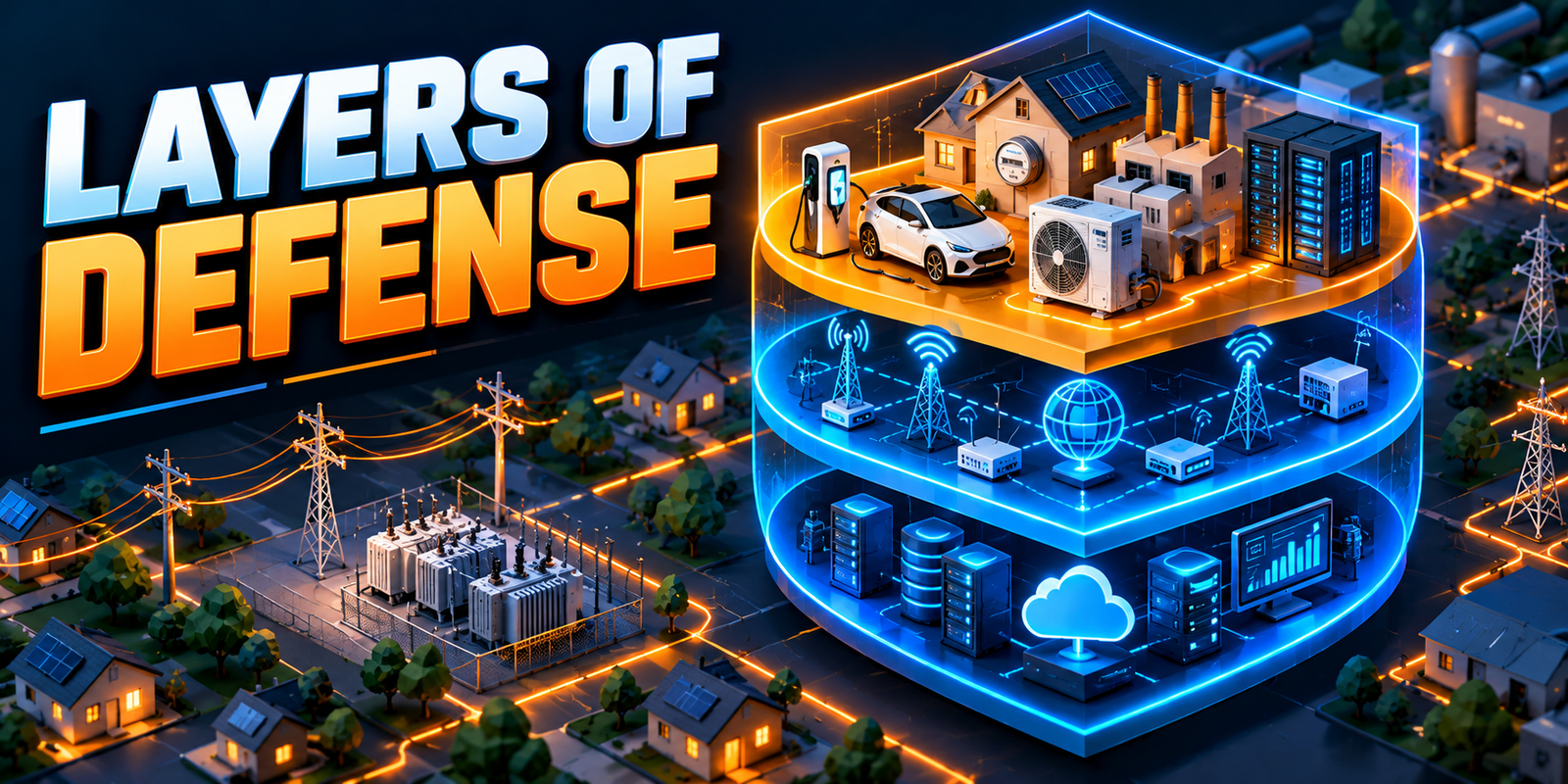
Several elements are layered onto this chain.
- Distributed energy resources and energy storage: Local solar and batteries feed power into distribution networks, so flows can reverse.
- Smart meters and sensors: Report usage, voltage and equipment conditions.
- Communication networks: Carry data and commands.
- SCADA, EMS and DMS: Supervisory and management systems used by operators.
- AI/ML analytics and automated control: Support forecasting, decisions and well-defined automatic actions.
- Consumers and prosumers: Customers who consume, and sometimes also produce, electricity.
Information moves in both directions as well. Field devices send measurements up to control systems, and control systems send commands and signals back down to equipment and flexible resources.
What Are the Main Components of the Future Electric Grid?
The table lists key components. Most exist today, and the future change is mainly in scale and integration.
| Component | Role | Why it matters |
|---|---|---|
| Smart meters / AMI | Record interval usage and communicate it | Extend visibility to the customer edge |
| Grid sensors | Measure voltage, current, temperature and condition | Provide the data that visibility depends on |
| Digital substations | Digitize measurement, protection and control | Make substations rich data and automation nodes |
| SCADA | Supervise and control remote equipment | Gives operators a central view |
| IEDs | Protect, measure, control and record | Do the local work of automation |
| Distribution automation | Monitor and operate feeders remotely | Speeds fault response and restoration |
| Energy storage | Absorb and release energy | Adds flexibility and support |
| Distributed energy resources | Generate or store power locally | Change power flows and add options |
| Communication networks | Carry data and commands | Connect devices to control centers |
| EMS | Manage the transmission system | Supports secure bulk system operation |
| DMS | Manage the distribution network | Supports switching and outage management |
| AI/ML analytics | Find patterns and forecast | Supports decisions, with human oversight |
| Forecasting systems | Predict load and renewable output | Support planning and balancing |
| Demand response | Adjust customer demand on request | Adds flexibility on the demand side |
| Cybersecurity | Protect devices, networks and data | Keeps connected systems trustworthy |
| Grid management platforms | Combine data, models and control | Help operators coordinate many resources |
Digitalization and the Future Electric Grid
Digitalization means applying sensing, communication, data and software to physical grid operations. It changes how utilities see and run their networks. Our guide to why traditional power grids are becoming digital and data-driven covers the background.
- Digital measurements and real-time data: Frequent, detailed information replaces periodic readings.
- Cloud and edge computing where appropriate: Some processing happens near the equipment, and some in central platforms, depending on security, speed and policy.
- Digital substations: Standardized communication inside substations.
- Automated monitoring: Software watches data and raises alarms.
- Asset data and predictive maintenance: Condition data guides inspection and replacement.
- Data integration: Combining operational, asset and customer data into a coherent picture.
- Digital twins as an emerging capability: Virtual models of equipment or networks, used in some applications, though broad use is still developing.
- Improved decision-making: Decisions rest on measured data.
These ideas connect to grid sensors, digital substations, power system automation and grid modernization, each of which we discuss below.
Distributed Energy Resources and the Future Grid
Distributed energy resources (DERs) are small or medium-scale resources connected close to where electricity is used. They change a grid designed for one-way flow.
- Rooftop solar and distributed generation: Generate power on customer premises or local feeders.
- Battery storage: Stores energy and releases it later.
- Electric vehicles: Add load, and in some cases flexibility.
- Microgrids: Local systems that can operate with the main grid or separately.
- Flexible loads and demand response: Demand that can be shifted or reduced.
In the traditional model, power flows one way from large plants to customers. With DERs, a feeder can see power flowing both ways at different times, which affects voltage, loading and protection. A customer who both consumes and produces electricity is called a prosumer. Managing many prosumers requires visibility and coordination, which is why DERs and digital tools are closely linked.
Rising Electricity Demand and Grid Capacity
Rising demand puts pressure on every part of the system, from generation to local equipment. The amount and timing of growth differ between regions, and this article does not assume a specific rate.
- Generation capacity: More supply, and flexible supply, may be needed.
- Transmission networks: Lines can approach thermal and stability limits.
- Distribution networks: Feeders face new and concentrated loads.
- Transformers and substations: Loading increases and upgrades take time to build.
- Conductors: Higher currents mean more heating and losses.
- Protection systems: Settings may need review as flows change.
- Grid planning and load forecasting: Planners must forecast new loads and their location.
Utilities can respond in several ways. Better data shows where capacity is tight. Forecasting estimates where and when demand will appear. Automation and flexible resources can use existing assets more fully. Reinforcement and new construction remain necessary where those measures are not enough. For the structural differences between networks, see our comparison of transmission vs distribution networks.
How AI and Machine Learning Could Change Grid Operations
AI and machine learning (ML) are tools that find patterns in large data sets. In the grid, their realistic role is decision support: they help engineers and operators see, forecast and prioritize.
- Load and demand forecasting: Estimating demand from history, weather and calendar data.
- Renewable generation forecasting: Estimating solar and wind output.
- Predictive maintenance and asset health analysis: Estimating which assets may need work.
- Fault and anomaly detection: Flagging unusual measurements.
- Outage prediction: Estimating risk from weather and asset condition.
- Grid optimization and DER coordination: Suggesting settings and schedules for many resources.
- Operational decision support: Ranking alarms and presenting options.
AI supports engineers and operators. It does not eliminate the need for human oversight, and it does not guarantee outcomes. Results depend on data quality, validation and review.
Real-Time Visibility and the Future Electric Grid
Real-time visibility is the ability to see the current state of the grid with little enough delay to act on it. It is a precondition for most future capabilities. Visibility comes from combining several sources:
- Grid sensors: Equipment and line measurements.
- Smart meters: Customer-edge usage and events.
- SCADA: Supervisory data from substations and field devices.
- Digital substations: Rich device and event data.
- Communications: The links that carry all of the above.
- Analytics: Software that turns data into understanding.
Good visibility can support faster fault identification, better situational awareness, better maintenance planning, faster restoration, better renewable integration and more informed decisions. It does not remove physical risks. Our article on why grid modernization depends on better electricity data and real-time visibility explores this in detail.
Smart Grids and the Future Electric Grid
These related concepts are often used loosely. The table shows how they differ, though they overlap.
| Concept | Main focus | Example technologies |
|---|---|---|
| Traditional grid | One-way delivery from central plants | Large generators, transmission lines, manual switching |
| Grid modernization | Upgrading equipment, data and practices | New transformers, sensors, communications, automation |
| Digitalization | Applying data and digital technology | Digital substations, analytics, data platforms |
| Smart grid | Two-way communication, monitoring and control | AMI, distribution automation, DER management |
| Future electric grid | The evolving overall system toward 2035 and beyond | All of the above, plus storage, flexibility and AI/ML |
In short, modernization and digitalization are processes, a smart grid is a type of grid they produce, and the future electric grid is the broader, evolving outcome. For a broader view, see our article on the modern electric grid.
How Energy Storage Will Support the Future Grid
Battery energy storage is expected to support the grid by absorbing energy when supply is plentiful and releasing it when it is needed. It is already used today, and its role is likely to grow.
- Peak demand support: Discharging during demand peaks can ease loading.
- Renewable energy balancing: Storing surplus wind or solar output for later use.
- Frequency support: Fast response helps keep frequency stable.
- Grid flexibility: Storage adds options for operators.
- Backup and resilience: Storage can supply important loads during outages where designed for it.
- Energy shifting: Moving energy from one time of day to another.
Storage has limits in capacity, duration, cost and siting, and performance depends on the design and control. This article does not assume any specific future battery technology.
Electric Vehicles and the Future Electric Grid
Growing electric vehicle (EV) adoption can raise electricity demand, mainly in local distribution networks where charging happens. The effect depends on how many vehicles there are, when they charge and how the network is built.
- Increasing demand: Charging adds load, especially if many vehicles charge at the same time.
- Smart and managed charging (current): Charging can be timed or limited to follow price signals or network conditions.
- Vehicle-to-grid (emerging): Vehicles feeding energy back to the grid is being explored and piloted, and is not yet widespread.
- Distribution network planning: Planners must anticipate charging locations and loading.
- Load forecasting: Forecasts must include charging patterns.
Managed charging is an established practice in some places. Wider vehicle-to-grid use depends on technology, standards, regulation and customer acceptance, so it should be treated as a possibility rather than a certainty.
Distribution Automation
Distribution automation applies monitoring and remote or automatic control to feeders. It helps utilities respond to faults faster and use the network more efficiently.
- Automated switches and reclosers: Devices that open and close on command or by logic.
- Sensors and fault location: Measurements that narrow the faulted section.
- Isolation: Switching that separates the faulted section.
- Service restoration: Switching that restores healthy sections from other feeders.
- FLISR: Fault location, isolation and service restoration, the combined function.
- DMS and remote control: Software and links that let operators manage switching.
Used well, these functions can shorten outages and reduce site visits. Results depend on design, communication reliability and available backup capacity. Our guide to power system automation goes further.
Transmission Automation and Wide-Area Monitoring
Transmission networks have long been heavily monitored. Future development is mainly about wider, faster and better-integrated information.
- Transmission monitoring: Real-time measurements of lines, substations and generation.
- Protection systems: Fast, coordinated detection and isolation of faults.
- PMUs where appropriate: Phasor measurement units provide time-synchronized measurements for wide-area visibility.
- Grid stability monitoring: Watching for oscillations and stress.
- Automated control: Defined control actions within set limits.
- Communication systems: Reliable, secure links, protected at a high level by defensive design.
The Role of Data in the Future Electric Grid
Data is the fuel for most future grid capabilities, and its quality sets a ceiling on what analytics can do.
- Data collection: Reliable capture from meters, sensors and devices.
- Data quality: Accuracy, completeness and consistency.
- Data integration: Joining data from separate systems.
- Real-time and historical data: Live data for operation, history for trends and training models.
- Asset data: Equipment records, tests and condition.
- Customer and load data: Usage patterns, handled with appropriate privacy controls.
- Weather and renewable generation data: Inputs for forecasts.
Better AI depends on reliable, well-managed data. Poor data leads to poor analysis, whatever the sophistication of the model.
Cybersecurity and the Future Electric Grid
As more devices connect, cybersecurity becomes a core engineering requirement. The priorities below are defensive and high-level.
- Network segmentation: Separate operational networks from other networks.
- Access control and authentication: Limit access and verify identities.
- Monitoring: Watch networks and devices for unusual activity.
- Secure communications: Protect data in transit.
- Software updates: Apply tested updates in a controlled way.
- Incident response: Prepare and practise response plans.
- Backup and recovery: Keep verified backups and recovery procedures.
- Protection of operational technology: Treat control systems as safety-critical.
Challenges of the Future Electric Grid
| Challenge | Why it matters | General response |
|---|---|---|
| Aging infrastructure | Older equipment is harder to maintain and monitor | Condition monitoring and planned renewal |
| Rising demand | New loads strain capacity | Forecasting, reinforcement and flexibility |
| DER integration | Reverse flows affect voltage and protection | Visibility, control and updated standards |
| Data complexity | Large, varied data is hard to manage | Data governance and integration |
| Interoperability | Systems from many suppliers must work together | Open standards and testing |
| Cybersecurity | More connections mean more to protect | Layered, defensive security |
| Communication reliability | Automation needs dependable links | Redundancy and suitable technologies |
| Workforce skills | Staff need power and digital skills | Training and recruitment |
| Investment requirements | Upgrades are costly | Phased, prioritized programs |
| Regulatory complexity | Rules differ and change | Early engagement and flexible design |
| Extreme weather | Storms and heat damage equipment | Hardening, monitoring and response planning |
| System coordination | Many actors and resources interact | Clear roles, shared data and coordinated operation |
Future Electric Grid vs Traditional Electric Grid
| Area | Traditional grid | Future electric grid |
|---|---|---|
| Power flow | Mostly one-way | Often two-way |
| Monitoring | Mainly at major points | Broader, reaching feeders and customers |
| Data | Limited and periodic | Frequent, detailed and integrated |
| Customer role | Passive consumer | Active participant, sometimes a prosumer |
| Generation | Mostly large, central plants | Central and distributed sources |
| DERs | Few or none | Many, needing coordination |
| Automation | Limited, with manual switching | More remote and automatic functions |
| Maintenance | Time-based or after failure | Increasingly condition-based |
| Fault response | Often after customer reports and site visits | Faster detection and remote restoration where equipped |
| Communication | Limited networks | Wide, layered networks |
| Planning | Based on periodic studies | Supported by data and scenario analysis |
| AI/analytics | Rare | Increasing use as decision support |
An Illustrative Example of a Future Grid Operation
Illustrative Example: This is a fictional, generic scenario for explanation. It is not a real utility case study, and real systems differ in detail.
A distribution area sees rapidly changing demand while rooftop solar, battery storage and EV charging are all connected.
Sensors detect conditions
Feeder sensors report rising current and voltage changes.
Smart meters add data
Meters show usage, local solar export and charging patterns.
The DMS receives the information
The operator view shows the feeder approaching its limits.
Forecasting identifies expected demand
Weather and load history indicate an evening peak.
Analytics support decisions
Software suggests options, such as storage dispatch or voltage adjustment.
Automated devices respond where configured
Voltage control equipment adjusts within set limits.
Storage supports flexibility
A battery discharges to reduce the peak.
Operators maintain oversight
They review the data and can override automatic actions.
The system returns to normal
As demand falls, equipment and storage return to their usual settings.
What Will Utilities Need to Prepare for the Future Electric Grid?
There is no single roadmap. These practical steps suit many utilities and can be adapted.
Improve data quality
Set standards for accuracy, timing and ownership.
Upgrade monitoring
Add measurement where visibility is weakest.
Modernize communications
Provide secure, reliable links with enough capacity.
Digitize substations
Use standardized digital communication where it adds value.
Expand automation
Automate well-defined tasks first.
Improve forecasting
Forecast load and renewable output more accurately.
Integrate DER management
Gain visibility and coordination of distributed resources.
Strengthen cybersecurity
Build protection into every layer.
Develop workforce skills
Train staff in power systems, data and communications.
Use AI and analytics responsibly
Validate results and keep humans in control.
Improve interoperability
Prefer open standards and test integration early.
Build long-term grid planning capability
Plan for several possible futures, not one.
Future Electric Grid and Grid Modernization
Grid modernization is the foundation of the future electric grid. It upgrades equipment, communications, data and operating practices so the grid can handle new conditions. Without good data and visibility, advanced features cannot work reliably. Our article on why grid modernization depends on better electricity data and real-time visibility sets out this foundation in detail.
Future Electric Grid and Digital Substations
Digital substations can provide the monitoring, communications and automation capabilities that modern grid operations need. They use intelligent electronic devices and standardized communication, so substations become rich sources of data and reliable points of control. Our guide to digital substations, covering architecture, automation, communications and benefits explains how they work.
Future Electric Grid and Grid Sensors
Sensors provide the measurements that visibility and automation depend on. They report voltage, current, temperature and equipment condition from across the network. Their data feeds monitoring systems, analytics and, where designed, automated control. Our article on how sensors, IoT devices and intelligent monitoring are changing electrical grid operations covers this in depth.
Future Electric Grid and Power System Automation
Automation turns grid data into operational action. It measures, communicates, analyzes, decides, controls and verifies, with defined rules and appropriate human oversight. Operators set the limits and can intervene. Our guide to power system automation and how utilities use control, monitoring and data explains the process.
What Could the Electric Grid Look Like by 2035?
This is an informed outlook, not a prediction. Outcomes will depend on investment, regulation, technology progress and local conditions, and they will differ widely between regions.
- More digital monitoring: Sensors and smart devices are likely to cover more of the network.
- More distributed energy resources: Rooftop solar, batteries and flexible loads could become more common.
- Greater use of energy storage: Storage may play a bigger role in balancing and local support.
- More automated distribution networks: Automatic switching and restoration could expand.
- Better forecasting: Forecasts of load and renewable output are expected to improve.
- More AI-assisted decision support: AI tools may become routine aids for operators.
- Increased electricity demand: Demand is expected to grow in many regions, at uncertain rates.
- Greater need for flexibility: Flexible resources are likely to become more valuable.
- More advanced grid planning: Planners could rely more on scenarios and data.
- Stronger cybersecurity: Security is expected to be built into more systems.
- More customer participation: More customers may generate, store and shift energy.
Conclusion
The future electric grid will be more digital, more distributed and more data-driven. Electricity demand is increasing, and distributed energy resources are changing power flows. Data and real-time visibility are becoming more important, and automation improves operational capability. AI and machine learning can support forecasting and decision-making, while digital substations and sensors provide critical infrastructure.
Grid modernization is the foundation for these capabilities. The timing and extent of change will vary between utilities and regions, and no outcome is guaranteed. What will not change is the need for sound engineering and human operational oversight, because technology supports the people who keep the electric grid safe and reliable.
Frequently Asked Questions About the Future Electric Grid
What is the future electric grid?
The future electric grid is an evolving electricity system that combines physical infrastructure with digital measurement, communication, automation and analytics. It is expected to handle rising demand, two-way power flows and distributed energy resources. It is not a single technology, and its form will vary between utilities and regions.
How does the future electric grid work?
It works like today’s grid at its core, moving power from generation through transmission and distribution to customers. It adds distributed resources, storage, smart meters, sensors, communications and analytics, so power and information can flow both ways. Operators and automated systems use that data to monitor, control and balance the network.
Why is the future electric grid important?
It matters because demand is rising, renewable and distributed resources are growing, and infrastructure is aging. A more digital and flexible grid helps utilities see conditions, respond faster and integrate new resources. It supports reliability and efficiency, though benefits depend on good engineering, investment and operation.
What are the main components of the future electric grid?
Main components include smart meters and AMI, grid sensors, digital substations, SCADA, IEDs, distribution automation, energy storage, distributed energy resources, communication networks, EMS, DMS, AI/ML analytics, forecasting, demand response and cybersecurity. Grid management platforms help combine them.
What are the challenges of the future electric grid?
Key challenges include aging infrastructure, rising demand, DER integration, data complexity, interoperability and cybersecurity. Communication reliability, workforce skills, investment, regulatory complexity, extreme weather and system coordination also matter. Utilities usually address them in phases, with clear priorities.
Where is the future electric grid used?
It is not a place but a direction of development across the whole power system. Its elements appear in generation, transmission, substations, distribution networks, customer premises, microgrids and control centers. Adoption differs by region, and most grids today are a mix of traditional and modern parts.
How will AI affect the future electric grid?
AI is expected to support forecasting, anomaly detection, asset health analysis, maintenance planning and operational decision support. It helps engineers and operators interpret large data sets. It does not remove the need for human oversight, and its value depends on data quality, validation and careful use.
How will distributed energy resources change the future electric grid?
Distributed energy resources, such as rooftop solar, batteries and flexible loads, make power flows two-way and add variability at the network edge. They can provide flexibility and local support, but they also affect voltage and protection. Managing them needs visibility, forecasting, automation and coordination.

I share real stories, practical ideas and honest perspectives on business, marketing and life. This blog is a space to learn, grow and connect.