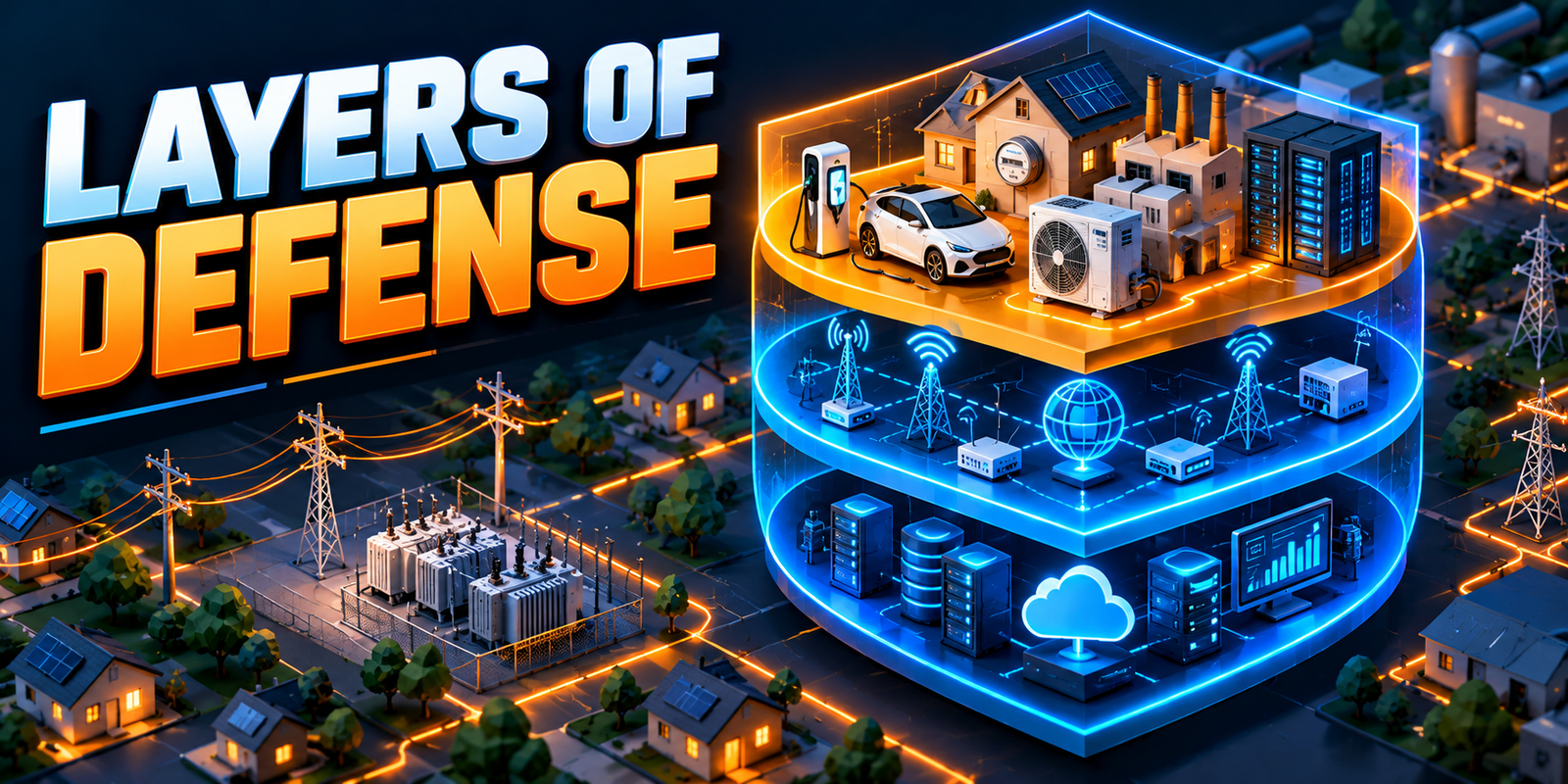

Generative AI in electric utilities means using large language models (LLMs) and related generative models to search, summarize, explain and draft information from utility documents and data, usually through natural-language interfaces. It does not mean letting a chatbot run the grid. The realistic value of generative AI for utilities is in knowledge access, documentation and decision support, with qualified people validating the output.
Utilities hold enormous volumes of technical material: engineering reports, standards, maintenance manuals, work orders, operating procedures, event logs and regulatory documents. Finding the right information quickly is hard. Generative AI lets people ask questions in plain language and receive summaries or drafts, which is different from conventional analytics that mainly predict or classify.
It also raises the stakes for reliability, safety and governance. A fluent but wrong answer can mislead an engineer, and sensitive utility data needs strict control. This article covers applications, data requirements, risks and governance, and keeps generative AI in its proper role as a support layer. For the wider context, see how artificial intelligence is transforming electric utilities.
Key Takeaway
- Generative AI can help electric utilities search, summarize, explain and generate information from approved utility data and documents.
- Safety-critical decisions require validated data, controlled access, governance and human engineering oversight.
- Generated output is not automatically correct and must be checked.
- Low-risk informational use cases are generally easier starting points than operational ones.
What Is Generative AI in Electric Utilities?
Generative AI is a class of AI models that produce new content, such as text, summaries, explanations, structured responses and code, based on patterns learned from large amounts of data.
- Large language models (LLMs) are generative models trained on large text collections. They power most text-based applications.
- Multimodal AI handles more than one data type, such as text and images, where relevant to drawings or inspection photos.
- Text generation and summarization produce drafts and condensed versions of long documents.
- Retrieval-augmented generation (RAG) grounds answers in retrieved documents.
- Structured output returns results in defined formats such as tables or JSON.
- Natural-language interfaces let users query systems in everyday words.
Traditional predictive AI generally predicts or classifies from patterns, for example estimating an asset risk score. Generative AI generates new content such as text, summaries, explanations, structured responses, code and documentation.
Generated output is not automatically correct. A well-written answer can still contain errors, so utility use requires grounding, validation and human review.
Generative AI vs Traditional AI/ML, Predictive Analytics and Automation
| Aspect | Generative AI | Traditional AI/ML | Predictive Analytics | Rule-Based Automation |
|---|---|---|---|---|
| Main purpose | Generate content and interact in language | Classify, detect or predict from data | Estimate future or unknown outcomes | Execute defined steps or rules |
| Typical inputs | Text, documents, prompts, sometimes images | Labeled or unlabeled data features | Historical and current data | Defined conditions and triggers |
| Typical outputs | Text, summaries, code, structured answers | Labels, scores, clusters | Forecasts, probabilities | Fixed actions or alerts |
| Model behavior | Probabilistic, can vary between runs | Learned from data, fixed task | Statistical or ML-based | Deterministic |
| Examples | Summarizing a maintenance report | Detecting abnormal sensor patterns | Load or failure-risk forecasting | Alarm-triggered notification |
| Utility applications | Knowledge search, drafting, explanation | Anomaly detection, classification | Forecasting, asset risk | Workflow routing, scripted tasks |
| Main risks | Hallucination, data leakage, prompt injection | Poor data, drift, false alarms | Uncertainty, wrong horizon | Rigid, hard to adapt |
| Validation requirements | Groundedness, citations, utility test sets, human review | Accuracy, precision, recall, backtesting | Forecast error, calibration | Functional testing |
Decision support is a role rather than a technology. Any of these approaches can provide it, and none replaces the accountable engineer. For a deeper look at choosing between models, see machine learning vs traditional utility analytics.
Why Electric Utilities Are Interested in Generative AI
Several utility-specific drivers explain the interest:
- Large technical libraries: engineering reports, standards, manuals and asset documentation.
- Maintenance records, work orders and event logs that contain useful free text.
- Operating procedures and regulatory documentation that people must find and apply correctly.
- Customer information and training material.
- Growing data volume and a need for faster retrieval.
- Knowledge transfer and retention as experienced staff change roles or retire, where relevant. No workforce statistics are claimed here.
Much of this information is unstructured text. Generative AI is well suited to reading and organizing text, which traditional analytics handles poorly.
Generative AI Utility Architecture
Utility Data / Documents
↓ Data Ingestion
↓ Data Classification
↓ Data Quality + Access Controls
↓ Document Processing / Indexing
↓ Knowledge Store / Vector Database where applicable
↓ Retrieval / Search
↓ LLM / Generative AI Model
↓ Grounding / Context
↓ Response Generation
↓ Validation / Guardrails
↓ Human Review
↓ Utility Application
- Ingestion: brings in documents and records from approved sources.
- Classification: labels data by sensitivity so rules can be applied.
- Quality and access controls: keep outdated or unauthorized material out.
- Processing and indexing: converts documents into searchable form.
- Knowledge store: holds indexed content, sometimes in a vector database.
- Retrieval: finds relevant passages for a question.
- LLM and grounding: generates an answer using the retrieved context.
- Validation and guardrails: checks format, sources and policy compliance.
- Human review: a qualified person confirms before action.
Architectures differ between utilities. Some use cloud services, others on-premises models, and many mix both depending on data sensitivity.
Retrieval-Augmented Generation (RAG)
RAG retrieves relevant passages from approved documents and gives them to an LLM as context, so the answer is grounded in those sources rather than only in the model’s general training.
Document Ingestion → Chunking → Embeddings → Vector Search + Metadata Filtering
→ Retrieval → Prompt/Context Construction → LLM Generation → Source Citations → Human Validation
- Document ingestion: load approved documents.
- Chunking: split documents into passages of manageable size.
- Embeddings: convert passages into numeric vectors that capture meaning.
- Vector search: find passages whose meaning matches the question.
- Metadata filtering: restrict results by document type, version, asset class or permission.
- Retrieval and context construction: assemble the best passages into the prompt.
- LLM generation: produce an answer using that context.
- Citations: show which sources support the answer.
- Human validation: the engineer checks the sources.
RAG is often preferable to relying only on an LLM’s general knowledge, because utility procedures, equipment documentation and standards versions are specific and change over time. Grounding also lets users trace answers to sources.
RAG does not automatically guarantee correctness. Poor retrieval, outdated documents or misread context can still produce wrong answers.
Data Sources for Generative AI in Utilities
Possible sources include engineering documents, asset and maintenance manuals, standard operating procedures, work orders, inspection and incident reports, equipment specifications, technical drawings where supported, regulatory documents, policies, training documents, historical reports, SCADA or event information where appropriately integrated, asset management data, GIS information, AMI, HES and MDMS information where appropriate, knowledge bases and approved operational documentation.
| Type | Description | Utility Examples |
|---|---|---|
| Structured | Fixed fields and tables | Asset registers, meter data, work-order fields |
| Semi-structured | Some structure with flexible content | Event logs, XML or JSON records, forms |
| Unstructured | Free text and media | Manuals, inspection notes, reports, drawings |
Not every source should be exposed to every user or model. Selection is a governance decision.
Data Requirements for Generative AI
Before deployment, utilities typically need:
- Accurate source data and current documents.
- Clear document ownership and source authority.
- Metadata and version control.
- Access permissions and data classification.
- Data lineage and data quality processes.
- Retention policies and update processes.
Bad source data can lead to unreliable generated answers. The principle of “garbage in, garbage out” applies to the knowledge and data layer even when using advanced generative AI. A superseded procedure indexed alongside the current one can be cited confidently and incorrectly. The data quality lessons in smart meter data quality apply here too.
Practical Application 1: Technical Knowledge Assistant
A utility could let engineers ask questions of approved manuals, standards, procedures, equipment documentation and internal technical knowledge.
Engineer Question → Retrieve Approved Sources → Generate Grounded Response → Show Sources → Engineer Validates
Hypothetical example. An engineer asks which test steps a manual lists for a type of equipment. The assistant retrieves the relevant approved passages, summarizes them with citations, and the engineer opens the sources to confirm before relying on them.
Practical Application 2: Maintenance Documentation
Generative AI could assist with maintenance report summarization, work-order summaries, inspection notes, historical maintenance review, suggested documentation structure and technician knowledge support. It can condense a long maintenance history into a readable summary with references.
AI must not independently approve maintenance actions. Approval stays with qualified personnel under the utility’s procedures.
Practical Application 3: Incident and Event Summarization
Generative AI could summarize event logs, alarm information, operator notes, incident reports and restoration documentation into a readable chronology. It should organize and summarize available information, and explicitly flag missing information rather than invent it.
Event summarization is not automated protection decision-making. Summaries help people understand what happened. They do not trip, switch or restore anything.
Practical Application 4: Engineering Report Generation
Generative AI can help draft reports, inspection and maintenance summaries, technical documentation, meeting summaries, project documentation and compliance documentation. Drafting saves effort on structure and wording. Human review must remain mandatory for safety-critical or regulatory documents, since the author remains accountable for the content.
Practical Application 5: Utility Operations Knowledge Support
Operators and engineers can use generative AI to retrieve procedures, equipment information, historical documentation, troubleshooting guidance and operating instructions faster than searching document folders.
Generative AI should not directly replace protection logic, interlocking, safety systems or approved operational controls. In operations it is an information aid, and approved procedures remain the authority.
Practical Application 6: Customer and Field-Service Support
Potential applications include customer-service knowledge assistants, field technician assistants, troubleshooting guidance, service documentation, FAQ generation and work-order assistance. Customer data raises privacy concerns, so access control, data minimization and logging matter. A technician assistant should only retrieve documents the person is authorized to see, and customer-facing answers need approved content and review.
Practical Application 7: Training and Workforce Knowledge
Generative AI can support training material drafting, technical Q&A, procedure explanations, scenario-based learning, knowledge transfer, onboarding and documentation discovery. AI-generated training is not automatically authoritative. Subject-matter experts should review material before it is used for qualification or safety training.
Practical Application 8: Code and Automation Assistance
Technical teams can use generative AI for SQL, Python, data transformation, API integration, scripts, automation workflows, documentation and test generation. For example, it can draft a query to summarize meter-event counts or a script to reformat a data export.
AI-generated code must be reviewed, tested and approved before production use, ideally in non-production environments first. It should not be used to produce unreviewed commands that act on operational systems.
Generative AI for Utility Analytics
Generative AI can sit above existing analytical systems:
Utility Data → Analytics / ML → Results → Generative AI Interface → Natural-Language Explanation
- Explaining analytics results in plain language.
- Query assistance, such as turning a question into a draft query.
- Report generation and summary generation.
- Natural-language dashboards and data exploration.
Generative AI may explain or interact with analytical outputs, while specialized analytical models perform the actual prediction. For example, smart meter analytics produces the results and a generative layer can help people interpret them.
Generative AI and Predictive AI Together
Sensor Data → Predictive Model → Asset Risk Score → Generative AI → Human-Readable Explanation → Engineer Review
| Component | Role |
|---|---|
| Predictive model | Estimates or predicts, such as a risk score or forecast |
| Generative AI | Explains, summarizes or provides an interface to the result |
| Engineer | Validates and decides |
An LLM does not automatically replace specialized predictive models. Forecasting and failure-risk estimation depend on purpose-built models validated on utility data. See AI predictive maintenance for utility assets and AI anomaly detection in electric utilities for those models.
Generative AI and Smart Grid
Possible applications around the smart grid include smart grid documentation, operational knowledge, asset information, grid analytics explanation, engineering support, smart meter analytics interpretation and grid modernization documentation. As systems multiply, finding and explaining information across them becomes harder, which is where a language interface can help. For background, see what a smart grid is and why grid modernization depends on better electricity data.
Generative AI and AMI
Potential uses include AMI documentation, smart meter knowledge, HES and MDMS documentation, meter-data explanations, operational reports and technical support. A support engineer could ask how a particular data flow works and get a cited answer. See advanced metering infrastructure for the underlying architecture.
Generative AI should not be trusted to make billing or operational decisions without controlled validation. Billing and operations rely on validated, deterministic processes.
Generative AI and Asset Management
Generative AI can support asset documentation, maintenance history summaries, inspection reports, asset knowledge retrieval, work-order analysis, engineering reports and maintenance planning support. It makes asset information easier to find and read. Actual maintenance decisions remain under qualified human control.
Generative AI with SCADA, EMS, DMS, ADMS and OMS
Utilities operate many systems: SCADA, EMS, DMS, ADMS, OMS, GIS, AMI, HES, MDMS, asset management systems, data historians, data lakes and enterprise data platforms. Not every utility uses all of them together.
Generative AI can act as an information and decision-support layer around these systems, for example by summarizing alarm context or helping staff find related documentation. An LLM should not directly control SCADA, protection or safety-critical equipment without specialized controls, validation and authorization. Control actions belong to purpose-built, tested and authorized systems. See power system automation for how these systems fit together.
Generative AI Risks in Electric Utilities
| Risk | Utility Context |
|---|---|
| Hallucinations | Invented procedure steps or specifications |
| Incorrect technical answers | Wrong ratings, standards or relationships |
| Outdated information | Superseded procedures presented as current |
| Data leakage | Sensitive operational data sent outside approved boundaries |
| Privacy | Customer data exposed in prompts or answers |
| Intellectual property | Vendor or confidential engineering material mishandled |
| Prompt injection | Malicious text in a document or input steering the model |
| Retrieval poisoning | Bad or tampered documents in the knowledge store |
| Unauthorized access | Users retrieving documents they should not see |
| Model misuse | Use outside approved purposes |
| Over-reliance and automation bias | Staff trusting output without checking |
| Lack of explainability | Hard to see why an answer was produced |
| Incorrect citations | Citations that do not support the claim |
| Incomplete context | Relevant documents not retrieved |
| Model drift and changing systems | Behavior shifts after model or system updates |
| Third-party dependency and vendor lock-in | Reliance on external services and proprietary formats |
Hallucination and Technical Accuracy
Hallucination is when a model produces content that sounds plausible but is false or unsupported. In engineering it is dangerous because a wrong value, step or standard reference can look entirely credible, and fluent answers can still be incorrect.
Mitigations include grounding in approved sources, RAG, source citations, uncertainty handling such as stating when sources do not answer the question, human review and guardrails that check output format and policy. Never present an LLM answer as authoritative merely because it sounds technically convincing.
Cybersecurity Considerations
Defensive measures include:
- Identity and access management, role-based access and least privilege.
- Network segmentation, especially around operational technology.
- Data encryption in transit and at rest.
- Logging, monitoring and audit trails.
- Prompt injection defenses and retrieval security, such as validating and controlling indexed content.
- Sensitive data protection and secure APIs.
- Vendor security assessment and model access controls.
Data Privacy and Governance
Governance covers data classification, personal information, customer data, sensitive operational data, confidential engineering information, access control, retention, data residency where applicable, data ownership, usage policies and auditability.
Utility AI governance needs both technical controls, such as permissions and logging, and organizational controls, such as policies, roles and review processes. Technology alone does not ensure responsible use.
AI Governance Framework
- AI use-case identification: record what the system is for.
- Risk classification: rate use cases by consequence of error.
- Data classification: decide which data may be used.
- Model and vendor assessment: review capabilities, data handling and stability.
- Security assessment: test controls before launch.
- Access control: assign roles and permissions.
- Human oversight: define required review by risk level.
- Testing and validation: use utility-specific test sets.
- Monitoring: track quality, usage and anomalies.
- Incident management: define how problems are reported and handled.
- Audit: review logs, decisions and compliance.
- Continuous improvement: update policies, data and models.
Human-in-the-Loop
Generative AI should support, not replace, qualified utility professionals. Human review should be required for safety-critical decisions, protection-related decisions, switching decisions, regulatory submissions, critical engineering recommendations, maintenance approvals and customer decisions with sensitive consequences.
| Risk Level | Example | Oversight |
|---|---|---|
| Low | Summarizing a public or low-sensitivity document | User judgment, spot checks |
| Medium | Drafting an engineering report | Author review before use |
| High | Regulatory submission, maintenance approval | Qualified expert review and sign-off |
| Safety-critical | Protection, switching, operational control | Not delegated to generative AI |
Reliability Considerations
Reliability factors include availability, latency, response consistency, source freshness, retrieval quality, model performance, failover, monitoring, logging, auditability and service dependencies. Generative AI should not become an uncontrolled single point of failure for critical operations. Staff must be able to continue working with approved procedures and systems if the AI service is unavailable.
Implementation Challenges
Common challenges include data silos, legacy systems, poor documentation, data quality, integration, security, privacy, governance, workforce skills, change management, vendor selection, model evaluation, cost, infrastructure, adoption, trust and regulatory requirements. Costs vary widely and depend on deployment choices, so none are estimated here.
Model and Vendor Selection
Factors include model capabilities, context window, retrieval capabilities, accuracy, latency, security, deployment options, data handling, privacy, integration, auditability, cost, vendor stability, lock-in, customization and evaluation support. The right choice depends on the use case and data sensitivity. This article does not recommend any specific vendor.
Evaluating Generative AI Systems
Evaluation dimensions include factual accuracy, groundedness, citation accuracy, retrieval accuracy, relevance, completeness, hallucination rate where measured, safety, latency, consistency, user satisfaction and operational usefulness.
Utility-specific test sets are important because general benchmarks do not cover a utility’s terminology, documents and procedures. A set of real, expert-reviewed questions with known source answers shows whether the system works in the environment where it will be used.
Practical Use-Case Prioritization
| Use Case | Value | Risk | Data Requirement | Human Oversight |
|---|---|---|---|---|
| Document summarization | Moderate to high | Low | Approved documents | User review |
| Technical knowledge search | High | Low to medium | Current indexed documents with metadata | Source verification |
| Maintenance report generation | Moderate | Medium | Work orders, inspection records | Engineer review |
| Incident summarization | Moderate | Medium | Event logs, notes, reports | Operator or engineer validation |
| Training assistant | Moderate | Low to medium | Approved training material | Expert review of content |
| Field technician support | Moderate to high | Medium | Manuals, procedures, asset data | Technician judgment, procedures prevail |
| Analytics explanation | Moderate | Medium | Validated analytics outputs | Analyst review |
| Customer-service assistance | Moderate | Medium to high | Approved content, protected customer data | Review and access controls |
| Engineering report drafting | Moderate | Medium | Project data, templates | Author accountable |
| Operational decision support | Potentially high | High | Validated operational data | Strict, qualified review |
Low-risk informational use cases are generally easier starting points than safety-critical applications.
Generative AI Implementation Roadmap
- Identify use cases: start with real information problems.
- Classify risk: separate informational uses from operational ones.
- Assess data: check quality, ownership, currency and access.
- Select architecture: choose deployment, retrieval and model approach.
- Build a secure prototype: limit scope and data.
- Evaluate: test against utility-specific questions.
- Pilot with users: gather feedback from engineers and operators.
- Add governance: formalize policy, roles and monitoring.
- Integrate workflows: connect to tools people already use.
- Monitor and improve: track quality, drift and usage.
Hypothetical Example: Engineering Knowledge Assistant
Hypothetical example. No real utility, statistics or results are described.
Engineer Question → Identity/Access Check → Retrieve Approved Documents → RAG → LLM
→ Cited Answer → Engineer Validation → Action if appropriate
An engineer asks about an equipment procedure. The system checks the engineer’s permissions and retrieves only approved, current documents. The LLM drafts an answer from those passages and cites them. The engineer opens the cited sections, confirms the procedure and, if appropriate, proceeds under normal work-authorization rules.
Hypothetical Example: Maintenance Report Summarization
Hypothetical example. The generated report is a draft until reviewed.
Maintenance Records → Data Preparation → GenAI Summary → Source References → Engineer Review → Final Report
Records for an asset are cleaned and gathered. The model produces a summary with references to each record. The engineer checks the summary against the records, corrects errors and finalizes the report. The AI output is only a draft.
Hypothetical Example: Event Summary
Hypothetical example. It does not describe a real event.
Event / Alarm Data + Operator Notes + Approved Documentation → Retrieval → Generative AI
→ Chronological Summary → Engineer/Operator Validation
The system assembles event records, alarms and notes, retrieves related procedures, and writes a chronological summary. Where timestamps or causes are missing, the summary marks them as missing rather than guessing. The operator or engineer validates the timeline before it is used in any report.
Benefits of Generative AI in Utilities
Realistic potential benefits include faster knowledge retrieval, better document accessibility, reduced manual summarization, improved documentation workflows, faster report drafting, better knowledge transfer, natural-language interaction with data, improved employee productivity, more consistent documentation and support for engineering decision-making. These are possibilities. No guaranteed return on investment or percentage gain is claimed.
Limitations
- Hallucination and dependence on source quality.
- Context limitations and model limitations.
- Security and privacy risks.
- Integration complexity and governance requirements.
- Need for human oversight.
- Cost and vendor dependency.
- Adoption challenges and reliability considerations.
Current, Emerging and Future Generative AI in Utilities
| Current | Emerging | Future / Experimental |
|---|---|---|
| Document summarization | Multimodal engineering assistants | More autonomous decision-support workflows |
| Knowledge assistants | Analytics copilots | AI agents coordinating multi-step utility tasks |
| Report drafting | Field-service assistants | Advanced multimodal engineering systems |
| Technical Q&A | AI-assisted maintenance workflows | More deeply integrated utility copilots |
| Training support | Natural-language interfaces to utility data |
Current items are in use or practical pilots. Emerging items are early deployments. Future or experimental items are concepts and not current production practice.
Future of Generative AI in Electric Utilities
Realistic directions include multimodal AI, utility-specific copilots, better RAG, agentic workflows, AI-assisted engineering and asset management, richer natural-language interfaces, closer integration with utility analytics, digital twins, and links to IoT, the smart grid and AMI, alongside improved governance and evaluation. These depend on safety, governance, data quality and integration maturity. See the electric grid in 2035 and the future of smart meter analytics for related outlooks.
Summary
Generative AI creates text, summaries, explanations and code, and helps utilities search and use technical knowledge. It relies on good data, a secure architecture and RAG to ground answers in approved sources. Its risks, including hallucination, leakage and over-reliance, are managed through governance, cybersecurity, evaluation and human oversight. Implementation works best when it starts with low-risk use cases and expands carefully.
Conclusion
Generative AI has meaningful potential in electric utilities, especially as a knowledge, documentation and decision-support layer. Its value depends not simply on the model, but on trusted data, secure architecture, grounded responses, governance, evaluation and qualified human oversight.
It will not replace utility engineers or operators. Used carefully, generative AI utilities can adopt as an assistant helps skilled people find, understand and communicate information faster.
Frequently Asked Questions About Generative AI in Electric Utilities
What is generative AI in electric utilities?
Generative AI in electric utilities refers to models, usually large language models, that generate text, summaries, explanations and code from utility documents and data. Typical uses are knowledge search, report drafting and explaining analytics results.
It supports engineers and operators with information. Its output is not automatically correct and does not replace validated engineering judgment.
How does generative AI work in electric utilities?
Utilities index approved documents, then use retrieval to find passages relevant to a question. An LLM writes an answer grounded in those passages and can cite them. Guardrails check the output, and a qualified person reviews it.
This retrieval-augmented approach ties answers to utility sources instead of relying only on the model’s general training knowledge.
Why is generative AI important for electric utilities?
Utilities hold large volumes of manuals, reports, work orders and procedures that are hard to search. Generative AI lets people query this information in plain language and produce summaries and drafts faster.
It can also support knowledge transfer. Its value depends on trusted data, governance and human oversight, particularly given utility reliability and safety requirements.
What are the main components of generative AI systems for utilities?
Main components include data ingestion and classification, quality and access controls, document processing and indexing, a knowledge store or vector database, retrieval, an LLM, grounding and response generation, validation and guardrails, and human review.
Applications sit on top, with security, logging and monitoring around the stack. Exact architectures differ between utilities.
What are the challenges of using generative AI in electric utilities?
Key challenges include hallucinations, outdated or poor-quality source data, data leakage and privacy, prompt injection, unauthorized access, over-reliance, integration with legacy systems, vendor dependency, cost and workforce skills.
Reliability and regulatory requirements add further constraints. Utilities address them with grounding, access control, evaluation, governance and human review.
Where is generative AI used in the electricity industry?
Common uses include technical knowledge search, document and report summarization, maintenance documentation, incident and event summaries, training support, field technician assistance, customer-service knowledge tools and code assistance for data teams.
Adoption varies by utility, and many uses are pilots. Safety-critical control and protection are not suitable for direct generative AI use.
What data is required for generative AI in electric utilities?
Utilities need accurate, current documents with clear ownership, metadata, version control and source authority. They also need access permissions, data classification, lineage, quality processes, retention rules and update procedures.
Structured, semi-structured and unstructured data may all be involved. Poor source data produces unreliable answers, so data preparation is as important as model choice.
How can utilities govern and safely use generative AI?
Utilities can classify use cases by risk, classify data, assess models and vendors, and apply security and access controls. They test with utility-specific test sets, monitor performance, manage incidents and audit use.
Human oversight scales with risk, and safety-critical decisions stay with qualified people. Governance combines technical controls with organizational policy.

I share real stories, practical ideas and honest perspectives on business, marketing and life. This blog is a space to learn, grow and connect.