A smart grid is an electricity network that adds digital monitoring, two-way communication, automation, sensors, advanced metering and data analytics to conventional power infrastructure. The goal is to give utilities better visibility and control, and to help them run networks that are becoming more complex.
Traditional grids were designed around large power plants sending electricity one way to customers, with limited monitoring beyond major substations. That model is changing. Utilities now deal with distributed energy resources (DERs), electric vehicles (EVs), aging equipment and higher expectations for reliability. Sensors measure grid conditions, communication networks move the data, and advanced metering infrastructure (AMI) extends visibility to customers. Automation and analytics then help turn that information into action. This article explains what a smart grid is, how its architecture works, which technologies and communication systems it uses, and how utilities apply it. It builds on our overview of electricity transmission and distribution.
A smart grid is an electricity network that combines conventional power infrastructure with digital monitoring, two-way communication, automation, sensors, advanced metering and data analytics to improve visibility, reliability, efficiency and operational control. Most of its technologies, such as SCADA, smart meters and distribution automation, are established. Others, such as digital twins and vehicle-to-grid, are still emerging.
What Is a Smart Grid?
A smart grid is an electrical network that uses digital technology, sensors, communication and automation to monitor, control and optimize the generation, delivery and use of electricity.
It does not replace physical infrastructure such as lines, transformers and substations. It adds a digital layer on top of that infrastructure. The main ingredients are:
- Electrical infrastructure: Generation, lines, substations and feeders.
- Digital monitoring and sensors: Devices that measure grid conditions.
- Communication networks: Links that move data and commands.
- Smart meters: Meters that record and report usage.
- Automation and control systems: Equipment that acts on defined rules.
- Data analytics and utility software: Tools that turn data into insight.
- Distributed energy resources: Local generation, storage and flexible loads.
| Aspect | Traditional grid | Smart grid |
|---|---|---|
| Power and information flow | Mostly one-way | More interactive, often two-way |
| Monitoring | Limited, mainly at major points | Broader visibility across the network |
| Operations | Largely manual | Increased automation |
| Data | Periodic readings | More frequent data |
| Maintenance | Often reactive or time-based | Increasingly condition-based |
| Customer information | Limited | Greater customer and load visibility |
How Does a Smart Grid Work?
A smart grid works by moving two things at once: electricity and information. Electricity flows through the physical network, while data about that network flows through communication systems to people and software that respond. The operating cycle usually runs as follows.
Sensors and meters collect data
Devices record conditions and usage.
Field devices measure grid conditions
Relays and controllers capture voltage, current and status.
Communication networks transfer information
Data travels to control centers and platforms.
Control systems receive the data
SCADA and management systems display and store it.
Analytics process the information
Software looks for trends, faults and forecasts.
Operators review conditions
People assess the situation and decide on actions.
Automated systems respond where configured
Defined functions act within set rules.
Data supports planning and maintenance
Historical data guides investment and upkeep.
The physical power flow
The basic power path is still generation, transmission, distribution and customers.
Solar, battery storage, EVs, microgrids and distributed generation can introduce additional power flows into this path. A feeder that once carried power only to customers may sometimes carry it back. That change makes monitoring and coordination more important. See our guide to transmission vs distribution networks for how those layers differ.
Smart Grid Architecture
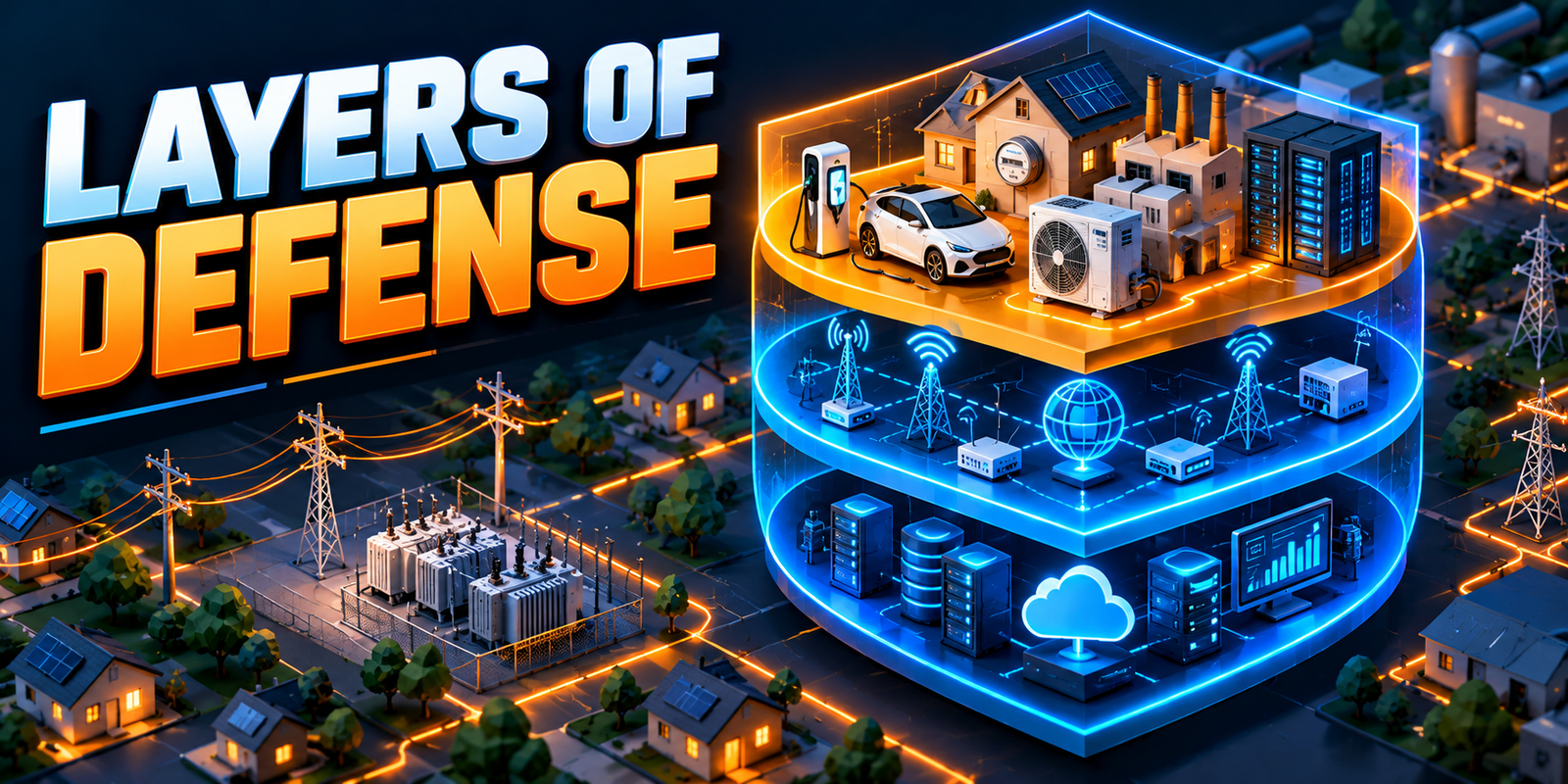
Smart grid architecture is commonly described in layers. Each layer depends on those beneath it, and actual designs vary between utilities.
Layer 1: Physical power infrastructure
This is the electrical backbone: generators, transmission lines, substations, transformers, distribution feeders, switchgear and customer connections.
Layer 2: Sensing and measurement
This layer observes the network. It includes grid sensors, smart meters, voltage and current sensors, equipment monitoring and, where appropriate, phasor measurement units (PMUs) that provide time-synchronized measurements.
Layer 3: Communication
This layer carries data and commands. It uses fibre, RF mesh, cellular, private utility networks, other wireless communication and gateways that connect different networks.
Layer 4: Control and automation
This layer acts on the grid. It includes SCADA, remote terminal units (RTUs), intelligent electronic devices (IEDs), programmable logic controllers (PLCs), automated switches, protection systems and distribution automation.
Layer 5: Applications and analytics
This layer processes information. It includes energy and distribution management systems (EMS and DMS), AMI systems, outage management, asset management, load forecasting, AI/ML analytics and demand response.
Layer 6: Utility and operational decision-making
People sit at the top of the architecture. Control room operators, engineers, asset managers, planning teams and maintenance teams use the information and set the rules that automation follows.
What Are the Main Components of a Smart Grid?
| Component | Main function | Utility benefit |
|---|---|---|
| Smart meters | Record usage and events and report them | Customer-level visibility |
| AMI | Collect and manage meter data | Billing, outage and load information |
| Grid sensors | Measure voltage, current, temperature and condition | Network and asset visibility |
| SCADA | Supervise and control remote equipment | Central operational view |
| RTUs | Collect field data and execute commands | Link field equipment to SCADA |
| IEDs | Protect, measure and control | Local protection and automation |
| Digital substations | Digitize substation measurement and control | Richer data and flexible automation |
| Communication networks | Carry data and commands | Connect devices with control centers |
| Distribution automation | Remotely or automatically operate feeders | Faster fault response |
| EMS | Manage the transmission system | Secure bulk system operation |
| DMS | Manage the distribution network | Switching and network management |
| Outage management systems | Track and manage outages | Better restoration coordination |
| Energy storage | Store and release energy | Flexibility and support |
| Distributed energy resources | Generate or store power locally | More supply options, with coordination needs |
| Demand response | Adjust customer demand on request | Demand-side flexibility |
| AI/ML analytics | Find patterns and forecast | Decision support and planning |
| Cybersecurity systems | Protect devices, networks and data | Trustworthy operation |
Smart Meters and Advanced Metering Infrastructure
A smart meter is an electronic meter that records electricity use at short intervals and communicates the data to the utility. Advanced metering infrastructure (AMI) is the complete system around those meters: the meters themselves, the communication network, and the data management software.
- Meter data collection: Interval readings replace occasional manual reads.
- Two-way communication: The utility can receive data and, where supported, send commands.
- Consumption visibility: Usage patterns become clearer.
- Meter events: Tamper and power status events can be reported.
- Outage information: Meters can report loss of supply on supported systems.
- Voltage information where supported: Some meters record voltage at the customer connection.
- Remote functions where supported: Examples include remote connection and disconnection.
- Customer data: Usage data supports billing and, with consent and controls, customer services.
Smart meters differ from general grid sensors. Meters are located at customer premises and mainly measure usage for billing and service. Grid sensors sit on lines, transformers and substations and mainly monitor network and equipment conditions. In the architecture, AMI extends visibility to the customer edge and complements network sensing.
Role of Grid Sensors in Smart Grids
Grid sensors measure physical and electrical conditions across the network. They provide the raw data that every later step depends on. Our article on how sensors, IoT devices and intelligent monitoring are changing electrical grid operations covers them in depth.
- Voltage: Shows whether supply stays within limits.
- Current: Shows loading and fault current.
- Temperature: Shows heating in equipment.
- Equipment condition: Includes gas levels, vibration and partial discharge.
- Power quality: Shows sags, harmonics and interruptions.
- Fault conditions: Show where abnormal current has passed.
- Environmental conditions: Include weather and, in some applications, vegetation or ice.
The general path is sensors, data, communication, analytics and then decision. Sensors do not automatically predict failures. They provide data, and prediction needs analysis, validation and engineering judgment.
Communication Networks in Smart Grids
Communication is essential because a smart grid is only as useful as the data and commands that can travel through it. Utilities usually combine several technologies, along with gateways that translate between networks and edge devices that process data close to the source.
| Communication type | Typical use | Key consideration |
|---|---|---|
| Fibre | Substations, backbone links and control centers | High capacity and reliability, but costly to build |
| Cellular | Scattered devices and meters | Wide coverage, with dependence on a carrier |
| RF mesh | Smart meters and distribution devices | Coverage depends on device density and terrain |
| Private wireless | Utility-owned field area networks | Control and security, with licensing and build effort |
| Other utility networks | Microwave, power-line and legacy links | Suitability varies, and capacity is often limited |
Choosing a technology means balancing latency, reliability, coverage, bandwidth, cost and security. Protection signals need very fast, dependable links. Many metering and monitoring uses can tolerate more delay.
What Role Does SCADA Play in a Smart Grid?
SCADA, or supervisory control and data acquisition, is the system that lets operators monitor and control remote equipment from a central location. It is a well-established part of utility operations and a major building block of a smart grid.
- Data acquisition: Collects measurements and status.
- Remote monitoring: Shows conditions at distant sites.
- Equipment status: Shows whether breakers and switches are open or closed.
- Alarms: Flags abnormal conditions.
- Control: Sends supervised commands.
- Substation monitoring and control center visibility: Gives operators a consolidated picture.
SCADA receives data from sensors, RTUs and IEDs, and sends commands back to them. SCADA alone does not make a smart grid. A smart grid also needs wider sensing, customer-edge data, analytics, distributed resource management and automation that does not depend on the control center.
IEDs, RTUs and Intelligent Grid Devices
Three kinds of field device recur in smart grid architecture. Each has a different focus, and they often work together.
- IEDs (intelligent electronic devices): Microprocessor-based devices that protect, measure, control and communicate. Protection relays are typical examples.
- RTUs (remote terminal units): Devices that gather field data and execute remote commands, acting as a gateway to SCADA.
- PLCs (programmable logic controllers): Programmable controllers that run logic, more often for auxiliary or station systems.
| Device | Main role | Typical smart grid application |
|---|---|---|
| IED | Protection, measurement, control and event recording | Substation protection and feeder automation |
| RTU | Data collection and remote command execution | Connecting field equipment to SCADA |
| PLC | Programmable control logic | Station auxiliary systems and local sequences |
The boundaries are not strict, and some devices combine functions.
Distribution Automation
Distribution automation applies monitoring and remote or automatic control to the distribution network. Its main purpose is to help utilities find and respond to network problems faster.
- Automated switches and reclosers: Operate on command or according to logic.
- Sensors and fault detection: Show where fault current has passed.
- Fault isolation: Separates the faulted section.
- Service restoration: Reconnects healthy sections from other sources.
- FLISR: Fault location, isolation and service restoration, combined.
- Remote switching and DMS integration: Operators and software coordinate actions.
These functions can reduce the time needed to identify and respond to network problems. Results depend on design, communication reliability and available backup capacity, and outage reductions are not guaranteed. Our guide to power system automation goes deeper.
Digital Substations and Smart Grids
A digital substation uses digital measurement, IEDs and standardized communication to protect, control and monitor a substation. It can be an important part of smart grid infrastructure because substations are key points for data and control. Our guide to digital substations, covering architecture, automation, communications and benefits explains the details.
- Digital measurement: Current and voltage are digitized near the equipment.
- IEDs: Perform protection and control.
- Station-level communication: Connects devices with supervisory systems.
- Process-level information: Brings equipment data into the network.
- IEC 61850 at a high level: A standard for substation communication and data models.
- GOOSE: Fast event messages between IEDs.
- Sampled Values: Streams of digitized measurements.
- Automation: Local and station-level functions.
Because these devices share data in a consistent form, digital substations can feed monitoring and analytics systems more easily.
Smart Grid and Distributed Energy Resources
Distributed energy resources (DERs) are small or medium-scale resources connected near the point of use. A smart grid helps utilities see and coordinate them.
- Rooftop solar and distributed generation: Produce power locally.
- Battery storage: Stores and releases energy.
- EV charging: Adds load and potential flexibility.
- Microgrids: Local systems that can operate with or apart from the main grid.
- Flexible loads: Demand that can be shifted or reduced.
The traditional model is mainly one-way, from central plants to customers. With DERs, power may flow in both directions on a feeder at different times. That affects voltage, loading and protection, so utilities need better monitoring and coordination.
Smart Grid and Renewable Energy Integration
Renewable generation creates operational challenges because wind and solar output varies with weather. Smart grid technology helps utilities see and coordinate those changes, but it does not solve integration on its own.
- Variable generation: Output changes quickly and unpredictably.
- Forecasting: Planners and operators need estimates of output and demand.
- Voltage management: Local generation can raise feeder voltage.
- Power flow changes: Flows may reverse or shift during the day.
- Distribution-level generation: Many small sources are hard to see without monitoring.
- Storage coordination: Batteries need to be scheduled and controlled.
Sensors, meters and analytics improve visibility, and automation helps with coordination. Network reinforcement, market design, standards and operating practice still matter.
Smart Grid and Electric Vehicles
EV charging increases electricity demand, and the effect is mainly local to the distribution network. A smart grid helps utilities see and manage that load.
- Local distribution impacts: Clusters of chargers can load transformers and feeders.
- Smart and managed charging (current): Charging is timed or limited to follow network conditions or price signals.
- Load forecasting: Forecasts must include charging patterns.
- Vehicle-to-grid (emerging): Vehicles exporting energy to the grid is being piloted and explored but is not yet widespread.
Managed charging is already used in some places. Vehicle-to-grid depends on technology, standards, regulation and customer acceptance, so it should be treated as an emerging concept.
Smart Grid and Energy Storage
Battery energy storage absorbs energy and releases it later, which adds flexibility to the grid. It is already in use, and monitoring and control are central to making it work well.
- Peak support: Discharging during peaks can ease loading.
- Renewable balancing: Storing surplus wind or solar output.
- Grid flexibility: Adds options for operators.
- Frequency support: Fast response helps stabilize frequency.
- Backup and resilience: Can supply selected loads during outages where designed for it.
- Energy shifting: Moves energy between times of day.
Storage needs communication, state-of-charge monitoring and control logic so that operators can dispatch it safely. Without them, storage cannot be coordinated with the wider network.
Smart Grid Automation
Automation connects measurement to action. It follows a loop of sensing, communication, data processing, decision, control and verification.
Sensors
Measure conditions.
Communication
Moves the data.
Data processing
Software validates and analyzes it.
Decision
An operator or configured rule selects an action.
Automated control
A device carries out the action.
Verification
New measurements confirm the result.
Common applications are remote switching, automated fault response, voltage control, distribution automation, demand response and asset monitoring. Automation works within defined protection, control and operational rules, and operators keep the ability to supervise and intervene.
Data Analytics and AI in Smart Grids
Analytics turns grid data into insight, and AI/ML extends this by finding patterns in large data sets. Analytics can support:
- Load and demand forecasting: Estimating future demand.
- Renewable forecasting: Estimating wind and solar output.
- Asset health and predictive maintenance: Estimating which equipment may need attention.
- Anomaly detection: Flagging unusual measurements.
- Fault and outage analysis: Reviewing events and their causes.
- DER coordination: Suggesting how to schedule many resources.
- Operational decision support: Presenting options to operators.
AI/ML depends on data quality, data availability, model validation, engineering review and appropriate governance. It is a decision-support tool. It does not replace utility engineers or operators.
Smart Grid and Grid Modernization
Grid modernization is the broad effort to upgrade equipment, data and practices. A smart grid is one important outcome of that effort, alongside digitalization. The progression is roughly from a traditional grid, through modernization and digitalization, to a smart grid and then to more advanced automated operations. These terms overlap but are not exact synonyms.
| Concept | Main focus | Example technologies |
|---|---|---|
| Traditional grid | One-way delivery of power | Central plants, lines, manual switching |
| Grid modernization | Upgrading infrastructure and practices | New equipment, sensors, communications |
| Digitalization | Applying digital data and software | Digital substations, data platforms |
| Smart grid | Two-way monitoring, communication and control | AMI, distribution automation, DER management |
| Advanced automated operations | Higher levels of automatic coordination | Advanced DMS, analytics, edge computing |
For the data foundation, read our article on why grid modernization depends on better electricity data and real-time visibility. For the wider view, see our look at the future electric grid and how traditional grids are becoming digital and data-driven.
Cybersecurity in Smart Grids
Connecting more devices creates more points that must be protected, so cybersecurity becomes a core engineering requirement. The priorities below are defensive.
- Authentication: Verify the identity of users and devices.
- Access control: Give only the access that is needed.
- Network segmentation: Separate operational networks from other networks.
- Secure communications: Protect data in transit.
- Monitoring: Watch for unusual activity.
- Software updates: Apply tested updates in a controlled way.
- Incident response: Prepare and rehearse response plans.
- Backup and recovery: Keep verified backups.
- Operational technology security: Treat control systems as safety-critical.
- Device management: Track and maintain every connected device.
Benefits of Smart Grid Technology
These benefits are possible, not automatic. Results depend on design, integration and operating practice.
| Benefit | How smart grid technology supports it |
|---|---|
| Better visibility | Sensors, meters and SCADA show more of the network |
| Faster fault identification | Fault indicators and event data narrow down locations |
| Improved operational awareness | Consolidated data and alarms help operators |
| Automation | Remote and automatic switching handles routine tasks |
| Better asset management | Condition and loading data show equipment health |
| Better load visibility | Interval meter data shows demand patterns |
| Renewable integration | Monitoring and forecasting help manage variable output |
| DER coordination | Communication and control link distributed resources |
| Customer information | AMI data supports usage insight and services |
| Maintenance planning | Condition data helps target work |
| Grid flexibility | Storage and demand response add options |
| Data-driven planning | Historical data supports forecasting and investment decisions |
Challenges of Smart Grid Implementation
| Challenge | Why it matters | General response |
|---|---|---|
| Legacy infrastructure | Older equipment may lack digital capability | Phased upgrades and interface devices |
| High implementation cost | Devices, networks and software are costly | Prioritized, staged investment |
| Communication reliability | Automation depends on dependable links | Redundancy and suitable technology choices |
| Interoperability | Many suppliers’ systems must work together | Open standards and testing |
| Data quality | Poor data leads to poor decisions | Validation and governance |
| Cybersecurity | More connections mean more to protect | Layered, defensive security |
| Large data volumes | Storage and processing needs grow | Data management and edge processing |
| Workforce skills | Staff need power and digital skills | Training and recruitment |
| Integration complexity | Many systems must be connected | Architecture planning and integration platforms |
| Regulatory requirements | Rules differ and change | Early engagement with regulators |
| Maintenance | Devices and software need ongoing care | Lifecycle and update planning |
| Customer adoption | Participation affects program results | Clear communication and fair programs |
| Privacy considerations | Usage data can be sensitive | Data protection and consent practices |
Traditional Grid vs Smart Grid
| Area | Traditional grid | Smart grid |
|---|---|---|
| Monitoring | Mainly at major points | Broader, reaching feeders and customers |
| Communication | Limited, often one-way | Two-way, layered networks |
| Power flow | Mostly one-way | One-way and two-way |
| Data | Periodic and limited | Frequent and detailed |
| Customer role | Passive consumer | Active participant, sometimes a producer |
| Automation | Little, with manual switching | More remote and automatic functions |
| Fault detection | Often after customer calls | Faster, using sensor, relay and meter data |
| Maintenance | Time-based or after failure | Increasingly condition-based |
| DER integration | Limited visibility and control | Monitoring and coordination |
| Renewable integration | Harder to manage at scale | Better supported, but still challenging |
| EV integration | Largely unmanaged load | Managed charging in some applications |
| Planning | Periodic studies | Supported by data and scenarios |
| Analytics | Limited | Growing use of analytics and AI/ML |
| Control | Mostly manual and local | Remote, centralized and automated |
How Utilities Apply Smart Grid Technology
Smart grid technology appears across the utility value chain. Adoption levels differ between utilities.
Transmission monitoring
Real-time measurements, sometimes with PMUs, for system awareness.
Substation automation
IEDs and station systems operate substations.
Distribution automation
Remote and automatic feeder switching.
AMI
Interval metering and meter communication.
Outage management
Detecting, locating and restoring outages.
Asset management
Using condition and loading data to manage equipment.
Demand response
Adjusting customer demand when needed.
Renewable integration
Monitoring and forecasting variable output.
EV management
Coordinating charging load.
DER coordination
Supervising distributed resources.
Predictive maintenance
Targeting inspection and repair.
Grid planning
Using data to plan investment.
Illustrative Smart Grid Example
Illustrative example — not a real utility case study. This fictional scenario is for explanation only.
A distribution feeder has rooftop solar, battery storage, EV charging, smart meters, grid sensors and automated switches.
Sensors collect data
Feeder sensors measure voltage and current.
Smart meters add customer-side data
Meters show usage and solar export.
Communication systems send data
Mesh and cellular links carry it to the control center.
The DMS processes network conditions
It shows feeder loading and voltage.
Analytics identify changing load patterns
Evening EV charging overlaps with falling solar output.
Operators review conditions
They assess the situation and options.
Automated controls respond where configured
Voltage control equipment adjusts within set limits.
Storage and flexible resources support operation
The battery discharges to reduce peak loading.
Operators maintain oversight
They can override automation and restore normal settings.
How to Build a Smart Grid: Practical Utility Roadmap
No single route fits every utility. This realistic high-level roadmap can be adapted.
Assess existing infrastructure
Record condition, age and capability.
Identify critical monitoring gaps
Find where visibility is weakest.
Deploy sensors and smart meters
Add measurement where it matters most.
Improve communication infrastructure
Provide reliable, secure links.
Modernize substations
Upgrade protection, control and measurement.
Implement automation
Start with well-defined functions.
Integrate AMI
Connect meter data with operational systems.
Improve data management
Set standards for quality and ownership.
Add analytics
Use forecasting and condition analysis.
Integrate DERs
Gain visibility and coordination of distributed resources.
Strengthen cybersecurity
Build protection into every layer.
Train the workforce
Prepare operators and engineers.
Measure operational outcomes
Track results against objectives.
Expand gradually
Scale what works.
Future of Smart Grid Technology
These are possibilities and expectations rather than guarantees, and the pace will differ between utilities and regions.
- More intelligent distribution networks: Automation could extend across more feeders.
- Advanced analytics and AI-assisted operations: Decision support is expected to become more common, with human oversight.
- More DERs and battery storage: Local resources may keep growing.
- EV integration: Managed charging is likely to expand, while vehicle-to-grid remains emerging.
- Advanced AMI: Meters may offer richer data and functions.
- Edge computing: More processing could happen near devices.
- Digital twins: An emerging capability in some applications.
- Greater automation: More defined tasks may be automated.
- Improved interoperability: Better standards and tools are expected.
- More flexible demand: Customer flexibility could play a larger role.
Conclusion
A smart grid combines physical electrical infrastructure with a digital layer of sensors, smart meters, AMI, communication networks, SCADA, intelligent devices, automation and analytics. Its architecture runs from the physical network, through sensing and communication, to control, applications and human decision-making. It helps utilities manage distributed energy resources, renewable generation, electric vehicles and energy storage, with cybersecurity as a core requirement and grid modernization as the broader foundation.
Smart grids combine electrical infrastructure with digital visibility, communication, automation and data-driven decision-making. They support engineers and operators, and they work best when technology, people and processes advance together. To explore related topics, see our guides to the modern electric grid and power grid failure causes.
Frequently Asked Questions About Smart Grids
What is a smart grid?
A smart grid is an electricity network that combines conventional power infrastructure with digital monitoring, two-way communication, sensors, advanced metering, automation and data analytics. It helps utilities improve visibility, reliability, efficiency and control, especially as renewable and distributed energy resources grow.
How does a smart grid work?
Sensors and meters collect data, and field devices measure grid conditions. Communication networks carry the data to control systems, where analytics process it and operators review it. Automated systems respond where configured, and the data supports planning and maintenance. Both electricity and information flow through the system.
Why is a smart grid important?
A smart grid helps utilities manage rising demand, distributed energy resources, EVs and aging equipment. It improves visibility, supports faster fault response, and enables better asset management and planning. Its benefits depend on good design and operation, and it does not eliminate outages.
What are the main components of a smart grid?
Main components include smart meters and AMI, grid sensors, SCADA, RTUs, IEDs, digital substations, communication networks, distribution automation, EMS and DMS, outage management systems, energy storage, distributed energy resources, demand response, AI/ML analytics and cybersecurity systems.
What are the challenges of a smart grid?
Challenges include legacy infrastructure, high implementation cost, communication reliability, interoperability, data quality and cybersecurity. Large data volumes, workforce skills, integration complexity, regulation, maintenance, customer adoption and privacy also matter. Utilities usually address them through phased, well-planned programs.
Where is a smart grid used?
Smart grid technology is used across the power system: in transmission monitoring, substations, distribution feeders, customer metering and control centers. It also supports microgrids, renewable sites, storage and EV charging. Adoption varies by utility and region, and most grids combine traditional and smart elements.
How does AMI support a smart grid?
AMI uses smart meters, communication networks and data management to collect interval usage data and meter events. It extends visibility to the customer edge, supports billing and outage information, and, where supported, remote functions. It complements grid sensors, which monitor the network itself.
How does AI support smart grid operations?
AI and machine learning support forecasting, anomaly detection, asset health analysis, outage analysis and DER coordination. They help engineers and operators interpret large data sets and prioritize actions. They depend on good data and validation, and they do not replace human oversight.

I share real stories, practical ideas and honest perspectives on business, marketing and life. This blog is a space to learn, grow and connect.