
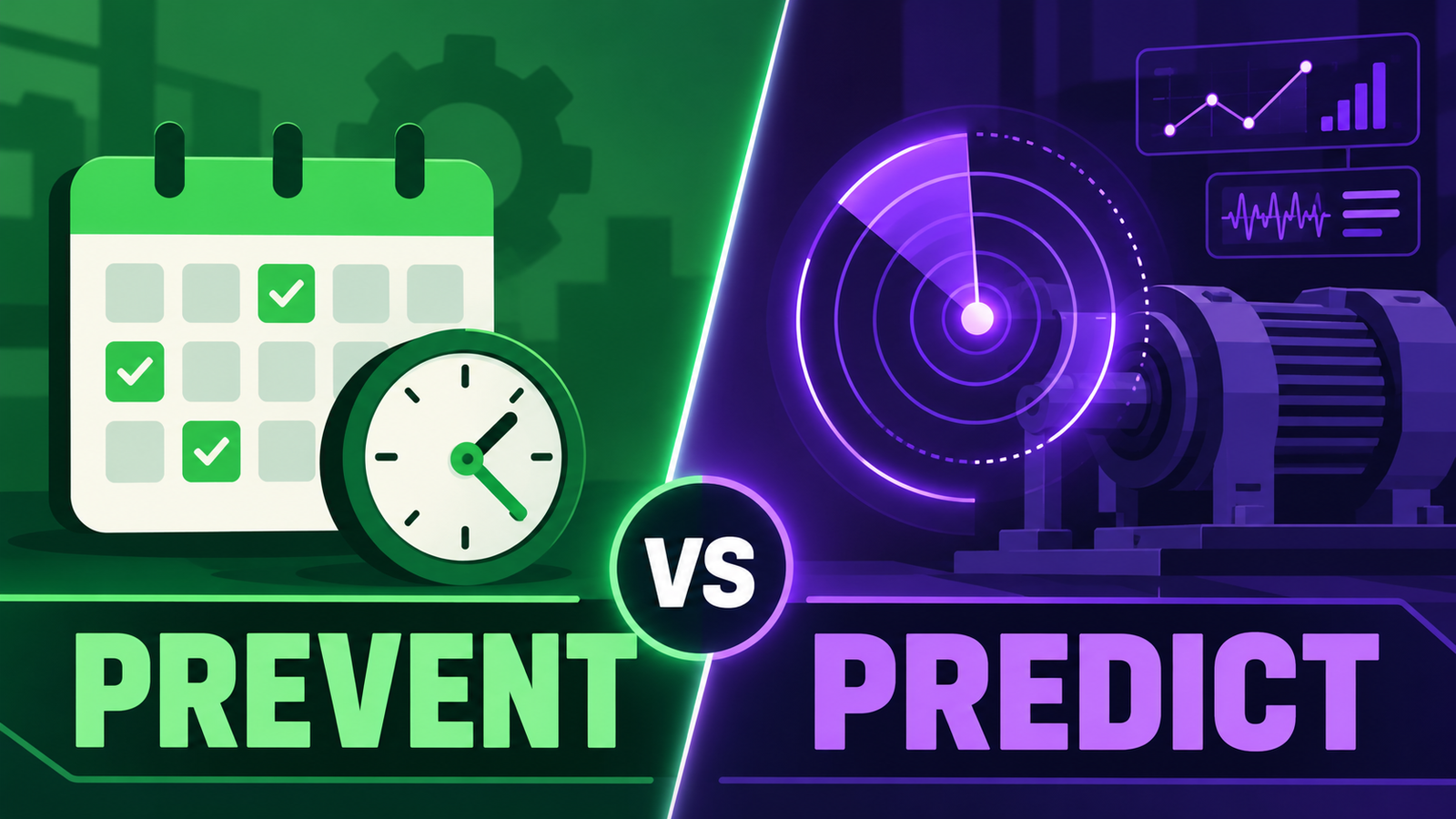
In preventive vs predictive maintenance, the core difference is the trigger. Preventive maintenance follows a planned schedule based on time or usage, while predictive maintenance uses asset condition and operational data to determine when maintenance may be needed. For electric utilities, both apply to transformers, breakers, switchgear, cables, poles and other assets, and neither is a universal replacement for the other.
The comparison matters because utilities manage large asset fleets with limited crews, budgets and outage windows. Modern programs usually combine preventive, predictive, condition-based, corrective and risk-based strategies, choosing by asset criticality, failure mode and data availability. This article compares the strategies and explains when each fits. For the foundation, see predictive maintenance for electric utilities.
Key Takeaway
- Preventive maintenance is scheduled maintenance.
- Predictive maintenance is condition- and data-driven maintenance.
- Preventive maintenance is useful when intervals are known or required.
- Predictive maintenance can identify changing asset condition before failure.
- Critical assets may benefit from combining both.
- Data quality and engineering validation are important.
What Is Preventive Maintenance?
Preventive maintenance is planned maintenance performed on a fixed schedule, by time or usage, to reduce the likelihood of failure.
It includes time-based and usage-based maintenance, inspection schedules, manufacturer recommendations and, where applicable, regulatory or safety requirements. Utility examples include transformer inspection, circuit breaker servicing, substation equipment inspection, vegetation management, pole inspection, battery maintenance and protection-system testing.
Preventive maintenance does not simply mean replacing parts at arbitrary intervals. Good programs set intervals from failure modes, experience, standards and manufacturer guidance, and many tasks are inspections and tests, not replacements.
What Is Predictive Maintenance?
Predictive maintenance is a strategy that uses asset condition and operational information to estimate when an asset may need maintenance, or how its failure risk is changing.
It supports condition-based decision making using continuous or periodic monitoring, sensor data, SCADA data, asset history, maintenance records, environmental information and, where useful, AI and machine learning.
Asset -> Monitoring -> Data Collection -> Data Quality -> Condition Assessment
-> Anomaly / Risk Detection -> Engineering Review -> Maintenance Decision
-> Maintenance Action -> Feedback
Preventive vs Predictive Maintenance: Core Difference
| Aspect | Preventive Maintenance | Predictive Maintenance |
|---|---|---|
| Maintenance trigger | Schedule (time or usage) | Condition and predicted risk |
| Main input | Intervals, standards, recommendations | Condition and operational data |
| Monitoring requirement | Low | Periodic or continuous |
| Sensors | Not required | Often useful, not always required |
| Data dependency | Low | High |
| Timing | Fixed | Variable, based on condition |
| Failure risk | Failure can occur between visits | Risk can be tracked, but not eliminated |
| Cost model | Predictable recurring effort | Monitoring and analytics investment |
| Asset suitability | Assets with known intervals or mandates | Assets with measurable degradation |
| Analytics | Minimal | Trends, rules, models |
| AI/ML requirement | None | Optional |
| Engineering judgment | Sets intervals | Validates alerts and decisions |
| Main challenges | May over- or under-maintain | Data quality, false alarms, cost |
| Utility applications | Inspections, testing, vegetation | Transformer and breaker condition |
Neither strategy is always cheaper or better.
Preventive vs Predictive vs Corrective vs Condition-Based Maintenance
| Concept | Trigger or Meaning | Typical Approach |
|---|---|---|
| Preventive | Time or usage schedule | Planned tasks |
| Predictive | Predicted condition or risk | Act on expected degradation |
| Corrective | Fault or defect found | Repair |
| Condition-based | Condition crosses a threshold | Maintain when triggered |
| Reactive | Failure | Run to failure, then repair |
| Asset health monitoring | Current condition | Observe and score |
| Failure prediction | Likelihood of a defined failure in a horizon | Estimate risk |
Condition monitoring is the measurement of condition. Condition-based maintenance acts when that condition crosses a limit. Predictive maintenance looks ahead, using condition and trends to estimate future risk. They are related but not exact synonyms.
Why the Comparison Matters
Strategy choice affects reliability, asset availability, safety, maintenance workload, asset life, outage risk, spare-parts planning, workforce planning, maintenance prioritization, capital planning and operational continuity. Matching strategy to asset and risk makes better use of limited resources.
Utility Asset Management Context
Asset Inventory -> Asset Criticality -> Condition -> Risk -> Maintenance Strategy
-> Work Planning -> Execution -> Performance Feedback
Strategy follows from criticality (how much the asset matters), condition (how it is performing), probability of failure and consequence of failure, summarized by an asset health index and used to prioritize work.
Conceptual Risk = Probability of Failure x Consequence of Failure
Actual utility risk methodologies can be more detailed. See electric grid reliability.
Condition Monitoring
Condition monitoring may include temperature, vibration, current, voltage, load, oil condition, dissolved gas analysis where relevant, partial discharge where relevant, breaker operating characteristics, environmental conditions and inspection observations. Measurements depend on asset type and failure mode, and no asset needs all of them.
Data Used for Predictive Maintenance
| Data Source | Example Data | Maintenance Value |
|---|---|---|
| Sensors | Temperature, vibration | Direct condition indicators |
| SCADA | Status, loading, alarms | Operating context |
| IoT devices | Remote condition readings | More frequent monitoring |
| Inspection records | Findings, test results | Observed condition |
| Maintenance history | Repairs, dates | Degradation patterns |
| Asset registry | Age, type, rating | Asset context |
| Weather | Temperature, wind, humidity | Environmental stress |
| Load data | Loading profiles | Thermal and electrical stress |
| AMI | Load and events | Operational context for some assets |
| GIS | Location, network | Spatial risk and consequence |
AMI does not replace dedicated equipment-condition monitoring.
Asset Health and Asset Health Index
Asset health describes an asset’s condition relative to its expected performance. It is expressed through health indicators, condition scores and health indexes, then combined with criticality to estimate risk. Remaining useful life is a related estimate. Utilities define indexes differently, and no universal scale is given here.
Predictive Maintenance Data Flow
Asset -> Sensors / Inspection -> Data Collection -> Communication -> Data Platform
-> Data Quality -> Feature Engineering -> Asset Health Assessment
-> Prediction / Risk Model -> Engineering Validation -> Maintenance Decision
-> Work Management -> Maintenance Action -> Feedback
- Collection and communication: measurements are captured and transported.
- Data platform and quality: data is stored and validated.
- Features and assessment: raw values become indicators and a health view.
- Prediction and validation: risk is estimated and checked by engineers.
- Decision, work and feedback: work is planned, executed and the outcome recorded.
AI and Machine Learning in Predictive Maintenance
| Model Type | Typical Use | Strength | Limitation |
|---|---|---|---|
| Logistic regression | Failure-risk classification | Interpretable | Linear assumptions |
| Decision trees | Classification | Easy to explain | Can overfit |
| Random forests | Risk classification | Nonlinear patterns | Less transparent |
| Gradient boosting | Risk prediction | Strong on tabular data | Needs tuning |
| XGBoost / LightGBM | Structured asset data | High predictive potential | Complexity |
| Neural networks | Complex signals | Flexible | Data and compute needs |
| Time-series models | Degradation trends | Temporal patterns | Assumptions |
| Survival models | Time to failure | Models timing | Needs event data |
| Anomaly detection | Unusual condition | Finds deviations | Anomaly is not failure |
ML is not mandatory. See AI-based predictive maintenance for utility assets.
Predictive Maintenance Without AI
Predictive maintenance can use thresholds, engineering rules, statistical analysis, condition indicators, trend analysis, alarm patterns and inspection history. A rising temperature trend checked against a limit is already predictive in practice. Predictive maintenance is not the same thing as AI.
Remaining Useful Life (RUL)
RUL is an estimate of remaining time or usage before a defined failure or degradation endpoint, under stated assumptions. Approaches include trend extrapolation, degradation models and survival analysis. RUL carries uncertainty and is not a guaranteed failure date, though it can help plan maintenance windows and spares. No accuracy figures are given.
Preventive Maintenance Workflow
Asset Register -> Maintenance Schedule -> Work Order -> Inspection / Service
-> Findings -> Maintenance Record -> Next Scheduled Activity
Strengths: simple, predictable, easy to plan and often required. Limitations: it may maintain healthy assets unnecessarily and may miss problems that develop between visits.
Predictive Maintenance Workflow
Asset -> Monitoring -> Data -> Condition Assessment -> Trend / Anomaly Detection
-> Risk Assessment -> Engineering Review -> Maintenance Decision
-> Work Order -> Maintenance -> Feedback
Compared with preventive maintenance, the trigger comes from data and not the calendar, so it needs monitoring and analytics, and it can adjust timing to actual condition.
Asset-Specific Applications
The following are illustrative, and available data differs by asset.
- Transformers: temperature, loading, oil condition, dissolved gas analysis, insulation condition and maintenance history.
- Circuit breakers: operation counts, timing, coil or current signatures where applicable, mechanical condition and inspection records.
- Switchgear: temperature, partial discharge where applicable, inspection and operating history.
- Cables: insulation condition, thermal loading, testing and fault history.
- Poles and overhead lines: visual inspection, structural condition, vegetation, weather exposure, age and environmental conditions.
Transmission and Distribution Applications
Transmission: transformers, circuit breakers, protection equipment, lines and substation assets. Distribution: distribution transformers, switches, reclosers, feeders, poles and conductors.
Criticality, monitoring availability and network topology influence strategy. A heavily relied-on transmission transformer may justify continuous monitoring, while a large population of low-consequence distribution assets may rely on scheduled inspection.
Preventive vs Predictive Maintenance for AMI and Smart Grid
Smart meters, AMI communication, meter events, remote diagnostics, distribution automation, sensors and asset monitoring all produce data. Data quality determines how useful it is. AMI data can provide operational signals, such as loading patterns or event clusters, but it does not replace dedicated equipment-condition monitoring for every asset. See how smart grid technology works, head-end systems in AMI and meter data management systems.
Maintenance Strategy Selection Framework
Consider asset criticality, failure consequence, failure predictability, condition monitoring and sensor availability, data quality, maintenance cost, failure mode, asset age, regulatory and safety requirements and workforce capability.
| Situation | May Suit | Why |
|---|---|---|
| Mandated inspection or test | Preventive | Required regardless of condition |
| Known wear-out interval | Preventive | Schedule fits the failure mode |
| Measurable degradation, sensors available | Condition-based or predictive | Condition drives timing |
| Critical asset, high consequence | Combined | Layers reduce risk |
| Low-consequence, low-cost asset | Corrective or light preventive | Monitoring cost may not be justified |
| Poor data quality | Preventive until data improves | Predictions would be unreliable |
Benefits and Business Value
These approaches can help reduce unexpected failures, improve maintenance prioritization and workforce planning, improve asset visibility and spare-parts planning, support reliability decision-making, may reduce unnecessary maintenance, support asset-life planning and improve risk management. No ROI or savings figures are given, and results depend on implementation.
Maintenance KPIs
Useful KPIs include planned maintenance compliance, preventive maintenance completion, predictive alert-to-action time, mean time between failures, mean time to repair, asset failure rate, maintenance backlog, condition coverage, critical asset monitoring coverage, false positive rate, false negative risk, data quality indicators, maintenance cost per asset and unplanned outage contribution. No benchmark values are given, and each utility should compare against its own baseline. See grid reliability metrics.
Hypothetical Utility Scenarios
All scenarios below are illustrative and hypothetical. They describe no real utility or measured data.
- Scenario 1, Transformer: a utility inspects a transformer on a fixed cycle. With condition monitoring, a rising temperature trend between visits prompts an earlier inspection, and engineers decide the action.
- Scenario 2, Circuit breaker: operating history and condition indicators show changing timing. Engineers compare it with the breaker’s service interval and decide whether to bring servicing forward.
- Scenario 3, Distribution asset: inspection findings and operational data are combined to rank pole-mounted equipment, so crews visit the highest-priority units first.
- Scenario 4, Critical infrastructure / data center: backup-power transformers and switchgear keep scheduled preventive tests and add monitoring to improve risk awareness, since an outage would have high consequence. This supports planning and does not guarantee uptime.
Challenges
Challenges include data quality, sensor reliability, missing data, legacy-system integration, model accuracy, false positives and negatives, cybersecurity, workforce skills, monitoring cost, data storage, model drift, limited historical failure data, explainability and the need for engineering validation.
Common Mistakes
- Treating predictive maintenance as only AI.
- Installing sensors without a clear use case.
- Ignoring asset criticality.
- Using poor-quality data.
- Treating every anomaly as failure.
- Automatically trusting model predictions.
- Ignoring engineering judgment.
- Completely replacing preventive maintenance.
- Ignoring cybersecurity.
- Not measuring outcomes.
Implementation Roadmap
- Phase 1, Asset inventory.
- Phase 2, Criticality assessment.
- Phase 3, Failure mode analysis.
- Phase 4, Data collection.
- Phase 5, Condition monitoring.
- Phase 6, Analytics and prediction.
- Phase 7, Engineering validation.
- Phase 8, Maintenance workflow integration.
- Phase 9, KPI measurement.
- Phase 10, Continuous improvement.
Final Comparison
| Aspect | Preventive | Predictive |
|---|---|---|
| Trigger | Schedule | Condition and risk |
| Data requirement | Low | High |
| Monitoring | Not required | Periodic or continuous |
| Planning | Calendar-based | Condition-based |
| Cost model | Recurring tasks | Monitoring and analytics |
| Failure-risk approach | Reduce through routine work | Track and prioritize risk |
| Best use cases | Mandated or interval-driven work | Measurable degradation, critical assets |
| Limitations | May over- or under-maintain | Data and validation needs |
| AI requirement | None | Optional |
| Utility application | Inspections, testing | Transformer and breaker condition |
Preventive and predictive maintenance are complementary rather than competing strategies. Utilities choose the right mix by asset, risk and data. See also machine learning for outage prediction and outage detection.
Frequently Asked Questions About Preventive vs Predictive Maintenance
What is preventive vs predictive maintenance?
Preventive maintenance is performed on a planned schedule based on time or usage, such as routine inspections and servicing. Predictive maintenance uses asset condition and operational data to estimate when maintenance may be needed.
They are complementary. Utilities often use both, depending on asset criticality, failure mode and available data.
How does preventive vs predictive maintenance work?
Preventive maintenance follows a schedule from the asset register to work orders, service, findings and the next scheduled activity. Predictive maintenance collects condition data, checks quality, assesses condition and risk, and triggers work after engineering review.
In both cases outcomes are recorded and fed back to refine the program.
Why is preventive vs predictive maintenance important?
The choice affects reliability, safety, maintenance workload, asset life and spare-parts and workforce planning. Matching strategy to asset criticality and failure mode can help use limited crews and budgets more effectively.
Neither strategy is always cheaper or better, so the comparison guides a sensible mix.
What are the main components of preventive vs predictive maintenance?
Preventive maintenance relies on an asset register, schedules, work orders, inspection and service tasks and maintenance records. Predictive maintenance adds condition monitoring, data collection and quality checks, condition and risk assessment, engineering validation and a feedback loop.
Both depend on accurate asset information and good work management.
What are the challenges of preventive vs predictive maintenance?
Preventive maintenance can over-maintain healthy assets or miss problems between visits. Predictive maintenance faces data quality issues, sensor reliability, false positives and negatives, limited failure history, integration with legacy systems, cybersecurity and skills.
Both need engineering judgment, and predictive programs also need model monitoring.
Where is preventive vs predictive maintenance used?
Both are used across transmission and distribution assets, including transformers, circuit breakers, switchgear, cables, poles, reclosers and substation equipment, as well as in critical facilities such as data centers and hospitals.
Preventive work suits mandated or interval-driven tasks, while predictive approaches suit assets with measurable degradation and sufficient monitoring data.
What data is used for predictive maintenance in electric utilities?
Common data includes sensor measurements, SCADA status and loading, inspection and test records, maintenance history, asset registry details, failure history, weather, load and GIS information. AMI data can add operational context for some assets.
AMI does not replace dedicated equipment-condition monitoring, and availability varies by asset and utility.
How does AI and machine learning support predictive maintenance?
AI and machine learning can learn patterns across condition signals to flag abnormal behavior, estimate failure risk and rank assets for inspection. Methods include classification, time-series and survival models and anomaly detection.
ML is not mandatory, since thresholds and trend analysis can also work. Outputs are estimates that engineers validate before any maintenance decision.

I share real stories, practical ideas and honest perspectives on business, marketing and life. This blog is a space to learn, grow and connect.