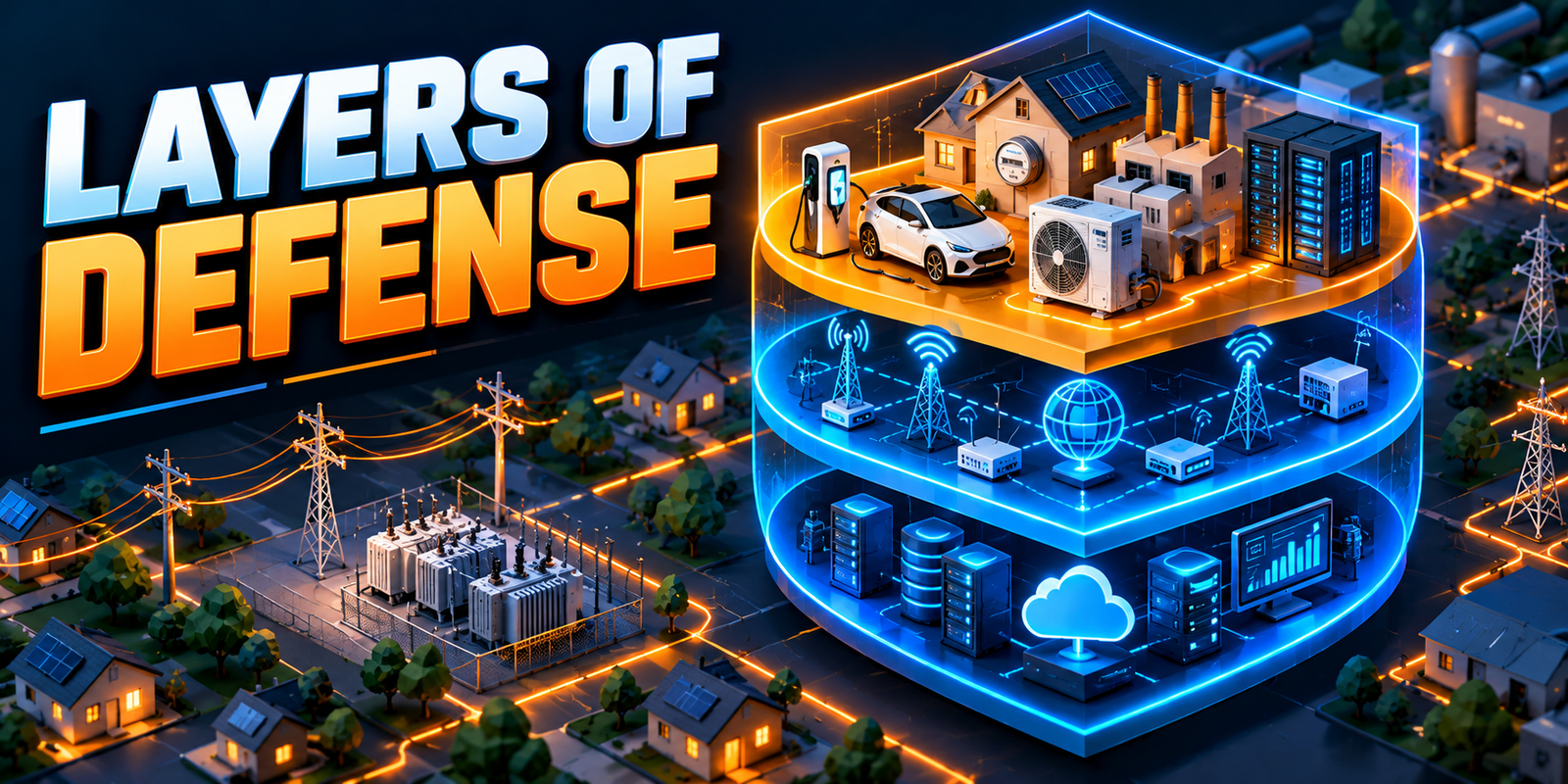

AI cybersecurity for electric utilities is the use of artificial intelligence to help detect, analyze and respond to threats against utility digital systems and notice unusual activity.
Electric utilities are connecting more of their operations than ever before. Operational technology (OT) now shares data with smart meters, digital substations, communication networks, cloud services and analytics platforms, and each connection adds activity that security teams must be able to see and understand. Often searched as “AI cybersecurity utilities”, this topic is about using artificial intelligence to help defenders notice unusual activity across that expanding environment, prioritize what deserves attention and investigate it efficiently.
This guide explains how AI cybersecurity for utilities works, why it matters, and how machine learning, anomaly detection and monitoring can support the defense of modern power systems. It is written for utility cybersecurity teams, OT security professionals, engineers and critical-infrastructure leaders. It is defensive and educational, and it treats AI as an aid to sound security fundamentals, not a replacement for them. No tool or model can independently guarantee protection, and every practice here should be evaluated against a utility’s own architecture, risks and obligations.
Key Takeaways
- AI-assisted detection helps identify unusual patterns and prioritize alerts. It does not replace access control, segmentation, patching or incident response.
- Monitoring in OT environments must respect safety, availability and compatibility, and should be coordinated with engineers and operators.
- Anomalies are not incidents. Maintenance, load changes and faults can look suspicious, so context and human review are essential.
- Models need representative data, validation, drift monitoring and documented governance.
- Standards and obligations vary by utility, so applicability should always be confirmed locally.
What Is AI Cybersecurity for Utilities?
AI cybersecurity for utilities is the use of machine learning and related analytics to support security monitoring, threat detection, anomaly detection and incident triage in electric utility IT and OT environments, under the oversight of authorized defenders.
It relates to several activities. Threat detection looks for signs of malicious activity. Security monitoring collects and reviews telemetry continuously. Anomaly detection flags departures from normal behavior. Incident triage helps analysts decide what to investigate first.
AI-assisted detection differs from traditional approaches in how it recognizes problems. Rules and signatures look for specific conditions that were defined in advance, which is precise but limited to what is already known. Conventional monitoring often relies on fixed thresholds. Machine learning can instead learn patterns from data and highlight activity that departs from them, which can surface unfamiliar behavior but also produces uncertain results that need review. In practice, mature programs combine both. See machine learning vs traditional utility analytics for a broader comparison of approaches.
Why Cybersecurity Matters in Modern Power Systems
Utility security rests on the familiar goals of confidentiality, integrity and availability, but with two additions that matter in power systems: safety and operational continuity. A security measure that disrupts a control process can itself create risk.
Operational technology has distinctive characteristics:
- Long asset lifecycles. Equipment can remain in service for many years, sometimes decades.
- Availability requirements. Many systems cannot be taken offline casually.
- Legacy equipment. Older devices may have limited security features or cannot be updated easily.
- Safety considerations. Changes to control environments must account for physical consequences.
Missed threats could, in principle, affect data integrity, system availability or operational decisions, but this article makes no claims about how often that happens or how severe the effects would be. The impact depends on the system, its design and its safeguards. The practical point is that visibility and early detection give defenders more time and better information.
How AI Threat Detection Works
Systems differ in what they collect and which models they use, but the defensive workflow is broadly similar:
- Collect authorized telemetry. Gather security and operational data that the utility has approved for monitoring.
- Validate and prepare the data. Check quality, normalize formats and align timestamps.
- Establish baselines or apply trained models. Learn what normal looks like, or use models trained to recognize known patterns.
- Identify deviations or known patterns. Flag activity that departs from baselines or matches learned patterns.
- Correlate with context and other signals. Combine findings with asset information, change records and other evidence.
- Present alerts for review. Deliver prioritized alerts to analysts for triage.
- Support investigation and response. Help analysts investigate under approved procedures.
The quality of each step determines the quality of the next. Poor data produces unreliable baselines, and unreliable baselines produce noisy alerts. For background on how utility data is gathered, see how smart grid technology works from field devices to control systems.
Common Data Sources for Utility Cybersecurity Monitoring
The table below lists typical sources at a high level. Availability varies by architecture and vendor.
| Data source | What it can show | Consideration |
|---|---|---|
| Network and security logs | Communication patterns, firewall and gateway events | Volume can be high and needs filtering |
| Authentication and access events | Who accessed what and when | Valuable for spotting unusual access |
| Endpoint and server telemetry | Host activity, where supported | May not be possible on legacy OT devices |
| SCADA and OT monitoring metadata | Communication behavior and device activity | Collection must not disturb operations |
| AMI and smart meter security events | Device and head-end events | Large device populations and varied vendors |
| Device health and communication status | Whether devices and links behave normally | Helps separate faults from suspicious activity |
| Configuration and change records | Planned and unplanned changes | Provides context for anomalies |
| Threat intelligence | Known indicators and advisories | Use trusted sources and check relevance |
| Cloud and enterprise logs | Activity in connected services | Include where linked to utility operations |
Collection has to respect safety, privacy, data governance, system compatibility and operational constraints. More data is not automatically better, and collecting sensitive data, such as detailed customer information, creates its own obligations. See AI-based anomaly detection for smart meter data for how meter data can be analyzed.
Machine Learning Approaches for Threat Detection
Several families of techniques are used, each with different data needs and suitable uses.
Supervised, Unsupervised and Semi-Supervised Learning
- Supervised learning learns from labelled examples and suits known, well-characterized patterns. Its weakness is that confirmed incident examples in utilities are scarce, and it can miss unfamiliar behavior.
- Unsupervised learning explores data without labels and suits finding unusual patterns. It can surface the unexpected but produces many anomalies that are benign.
- Semi-supervised approaches use a small amount of labelled data with much more unlabelled data, which is helpful where labels are limited.
Time-Series Analysis, Classification and Clustering
Time-series analysis studies how behavior changes over time, such as daily and seasonal rhythms. Classification assigns observations to categories, and clustering groups similar observations so that outliers stand out. At a conceptual level these help distinguish normal from unusual behavior.
Combining Rules and Machine Learning
Many utilities pair deterministic rules for well-understood conditions with machine learning for the rest. Rules are transparent and predictable, while models can cover broader patterns. A hybrid design often gives analysts more confidence than either alone.
A model score is a measure of statistical unusualness or similarity, not proof of an incident. Treating it as proof is a common mistake. No performance figures are given here because results depend entirely on data, environment and implementation. See how electric utilities use machine learning for general practice.
Anomaly Detection in Power Systems
A baseline describes normal behavior for a system, device or user, usually learned over a period of time. Deviations from that baseline are flagged for review. Examples of what defenders may watch for, kept generic, include:
- Unusual authentication patterns, such as access at unexpected times or from unexpected places.
- Unexpected communication behavior between systems that do not normally interact.
- Changes in device activity compared with its usual pattern.
- Abnormal sequences of security events that are unusual taken together.
An anomaly is not a threat. Legitimate maintenance, seasonal load changes, configuration updates, equipment faults and communication problems can all generate unusual patterns. Contextual validation reduces false alarms. Analysts check whether a change was scheduled, whether a device was being serviced, whether other independent sources show the same behavior and whether device and communication health explain the difference. See AI anomaly detection in electric utilities for related analytical ideas.
AI Monitoring Across Utility Environments
Monitoring needs differ across the utility. Capabilities vary by architecture and vendor, and monitoring should never involve intrusive actions that could interfere with live operations.
- Transmission and distribution operations depend on timely, reliable data, so monitoring should be non-disruptive.
- SCADA and energy management environments are sensitive to latency and load, which favors careful, approved collection methods.
- Digital substations and connected devices combine many devices and communication flows. See digital substations.
- Smart meters and AMI involve very large device populations and layered communication paths. See advanced metering infrastructure.
- Head-End Systems (HES) and Meter Data Management Systems (MDMS) are central platforms whose administrative and integration activity merits monitoring. See head-end systems in AMI and meter data management systems.
- Utility data centers and connected cloud services add enterprise-style logs that should be correlated with operational ones.
AI for OT and IT/OT Security
Enterprise IT and utility OT differ in priorities. IT often emphasizes confidentiality and rapid change. OT emphasizes availability, latency, safety and long-term stability, and many devices cannot be scanned, patched or restarted without planning.
Several practices help adapt AI-assisted monitoring to OT:
- OT-aware baselines that reflect real operating rhythms, including maintenance and seasonal patterns.
- Approved passive monitoring where appropriate, which observes traffic without interacting with devices.
- Change control, so planned changes are known and explain their own anomalies.
- Coordination with control-room and engineering personnel before and during deployment.
Collaboration is the key. Cybersecurity teams understand threats, engineers understand equipment and processes, operations staff understand what is normal, and incident responders coordinate action. None of these groups can interpret alerts well alone. See power system automation for context on the systems involved.
Threat Correlation and Alert Prioritization
A single weak signal rarely tells a full story. AI-supported systems can combine multiple signals, enrich alerts with asset and change context, group related events and help analysts rank investigations. This can reduce noise and speed up triage.
Correlation has limits. Events that appear related may not be, and relationships may be missed when data is incomplete. Correlation should not be confused with confirmed attribution or proof of compromise. It is a way of organizing evidence for human judgment, and its output should be treated as a lead to verify.
AI-Assisted Incident Response
Used appropriately, AI can support analysts during an investigation by:
- Summarizing alerts and relevant logs.
- Helping organize evidence.
- Suggesting investigation questions.
- Identifying related events for authorized review.
- Supporting reporting and post-incident analysis.
Decisions about containment, isolation, control changes and recovery in OT environments belong to authorized personnel following approved procedures. Autonomous changes to live grid operations should not be recommended without validated safeguards and explicit operational governance. Summarization tools also create their own data-handling questions, so see generative AI in electric utilities for governance considerations.
AI Model Training, Validation and Maintenance
A detection model is a system that needs lifecycle management, not a one-time installation.
- Data quality and representativeness. Training data should reflect real operating conditions across seasons, equipment states and maintenance patterns.
- Label quality. Confirmed incidents are rare, so labels may be limited or uncertain.
- Training, validation and testing. Use separate data to check how a model behaves on information it has not seen.
- Drift. Operating conditions change, so models can become less reliable over time.
- False positives and false negatives. Track both, since each has operational cost.
- Version control and change management. Record which model version is in use and what changed.
- Periodic reassessment and approval. Review models on a schedule and document approvals.
- Human review and explainability. Analysts should be able to understand why an alert was raised.
No accuracy figures, benchmark scores or cost savings are claimed here. They depend on the environment and cannot be assumed.
Risks and Limitations of AI Cybersecurity
- False alarms and missed threats. Both occur, and reducing one can increase the other.
- Incomplete or biased data leading to blind spots.
- Model drift as conditions evolve.
- Limited explainability that makes alerts hard to trust or challenge.
- Data privacy and retention concerns when monitoring involves sensitive data.
- Dependence on vendor platforms, which can limit transparency and portability.
- Integration with legacy OT, where telemetry may be thin.
- Alert fatigue and overreliance on automation.
- Compromised or untrustworthy inputs. Models are only as dependable as the data and logs they consume, so the integrity of telemetry matters.
- Governance challenges when AI-generated recommendations influence security decisions.
AI can support defenders but cannot independently guarantee security or replace established OT controls, and treating it as a guarantee is itself a risk.
Defensive Architecture and Best Practices
AI works best as one layer in a defense-in-depth design. Practical recommendations include:
- Asset inventory and risk assessment so you know what you are protecting.
- Network segmentation and controlled communications between zones.
- Strong identity and access management, with least privilege and privileged-account oversight.
- Secure configuration and patch management, planned around operational constraints.
- Centralized, protected logging where appropriate.
- Validated monitoring and alert escalation with named owners.
- Data governance and secure integrations for the data that feeds analytics.
- AI model governance and human oversight.
- Tested incident-response and recovery procedures.
- Vendor and supply-chain risk management.
- Regular review, exercises and continuous improvement.
Each item reduces the chance of an incident or limits its consequences, and AI helps by making problems visible sooner. It adds value on top of these measures, not instead of them.
Standards, Guidance and Governance
Several sources of guidance are relevant. None applies identically to every utility, and voluntary guidance differs from organizational policy and from binding legal or regulatory obligations. Check current versions and applicability with the issuing bodies and with legal and regulatory advisers.
- NIST Cybersecurity Framework (CSF) 2.0. Released on 26 February 2024, it adds a Govern function and is voluntary guidance.
- NIST SP 800-82 Rev. 3, Guide to Operational Technology (OT) Security. Published in September 2023, it addresses OT security with attention to performance, reliability and safety.
- NISTIR 7628 Rev. 1, Guidelines for Smart Grid Cybersecurity. Published in 2014, it offers smart grid background and is best read with newer guidance.
- NIST AI Risk Management Framework (AI RMF 1.0). Released on 26 January 2023 as voluntary guidance for managing AI risks, it organizes work around Govern, Map, Measure and Manage. Check NIST for any revisions.
- IEC 62443 series. Standards for industrial automation and control system security, relevant where a utility’s environment falls within that scope.
Frameworks work best as structured ways to ask questions. Governance turns them into practice through ownership, policy, training and periodic review.
Hypothetical Defensive Scenario
Hypothetical example. This scenario is fictional. It does not describe a real utility, incident or case study, and it contains no attack details.
Imagine that a utility’s AI-assisted monitoring platform flags a combination of unusual access and communication patterns: an account accesses a system outside its normal hours, and that system communicates with a device it does not usually contact.
- Validate the alert. Analysts confirm the alert reflects real events and check data quality and timestamps.
- Check logs and independent sources. They review authentication and communication logs and compare them with other approved monitoring sources.
- Consider benign explanations. They check change records, maintenance schedules, device health and communication status for an ordinary cause.
- Escalate appropriately. Because part of the pattern cannot be explained, they involve OT engineers and control-room personnel and open an incident under the approved process.
- Document findings. The team records what was examined and concluded, and reviews whether the model, baselines or procedures need adjustment.
The scenario shows validation, context and coordination. It is not a procedure, and real steps depend on each utility’s systems, authorizations and safety requirements.
Practical Implementation Checklist
Use this list as a set of practices to evaluate. It is not a guarantee of protection or compliance.
- Monitoring objectives: Are goals and scope defined?
- Inventory: Are assets and data sources documented?
- Approved telemetry: Is collection authorized and safe for operations?
- Data quality and governance: Are quality, retention and privacy rules defined?
- Model validation and evaluation: Are models tested and re-evaluated on a schedule?
- Triage and escalation: Do alerts have owners and escalation paths?
- OT-safe monitoring and response: Are methods approved by engineering and operations?
- Access and integration security: Are analytics platforms and integrations protected?
- Human oversight: Do qualified people review and decide?
- Vendor assurance: Are supplier obligations and data handling clear?
- Incident-response testing: Are procedures rehearsed with IT and OT together?
- Periodic review: Are lessons learned fed back into improvements?
Future of AI Cybersecurity in Utilities
Several directions are being explored, and none is certain. Security analytics may become better at correlating signals across systems. Explainable approaches may help analysts understand and trust results. Monitoring that is more privacy-conscious may reduce the amount of sensitive data analyzed. Detection that is more OT-aware may reflect equipment behavior and operating context more closely. How quickly any of this matures will differ between utilities and vendors. See how AI is transforming electric utilities for the wider context.
Conclusion: AI Cybersecurity for Utilities Works Best as One Layer
AI cybersecurity utilities programs can help security teams spot suspicious patterns and prioritize investigations across growing, interconnected power systems. That value depends on validated data, sound governance, human oversight and the established controls that AI is meant to support: access management, segmentation, patching, logging and tested incident response. Utilities that treat AI as one layer in a defense-in-depth approach, coordinate IT and OT teams, and keep validating and improving their models and procedures are better placed to protect critical infrastructure as it becomes more digital.
Frequently Asked Questions About AI Cybersecurity for Utilities
What is AI cybersecurity utilities?
It refers to AI cybersecurity for utilities: using machine learning and related analytics to support threat detection, security monitoring, anomaly detection and incident triage in electric utility IT and OT environments. It assists authorized defenders and does not replace established security controls.
How does AI cybersecurity utilities work?
AI cybersecurity for utilities collects authorized security and operational data, validates it, builds baselines or applies trained models, flags unusual or known patterns, correlates them with context and presents prioritized alerts for human review and response under approved procedures. Methods vary by system and vendor.
Why is AI cybersecurity utilities important?
Power systems are increasingly connected, producing large amounts of data that are hard to review manually. AI-assisted monitoring can help analysts notice unusual patterns and prioritize investigations, supporting reliability and safety when it is validated and used alongside strong security controls and human judgment.
What are the main components of AI cybersecurity utilities?
The main components of AI cybersecurity for utilities are authorized data sources, data preparation, baselines and detection models, correlation and alert prioritization, analyst review and incident response, and governance covering model validation, access control and human oversight.
What are the challenges of AI cybersecurity utilities?
Challenges include false positives and missed detections, noisy or incomplete data, limited labelled incidents, model drift, limited explainability, legacy OT integration, vendor dependence, privacy concerns, alert fatigue and the need to protect systems without compromising safety or availability.
Where is AI cybersecurity utilities used?
AI cybersecurity for utilities is used in utility security operations covering enterprise IT, SCADA and energy management environments, substations, smart meter and AMI systems, head-end and meter data platforms, and connected cloud services, depending on each utility’s architecture and approvals.

I share real stories, practical ideas and honest perspectives on business, marketing and life. This blog is a space to learn, grow and connect.