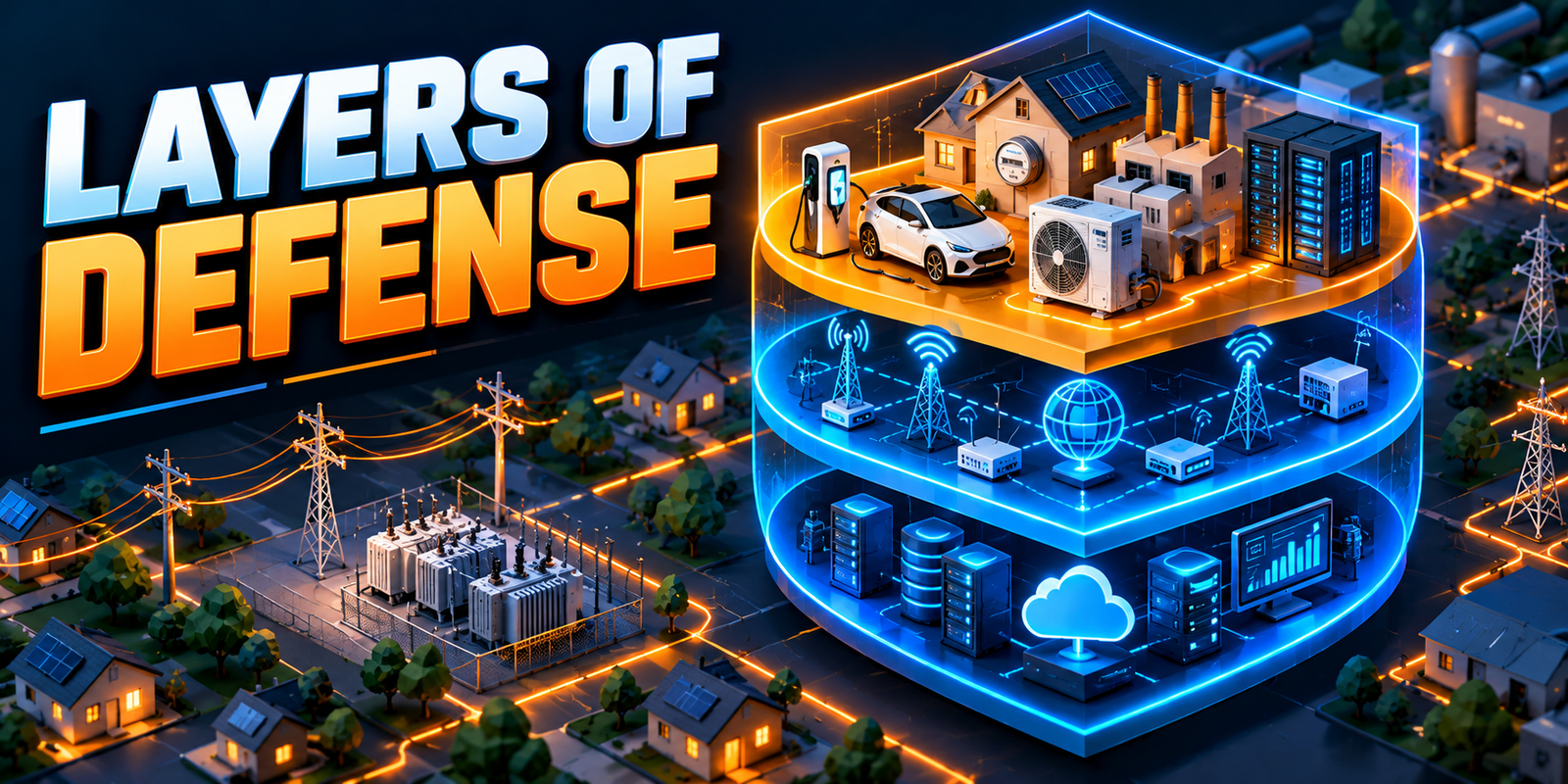

Data centers are the physical foundation of the digital economy. They host the servers, storage and networks behind cloud services, streaming, financial systems and a growing share of artificial intelligence. Every one of those functions depends on electricity, which is why data center electrification, the dependence of computing infrastructure on large, continuous and reliable electrical supply, has become a topic of interest for utilities and grid planners. A single large facility can place a significant load on a local network, and clusters of facilities can influence regional planning.
This guide explains how data centers use electricity, why their demand can grow, how that demand reaches the grid and how utilities can prepare. It is written for grid planners, utility engineers, energy strategists, EV professionals and researchers. Electricity requirements differ widely with facility size, workload, hardware, cooling design, utilization and location, so no single description fits every facility. This article quotes no external statistics, and all numbers in the example are hypothetical. For background on the networks involved, see how electricity moves through generation, transmission and distribution networks.
Key Takeaway
- Data centers depend on continuous electricity for computing, cooling and support systems.
- Planned capacity is not the same as actual consumption, so forecasts should use scenarios.
- The grid connection, transformers, feeders and substations often set the practical limit on a new site.
- Backup systems support reliability; they are not normally a continuous grid resource.
- Impacts are local, so early coordination between developers and utilities matters.
What Is Data Center Electrification?
Data center electrification, as used in this article, is the reliance of computing infrastructure and its supporting systems on large, continuous and reliable electrical supply, and the planning of power infrastructure to meet it.
Servers, networking equipment and storage systems convert electricity into computation, data movement and data retention, and nearly all of that electricity ends up as heat. Cooling systems then use more electricity to remove the heat. Lighting, security, controls and other facility systems add smaller loads. Because services must stay available, data centers need supply that is continuous and reliable, backed by redundancy and monitoring.
This is different from the wider electrification of transportation, buildings and industry, which replaces fuel use with electricity. Data centers were already electric. Their significance comes from the scale and concentration of their demand and from the growth in computing. They share one feature with other electrification trends: demand that concentrates at specific network locations. For comparisons, see the electric grid in 2035, which discusses how several demand drivers interact.
How Does Data Center Electrification Work?
Electricity passes through a chain of systems, and each has its own role. The arrangement depends on facility requirements, so not every data center uses the same configuration.
| Stage or System | Role | Planning Consideration |
|---|---|---|
| Electricity supply | Provides power from the grid or another suitable source | Availability and capacity at the site |
| Utility connection and incoming infrastructure | Brings supply into the facility | Agreed capacity and connection requirements |
| Transformers and switchgear | Convert voltage and route and protect circuits | Ratings, redundancy and lead times |
| Power distribution units and facility distribution | Deliver power to rooms, rows and racks | Rack density and balanced loading |
| UPS systems | Bridge short interruptions and condition power | Stored energy is limited |
| Backup generators and other arrangements | Supply power in longer outages where installed | Fuel, testing and permits |
| Racks, computing and networking | Perform the computing work | Load depends on hardware and utilization |
| Cooling and thermal management | Remove heat from the equipment | Adds to total facility demand |
| Monitoring, automation and energy management | Provide visibility and control | Data quality and response procedures |
These systems have to be designed together. A decision about redundancy affects transformer and UPS sizing, and a decision about cooling affects both electrical capacity and total demand.
Why Data Center Electricity Demand Is Increasing
Several factors can drive demand, and they affect facilities differently:
- Cloud computing concentrates workloads in large facilities.
- Artificial intelligence and high-performance computing use accelerator hardware that can draw substantial power.
- Digital services and data storage keep growing in volume.
- Higher computing workloads raise utilization.
- Server and rack power density can rise with newer hardware.
- Cooling requirements grow with heat output.
- Facility size and utilization determine total load.
- Redundancy and reliability requirements add supporting equipment and losses.
Growth is not uniform. Some facilities expand quickly, while others stay close to their original size. Efficiency improvements in hardware, cooling and facility design can offset part of the growth in workload, so demand depends on both. For related forecasting context, see AI for electricity load forecasting.
Data Center Power Demand: Energy, Capacity and Peak Load
Precise terms prevent common planning errors.
| Term | Meaning | Why It Matters |
|---|---|---|
| Electricity consumption (kWh, MWh) | Energy used over a period | Drives annual totals and billing |
| Electrical demand (kW, MW) | Rate of use at a moment | Sizes equipment and connections |
| Installed equipment capacity | What equipment is rated to carry | Sets design limits, not actual use |
| Maximum vs actual operating demand | Highest possible or planned load vs what is drawn | Planning uses the first; operations see the second |
| Average and peak demand | Mean and highest load over a period | Peak drives network capacity |
| IT load vs total facility demand | Computing equipment alone vs everything including cooling and losses | The grid supplies the total |
Annual energy alone is insufficient for sizing a grid connection, because networks are limited by power at the busiest times. A facility that runs steadily and one that has sharp peaks can use the same annual energy and need very different capacity. Total facility demand is commonly estimated as IT load multiplied by a factor that reflects cooling and conversion overhead, such as the power usage effectiveness (PUE), though the right value depends on the site.
Main Electrical Components of a Data Center
- Grid connections and incoming supplies link the site to the utility.
- Transformers step voltage down in stages.
- Medium- and low-voltage switchgear routes and protects power.
- Circuit breakers and protective devices clear faults.
- Busways and power distribution units carry power to racks.
- UPS systems and batteries maintain supply through short interruptions.
- Backup generators cover longer outages.
- Power monitoring and control systems provide visibility.
- Grounding and electrical safety systems protect people and equipment.
Component selection and configuration depend on load requirements, redundancy strategy, local standards and facility design. For a closer look at one key asset type, see digital substations.
Cooling Systems and Their Effect on Electricity Demand
Cooling is a major consideration in data center energy planning, since the heat that equipment produces must be removed continuously. The IT equipment’s demand and the facility’s total demand are linked, because more IT load means more heat to remove and so more cooling energy.
- Air cooling uses fans and airflow management. It is mature and widely used.
- Liquid cooling carries heat away more effectively and is increasingly used for dense equipment, but it is not required for every installation.
- Cooling distribution and heat rejection move heat out of the building, using fans, pumps, chillers or dry coolers.
- Fan and pump energy is part of the facility load.
- Environmental conditions affect how much cooling energy is needed.
Cooling requirements vary with climate, equipment, workload and system design. High-density computing changes thermal requirements, and cooling and electrical design need to be planned together. This article does not claim universal efficiency numbers, because they depend on the specific facility and how it is measured.
AI Data Centers and High-Density Computing
AI and high-performance computing can affect several parts of the planning picture. Accelerator-based racks can draw more power per rack than many general-purpose racks, which raises rack density, total facility demand, cooling requirements and the design of power distribution. It can also change how demand is forecast, what utility connection is requested and what reliability arrangements are chosen.
| Planning Area | Possible Effect | Qualification |
|---|---|---|
| Rack power density | Higher power in each rack | Varies by hardware and design |
| Total facility demand | Larger aggregated load | Depends on scale and utilization |
| Cooling infrastructure | More heat to remove; liquid cooling may be needed | Not universal |
| Power distribution design | Higher currents and different layouts | Design-specific |
| Demand forecasting | Greater uncertainty in load and growth | Workloads differ |
| Utility connection requirements | Larger or more phased connection requests | Depends on location and network |
| Reliability and redundancy | More equipment to maintain availability | Targets vary by application |
Not every AI workload has the same energy profile. Training, inference and other uses behave differently, and facilities differ in design, so identical infrastructure should not be assumed.
How Data Centers Affect Grid Capacity and Utility Planning
Large or fast-growing data center loads can affect several parts of the network. Whether they do depends on location, facility size, load profile, existing network capacity and the timing of other demand. For the structure of these networks, see transmission vs distribution networks.
| Network Element | Possible Effect | Planning Response |
|---|---|---|
| Distribution transformers | Loading approaches ratings | Check against peak demand and thermal limits |
| Feeders and distribution circuits | Conductor and voltage limits restrict supply | Reinforce or add circuits |
| Substations | Firm capacity is used up | Add or upgrade transformers |
| Transmission connections | Larger loads may connect at higher voltage | Studies and coordination with the system operator |
| Local connection capacity | May be less than requested | Stage the connection |
| Thermal ratings of equipment | Overheating risk at high loading | Use realistic profiles and monitoring |
| Voltage regulation and power quality | Large loads and power electronics affect voltage | Voltage and power-quality studies |
| Protection coordination | New loads and sources change fault levels | Protection studies |
| Investment and upgrade timelines | Equipment can take long to deliver | Early procurement and planning |
Many sites connect with limited reinforcement, and others, in constrained areas, need substantial work. The effect should be assessed locally and not assumed from general claims. For a broader discussion of the data needed, see why grid modernization depends on better electricity data.
Data Center Electrification and Load Forecasting
Utilities can assess prospective data center demand using several inputs. Each has limits, and they work best together.
- Customer connection requests are a formal signal of intent.
- Project stages and commissioning dates show how advanced a project is.
- Planned IT capacity and expected utilization set the load estimate.
- Total facility demand adds cooling and auxiliary loads.
- Redundancy and backup arrangements affect the capacity that must be reserved.
- Load profiles and ramp-up assumptions describe how demand grows after energization.
- Local network constraints determine what can be served.
- Uncertainty from delays, changes or cancellations affects timing.
Planned capacity is not necessarily the same as actual electricity consumption. A facility may be designed for a large load yet operate well below it for years. Utilities should therefore build scenarios, such as low, central and high cases, and not rely on one fixed forecast. They can weight projects by their stage, revisit assumptions as they advance and compare forecasts with actual demand once facilities operate.
Data Center Reliability and Backup Power
Reliability is central to data center design, and several systems contribute:
| System | Purpose | Limitation |
|---|---|---|
| UPS systems | Bridge short interruptions and condition power | Limited stored energy |
| Batteries | Store energy for the UPS | Degrade with age; need testing |
| Backup generators | Supply power in longer outages | Start delay, fuel and permit constraints |
| Redundant electrical paths | Allow supply through a failure or maintenance | Shared components can undermine independence |
| Maintenance planning | Keeps equipment ready | Needs safe procedures and scheduling |
| Monitoring and protection | Show condition and clear faults | Alarms need an effective response |
| Transfer between sources | Switches supply when needed | Must be coordinated and tested |
Backup systems primarily support reliability and continuity objectives. Backup capacity is not necessarily available as a continuous grid resource, and not every installation exports power to the grid. Using generators or batteries to support the network would need separate technical arrangements, approvals and operating rules. See what causes power grid failures for the supply-side events these systems help cover.
Data Centers, Renewable Electricity and the Energy Transition
Data centers may use several approaches to the source and timing of their electricity, where technically and commercially suitable: renewable electricity procurement, on-site generation, energy storage and demand management. Each has trade-offs in cost, availability and complexity.
It is important to separate a facility’s electricity procurement arrangements from the physical operation of the local grid. A contract that matches annual consumption with renewable generation says something about where energy is sourced. It does not by itself mean the facility’s demand has no effect on local network capacity, because electricity still has to be delivered at the right place and time through feeders, transformers and substations. Procurement and physical capacity are two different questions, and both matter for the energy transition. See future smart grid technology for related technology.
Smart Grids, AMI and AI/ML in Data Center Planning
Data helps utilities and facility operators plan and operate. Related ideas are covered in why smart grids need real-time electricity data.
| Technology | Use | Limitation |
|---|---|---|
| Advanced metering infrastructure (AMI) and interval data | Show load shapes and demand trends. See advanced metering infrastructure | Large customers may use dedicated metering |
| Substation and feeder monitoring | Show asset loading | Coverage can be partial |
| Facility energy management systems | Track internal energy use | Depend on instrumentation |
| Power quality monitoring | Record disturbances | Needs interpretation |
| Demand forecasting models and AI/ML load forecasting | Estimate future demand | Need validation and good data |
| Anomaly detection and predictive maintenance | Flag unusual behavior and asset risk | Alerts need engineering review |
| Demand response and flexible load management | Reduce or shift load where feasible | Depends on workload flexibility |
AI/ML tools depend on reliable data, model validation and expert oversight. They do not eliminate physical grid constraints or replace engineering studies. See AI in smart grids for how such tools are used.
Challenges of Data Center Electrification
Projects can face a range of challenges. Not every project meets all of them, and local conditions differ.
| Challenge | Why It Matters | Possible Response |
|---|---|---|
| Limited connection capacity | Supply may not be available as requested | Early assessment; phasing |
| Long lead times for network upgrades | Schedules depend on utility works | Early planning and coordinated delivery |
| Transformer and switchgear procurement | Equipment may take long to deliver | Early orders and spare strategy |
| High and uncertain demand forecasts | Over- or under-building is costly | Scenario-based forecasting |
| Cooling and thermal management | Heat limits density and adds load | Integrated electrical and cooling design |
| Reliability and redundancy expectations | Raise equipment and capacity needs | Set targets from the application |
| Site selection and local infrastructure | Location determines network options | Assess the grid before committing to a site |
| Power quality and protection | Large loads can affect network behavior | Studies and monitoring |
| Capital costs and timelines | Projects are capital-intensive | Phased investment |
| Coordination among parties | Many stakeholders must align | Clear responsibilities and shared data |
How Utilities Can Prepare for Future Data Center Demand
- Engage developers early so requirements and constraints are known.
- Assess connection and capacity transparently and explain what limits supply.
- Evaluate load profiles, not only annual figures.
- Use scenario-based forecasting to cover uncertain projects.
- Run network capacity studies for feeders, transformers and substations.
- Plan transformer, feeder and substation upgrades with realistic lead times.
- Coordinate procurement and schedules so equipment arrives when needed.
- Exchange monitoring and operational data once facilities operate.
- Explore demand flexibility where it is feasible.
- Review forecasts against actual demand periodically.
Planning should balance expected demand with uncertainty about project development and utilization. Building too early ties up capital and may not be needed, while building too late delays projects, so staged commitments tied to project milestones can help.
Hypothetical Data Center Grid-Planning Example
This is a hypothetical example. It does not describe a real company, utility or project, and none of its numbers are industry averages or measured results. They are illustrative assumptions used to show method.
1. Proposed capacity and operating profile. A developer plans three phases of 20 MW of IT load each, giving 20, 40 and 60 MW of IT load. Assumed operating profile: steady, with average demand at 75% of peak once mature.
2. Total facility demand. Assume PUE 1.3 and power factor 0.98.
Phase 1: 20 × 1.3 = 26 MW → 26 ÷ 0.98 ≈ 26.5 MVA
Phase 2: 40 × 1.3 = 52 MW → ≈ 53.1 MVA
Phase 3: 60 × 1.3 = 78 MW → ≈ 79.6 MVA
3. Maximum and average demand. For phase 1, peak is about 26 MW. At 75%, average demand is about 19.5 MW.
Annual energy at phase 1 average = 19.5 MW × 8,760 h ≈ 170,800 MWh
(Running at 26 MW all year would give 227,760 MWh)
4. Commissioning phases and ramp-up. After energization, IT load rises gradually as racks are filled. If phase 1 operates at 60% to 90% of planned IT load, the facility’s demand would be:
At 60%: 12 MW IT × 1.3 = 15.6 MW | At 90%: 18 MW IT × 1.3 = 23.4 MW | Planned: 26 MW
5. Available network capacity. Assume the nearest substation has 30 MVA of firm spare capacity.
Phase 1: 26.5 MVA → fits within 30 MVA
Phase 2: 53.1 MVA → exceeds by about 23.1 MVA
Phase 3: 79.6 MVA → exceeds by about 49.6 MVA
6. Reliability and backup configuration. Assume UPS in a 2N arrangement and generators of 3.25 MW each to cover the 26 MW critical load for phase 1: 26 ÷ 3.25 = 8 units, plus one spare for 9 in total. These generators exist for continuity and are not assumed to export power to the grid.
7. Network upgrades and lead times. Phases 2 and 3 would need additional transformer or substation capacity. The utility’s studies would define the work. Assume, for illustration only, that long-lead equipment takes several years to deliver, so orders should be placed well before phase 2 is due.
8. Forecast uncertainty and scenarios. The utility models a low case (phase 1 only for several years), a central case (phase 2 later) and a high case (all three phases on the developer’s schedule), and it weights them by how firm each commitment is.
9. Monitoring after operation. Interval metering and substation monitoring show actual demand, which the utility compares with the scenarios to decide when to commit to the next upgrade.
Practical Checklist for Data Center and Utility Planning
| Area | Questions to Answer |
|---|---|
| Site and grid connection | What network options and capacity exist at the site? |
| IT and facility load estimates | What are the IT load and total facility demand? |
| Cooling and auxiliary requirements | What do cooling and support systems add? |
| Peak and average demand | What are the peak, average and load profile? |
| Load growth and commissioning timeline | How does demand ramp across phases? |
| Redundancy and backup architecture | What configuration is needed, and how does it affect capacity? |
| Power quality and protection studies | Which studies does the utility require? |
| Transformer, feeder and substation capacity | Where are the constraints and upgrades? |
| Forecast uncertainty | Which scenarios and sensitivities are documented? |
| Monitoring and operational coordination | How will actual demand be tracked and shared? |
Future Outlook: Data Centers and Electricity Demand
Several developments could shape how data centers relate to electricity demand. Computing hardware may become more efficient per unit of work. Cooling and power distribution may continue to evolve. Grid modernization, energy storage and flexible demand could change how large loads interact with networks, and utility planning may become more closely coordinated with developers.
Technology improvements may change the relationship between computing activity and electricity use, but overall demand will also depend on workload growth, facility deployment and utilization. A more efficient chip can lower energy per task while total demand still rises if the number of tasks grows faster. These are possibilities and not guaranteed outcomes. Established practice includes careful connection studies and scenario forecasting, while large-scale flexible operation by data centers is still emerging and depends on workloads and agreements. For wider context, see smart grid vs traditional grid.
Conclusion: Data Center Electrification and Future Power Demand
Data center electrification matters for future electricity demand and grid planning because large, continuous and reliable loads concentrate at specific places on the network. Accurate load estimates, coordinated planning between developers and utilities, reliable electrical infrastructure and ongoing monitoring are all necessary. Planned capacity is not actual consumption, grid connection limits often decide what can be built and when, and uncertainty is best handled with scenarios.
The practical takeaway is to treat the grid connection as part of the project from the start and to keep forecasts under review as facilities are built and operated. Readers who want to explore further can continue with AboutShrey.com’s articles on electricity demand, grid capacity and grid modernization.
Frequently Asked Questions About Data Center Electrification
What is data center electrification?
It is the reliance of data center computing and supporting systems on large, continuous and reliable electrical supply, and the planning of power infrastructure to meet that demand.
Unlike electrification of vehicles or heating, it concerns equipment that is already electric but increasingly large.
How does data center electrification work?
Power comes from the grid through a utility connection, transformers and switchgear, then through UPS and distribution to racks, with cooling and monitoring supporting the facility.
Backup generators cover longer outages.
Why is data center electrification important?
Data centers can be large, concentrated loads, so they affect grid capacity, utility investment and reliability planning.
Digital services also depend on their continuous operation.
What are the main components of data center electrification?
The main components are the grid connection, transformers, switchgear, distribution units, UPS systems, generators, cooling systems and monitoring and control.
The exact arrangement varies by facility.
What are the challenges of data center electrification?
Challenges include limited grid capacity, long equipment lead times, uncertain forecasts, cooling and thermal limits, reliability expectations and coordination among parties.
Not every project meets all of them.
Where is data center electrification used?
It applies in enterprise, colocation, cloud and AI data centers, from small server rooms to large campuses.
Similar planning applies to other large, critical digital facilities.
How do data centers affect electricity demand?
They add continuous load for computing, cooling and support systems. The size depends on facility scale, hardware, utilization and design.
Their effect is often local and concentrated.
Why do AI data centers need significant electrical infrastructure?
Accelerator-based racks can draw more power per rack and produce more heat, which raises distribution and cooling needs.
The scale depends on hardware and workload.
How do data centers affect grid capacity?
A large new load uses feeder, transformer and substation capacity and may need studies or upgrades.
The effect depends on location, load profile and spare capacity.
What role do transformers and switchgear play in data centers?
Transformers step voltage down to usable levels. Switchgear routes power, protects circuits and isolates faults.
Their ratings and redundancy limit the power a site can use.
How can utilities forecast future data center demand?
They combine connection requests, project stages, planned IT capacity, utilization assumptions and network constraints into scenarios.
They compare forecasts with actual demand over time.
How do UPS systems and backup generators support reliability?
A UPS covers short interruptions with stored energy, and generators supply power during longer outages.
They are designed for continuity, not as a routine grid resource.

I share real stories, practical ideas and honest perspectives on business, marketing and life. This blog is a space to learn, grow and connect.