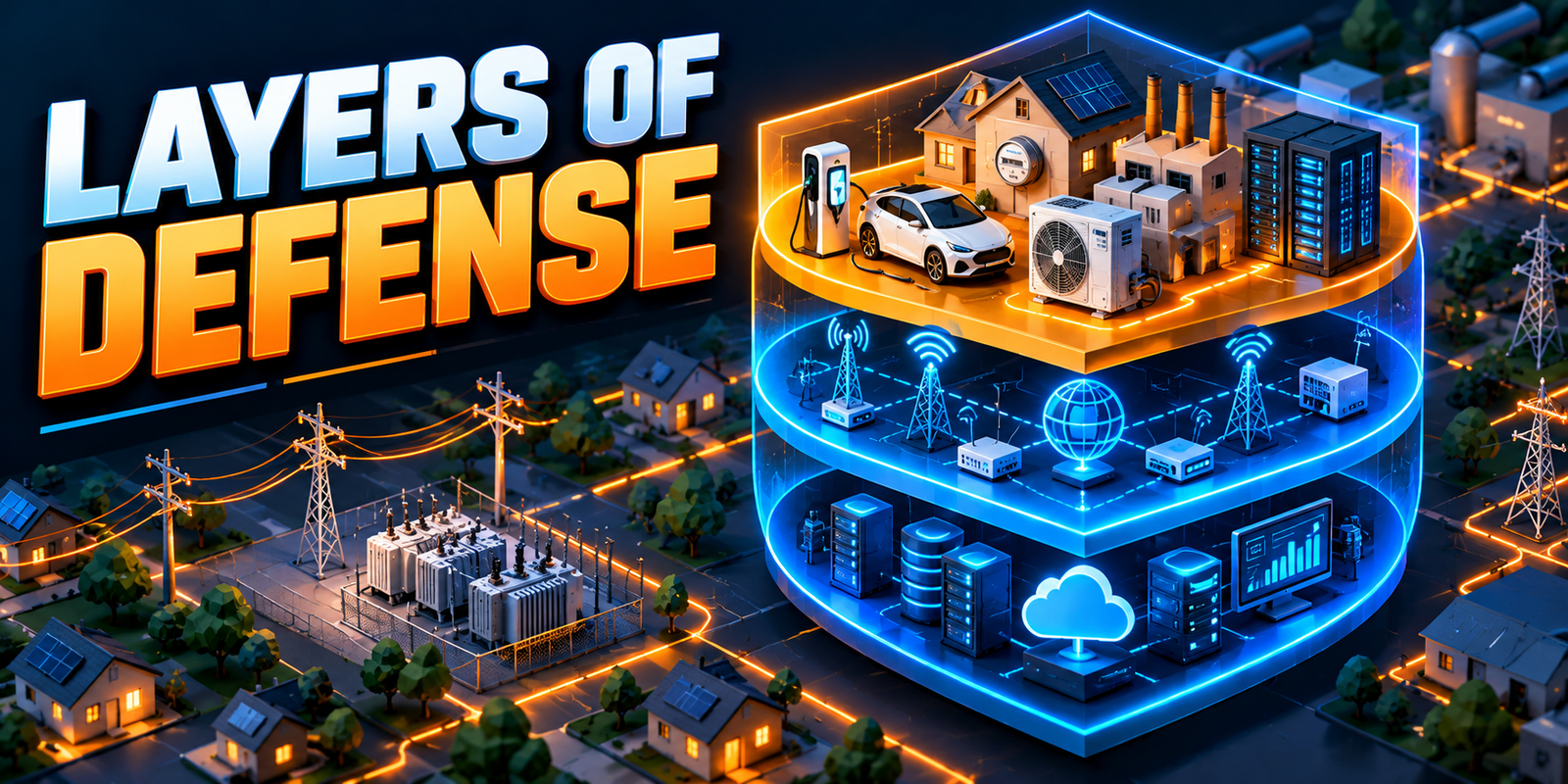

The smart grid vs traditional grid comparison comes down to how electricity and information move through the network. A traditional grid delivers power mainly from centralized plants to customers, with limited visibility beyond major points. A smart grid adds sensors, smart meters, two-way communication, automation and analytics around the same physical network, so utilities can see and manage conditions in more detail.
So what is the difference between a smart grid and a traditional grid? In short, a smart grid is not a different set of wires. It is the physical grid plus a digital layer. That layer matters more as distributed energy resources (DERs), renewable generation, electric vehicles (EVs) and aging assets make networks harder to run. This article compares both models in architecture, power flow, data flow, monitoring, communication, automation, maintenance, DERs, analytics, cybersecurity and utility applications. For background on the physical network, see our overview of electricity transmission and distribution.
A traditional grid is built around centralized generation, mostly one-way power flow and limited real-time visibility in many parts of the network. A smart grid keeps the same physical backbone but adds digital monitoring, two-way communication, advanced metering, automation and analytics, so operations can be more flexible and data-driven. The two are not strict opposites. Many real grids sit somewhere between them, and a smart grid still needs engineers, planning and physical infrastructure.
What Is a Traditional Grid?
A traditional grid is an electricity network designed around centralized generation, high-voltage transmission and radial distribution, in which power flows mainly in one direction from large plants to customers.
Its typical architecture and features are:
- Centralized generation: Large power plants supply most of the energy.
- Transmission, substations and distribution: Power steps down through voltage levels to customers.
- Predominantly one-way flow: Electricity moves from supply toward load.
- Limited field visibility: Monitoring concentrates on major substations and critical points.
- Conventional meters: Consumption is read manually or periodically.
- Manual or semi-automated operations: Crews often operate equipment in the field.
- Periodic inspection: Equipment is checked on a schedule.
- Limited customer-side information: The utility sees little behind the meter.
This does not mean every traditional grid is analog or fully manual. Many already use SCADA, digital relays and remote control at key sites. The difference is the depth and breadth of that digital coverage. Our guide to transmission vs distribution networks explains the layers in more detail.
What Is a Smart Grid?
A smart grid is an electricity network that builds digital monitoring, two-way communication, automation and analytics around the physical power system to improve visibility, control and flexibility.
Its main elements are:
- Digital monitoring and sensors: Devices that measure network and equipment conditions.
- Smart meters and AMI: Metering with two-way communication.
- Automation and advanced control: Remote and automatic operation of equipment.
- Analytics, including AI/ML where appropriate: Decision support from data.
- DERs, energy storage and demand response: Local resources and flexible demand.
A smart grid builds these digital and communication capabilities on top of the physical network. It does not replace lines, transformers or substations. For a full explanation, read our pillar guide, what is a smart grid: architecture, technologies, communication and utility applications.
Smart Grid vs Traditional Grid: Core Differences
The table gives the main comparison. Later sections examine each area in more depth.
| Area | Traditional grid | Smart grid |
|---|---|---|
| Architecture | Centralized, layered from generation to customer | Layered, with distributed resources and a digital layer |
| Power flow | Mostly one-way | One-way and, where applicable, two-way |
| Data flow | Limited, often upward from key points | Two-way and more detailed |
| Monitoring | Major substations and critical points | Wider, down to feeders and customers |
| Metering | Conventional, periodic readings | Smart meters and AMI |
| Communication | Mainly to major sites | Extended deeper into the network |
| Automation | Limited, with more manual operation | Remote and automatic functions |
| Fault detection | Protection plus customer reports and patrols | Sensors, relays and meter data |
| Maintenance | Time-based and reactive | Increasingly condition-based |
| Customer interaction | Mostly passive | Active participation possible |
| DER integration | Limited visibility and control | Monitoring and coordination |
| Renewable integration | Harder to manage at scale | Better supported, still needs planning |
| Energy storage | Often standalone | Integrated with monitoring and control |
| EV integration | Mainly added load | Managed charging possible |
| Analytics | Studies and manual analysis | More continuous, data-driven analytics |
| Grid planning | Based on periodic studies | Supported by richer data |
| Operational visibility | Partial | Broader and more frequent |
| Control | Mostly local and manual | Remote, centralized and automated |
Architecture Comparison
The main architectural difference is that a smart grid adds a digital layer and distributed resources to the same physical structure.
Traditional grid architecture
Generation
Large, central plants produce power.
Transmission
High-voltage lines carry it over long distances.
Substation
Voltage is stepped down and switched.
Distribution
Local feeders deliver power.
Customer
Homes and businesses use it.
The structure is largely centralized, and control mainly follows the same direction.
Smart grid architecture
The physical chain links generation, transmission, distribution, distributed energy resources and customers, and in a smart grid several of these links can exchange both energy and information. A digital layer connects the whole system.
Sensors
Measure grid and equipment conditions.
Communication
Carries data and commands.
Data platforms
Store and organize information.
Analytics
Turn data into insight.
Control
Operators and automation act on the network.
Electricity and information can therefore move in more directions than in a traditional grid.
Smart Grid vs Traditional Grid: Power Flow
In a traditional grid, power flows from generation through transmission and distribution to the customer. In a smart grid, central generation is joined by distributed generation, storage, flexible loads and customers who may both consume and produce energy.
- Bidirectional power flows: A feeder can sometimes carry power back toward the substation.
- Rooftop solar: Produces power at the customer site.
- Battery storage: Charges and discharges at different times.
- EVs: Add load and, in some cases, flexibility.
- Microgrids: Local systems that can operate with or separately from the main grid.
- Distributed generation: Smaller sources connected at distribution level.
Not every smart grid has bidirectional flow everywhere. Many feeders still carry power one way, and reverse flow appears only where enough local generation exists. The smart grid’s contribution is that utilities can see and manage such flows when they occur.
Smart Grid vs Traditional Grid: Data Flow
Data flow is where the two models differ most. A traditional grid gathers a limited amount of information, mostly from key points. A smart grid collects information from many more points and uses it continuously.
- Traditional grid: More limited measurements, periodic meter data, less granular field information, more manual inspection and limited customer-side visibility.
- Smart grid: Smart meters, grid sensors, IoT devices, SCADA, IEDs, AMI, communications, data platforms and analytics, with real-time or near-real-time visibility where supported.
| Data area | Traditional grid | Smart grid |
|---|---|---|
| Measurement coverage | Key substations and some feeder points | Substations, feeders, equipment and customers |
| Meter data | Periodic readings | Interval data from smart meters |
| Update frequency | Slower, often scheduled | Frequent, near-real-time where supported |
| Direction | Mostly upward to operators | Upward and downward, with commands and signals |
| Field information | Often from patrols and reports | Often from sensors and devices |
| Customer-side data | Limited | Usage, events and, with consent, more detail |
| Data platforms | Separate systems, limited integration | Integrated platforms and historians |
| Use of data | Operation, billing and periodic studies | Operation, analytics, planning and automation |
Monitoring and Visibility
Traditional monitoring concentrates on major substations and critical points. Distribution visibility is more limited, manual inspections fill gaps, and information can arrive with delay in some areas.
Smart grid monitoring extends coverage with more sensors, smart meter information, feeder monitoring and equipment condition monitoring. Automated alarms flag abnormal conditions, and near-real-time visibility is available where infrastructure supports it. The visibility gap is a theme of our pillar article on smart grid architecture and of our article on why grid modernization depends on better electricity data and real-time visibility. Sensor technology itself is covered in how sensors, IoT devices and intelligent monitoring are changing grid operations.
Metering: Conventional Meters vs Smart Meters
Traditional metering
- Basic consumption measurement.
- Manual or periodic reading.
- Limited communication.
Smart meter and AMI
- Automated meter reading.
- Two-way communication.
- More frequent data.
- Event information, such as power loss.
- Outage information where supported.
- Voltage information where supported.
- Remote functions where supported.
| Feature | Conventional meter | Smart meter / AMI |
|---|---|---|
| Reading method | Manual or periodic | Automated, remote |
| Data frequency | Low, often monthly | Interval, often short |
| Communication | None or one-way | Two-way |
| Events and outages | Usually none | Reported where supported |
| Voltage data | Usually none | Available on some meters |
| Remote functions | Not available | Available where supported |
| Customer insight | Limited | More detailed usage information |
Communication: Traditional Grid vs Smart Grid
Traditional grids may have communication at major operational points. Smart grids generally extend digital communication deeper into the network, using several technologies together.
- Fibre: High-capacity backbone and substation links.
- RF mesh: Meter and distribution device networks.
- Cellular: Wide-area links to scattered devices.
- Private utility networks: Utility-owned wireless or wired systems.
- Wireless communication, gateways and edge devices: Translate, filter and process data near the source.
| Communication capability | Traditional grid | Smart grid |
|---|---|---|
| Coverage | Major substations and key sites | Extends to feeders, devices and meters |
| Direction | Often one-way or limited | Two-way |
| Technologies | Fewer, often dedicated links | Mix of fibre, mesh, cellular and private wireless |
| Gateways and edge | Few | Common |
| Standardization | Often mixed protocols | More emphasis on standards |
| Security needs | Focused on fewer endpoints | Wider, with more endpoints |
Automation and Control
Automation is where visibility turns into action. Traditional grids rely more on manual field operations and local protection, with remote control available in some areas. Smart grids add remote switching, distribution automation, automated fault isolation, fault location, isolation and service restoration (FLISR), voltage control and a distribution management system (DMS), with automated responses within configured rules.
Automation depends on four things: measurement, communication, control logic and appropriate protection systems. Without any one of them, it cannot work safely. Our guide to power system automation explains the loop in detail.
Fault Detection and Outage Management
In a traditional grid, protection operates when a fault occurs. The utility may learn of the outage from customer reports, crews inspect the line, and manual switching may be needed to isolate the fault and restore supply.
In a smart grid, sensors and relays detect abnormal conditions, and automated alarms alert operators. Fault indicators narrow the search, and remote switching can isolate the faulted section. FLISR, where implemented, can restore healthy sections quickly, and outage visibility improves through meter and device data.
A smart grid does not eliminate outages. Faults still occur, and protection still operates. Better detection and switching can shorten the time customers spend without power, depending on design and conditions. Our article on power grid failure causes explains why outages still happen.
Maintenance: Traditional vs Smart Grid
Traditional maintenance relies on time-based work, scheduled inspection and reactive repair. Smart-grid-enabled maintenance adds condition monitoring, asset health information, sensor data, predictive analytics and condition-based maintenance.
| Maintenance approach | Traditional grid | Smart grid |
|---|---|---|
| Trigger | Calendar or failure | Condition and risk, as well as calendar |
| Inspection | Scheduled site visits | Supported by remote data |
| Asset information | Periodic test results | Continuous or frequent data |
| Repair | Often reactive | More often planned |
| Analytics | Manual review | Asset health and predictive analytics |
| Limitation | May miss developing problems | Needs good data and validation |
Predictive tools estimate risk. They do not guarantee that a given asset will or will not fail.
Renewable Energy Integration
Renewable output changes with weather, and that creates challenges for any grid.
- Traditional grid challenges: Variable output, limited distribution visibility and more difficult coordination.
- Smart grid capabilities: Renewable monitoring, forecasting, voltage monitoring, DER management, storage coordination, flexible loads and better visibility.
Smart grid technologies support renewable integration, but they do not remove the need for network planning and investment. Lines, transformers and protection may still need reinforcement or redesign.
Distributed Energy Resources
The two models treat DERs very differently, because traditional grids were not designed around them.
| Resource | Traditional grid | Smart grid |
|---|---|---|
| Rooftop solar | Limited visibility behind the meter | Monitored through meters, sensors and inverter data |
| Battery storage | Often operated independently | Can be monitored and coordinated |
| EVs | Appear as load | Managed charging possible |
| Microgrids | Rare or standalone | Can be integrated and supervised |
| Distributed generation | Hard to see and control | Better visibility and coordination |
| Flexible loads | Little use | Demand response possible |
DERs need better monitoring and coordination because they change voltage, loading and protection on distribution feeders.
Electric Vehicles
In a traditional grid, EV charging appears mainly as additional load, and visibility of where and when it happens may be limited. In a smart grid, utilities can use smart charging, load forecasting, managed charging, distribution monitoring and EV load coordination.
- Current: Managed and smart charging, load monitoring and forecasting.
- Emerging: Vehicle-to-grid, in which vehicles export energy, is being explored and piloted but is not widespread.
Energy Storage
Storage works in both models, but its value depends on how well it can be seen and controlled.
- Monitoring: Traditional systems may monitor storage separately. Smart grids integrate it into network views.
- State of charge: Smart systems track it to plan dispatch.
- Dispatch: Control signals can schedule charging and discharging.
- Renewable balancing: Storage can absorb surplus output.
- Peak support: Discharge can ease loading.
- Grid flexibility: Storage adds operating options.
Smart grid systems generally provide better digital visibility and control options for storage.
SCADA, IEDs and DMS
These systems appear in both models. The difference is how widely and deeply they are used.
| System / device | Main function | Traditional grid | Smart grid |
|---|---|---|---|
| SCADA | Supervision and control from a central location | Often present, mainly at major sites | Wider reach, integrated with other systems |
| RTU | Collect field data, run remote commands | Used at selected sites | Used more widely |
| IED | Protection, measurement and control | Present where digital relays exist | Common, often networked |
| DMS | Manage distribution network operations | Limited or absent in some utilities | Central to distribution automation |
| EMS | Manage the transmission system | Used in control centers | Used, with richer data inputs |
SCADA is not exclusive to smart grids, and many traditional utilities use it. Read about digital substations to see how IEDs and standard communication extend these capabilities.
Role of IoT in Smart Grid Operations
The Internet of Things (IoT) connects sensing devices to data systems. In a smart grid, the typical chain runs as follows.
Sensors
Measure conditions at equipment and lines.
Gateways
Collect and translate data.
Communication
Carries it to central systems.
Data platforms
Store and organize it.
Analytics
Process and interpret it.
Operations
Use it for decisions and control.
Traditional grid environments usually have more limited connected-device coverage, so IoT-style visibility is thinner in the field.
AI and Analytics
Smart grid analytics can support many tasks:
- Load and demand forecasting.
- Renewable forecasting.
- Asset health and predictive maintenance.
- Anomaly detection.
- Fault and outage analysis.
- DER coordination.
Traditional systems rely more heavily on historical studies, manual analysis, scheduled inspections and conventional forecasting. That does not mean traditional grids never use analytics or digital tools. They do, but usually with less data and less continuous analysis.
AI is decision support. It helps engineers and operators interpret data, and it depends on data quality and validation. It does not replace engineering judgment.
Customer Role
In a traditional grid, customers are mostly electricity consumers with limited operational interaction. In a smart grid, a customer can also be a prosumer, a distributed generator, an EV owner, a storage owner or a demand-response participant.
How much customers participate depends on the utility program, the market and the infrastructure in place. A smart meter alone does not make a customer an active participant. Programs, pricing and rules do.
Smart Grid vs Traditional Grid: Benefits
These advantages are possible, not automatic, and depend on design and operation.
| Area | Traditional grid | Smart grid advantage |
|---|---|---|
| Visibility | Partial, concentrated at key points | Broader and more frequent |
| Automation | Limited, manual operation | Remote and automatic functions |
| Reliability support | Protection and manual restoration | Faster detection and switching where implemented |
| Asset management | Time-based | Condition-based information |
| Renewable integration | Harder to see and manage | Monitoring and forecasting support |
| DER coordination | Limited | Monitoring and control options |
| Customer information | Limited | Detailed usage and event data |
| Demand management | Limited | Demand response possible |
| Maintenance | Scheduled and reactive | Better targeting |
| Planning | Periodic studies | Data-rich planning |
Smart Grid vs Traditional Grid: Challenges
Each model has its own challenges. A smart grid trades some old problems for new ones.
| Challenge | Traditional grid | Smart grid |
|---|---|---|
| Legacy infrastructure | Aging assets are common | Must be integrated or upgraded |
| Visibility | Limited | Improved, but gaps remain |
| Manual processes | Labor-intensive and slower | Reduced, with new process needs |
| Implementation cost | Lower upfront, higher operating effort | High upfront investment |
| Cybersecurity | Fewer endpoints | More endpoints to protect |
| Data quality | Less data | Large data volumes to validate |
| Interoperability | Mixed legacy protocols | Many suppliers’ systems to connect |
| Communication reliability | Limited dependence | Strong dependence |
| Workforce skills | Traditional power skills | Power, data and communication skills |
| Integration complexity | Lower | Higher |
| Privacy | Less customer data | More data, so stronger protection is needed |
| Maintenance of digital systems | Limited | Software, firmware and device upkeep |
Cybersecurity Differences
More connectivity means more cybersecurity responsibility. Traditional environments may have fewer connected endpoints, and some systems are more isolated, though that does not make them secure. Smart grids have more connected devices, more communication pathways and more operational technology interfaces.
Defensive priorities include:
- Authentication: Verifying users and devices.
- Network segmentation: Separating operational networks.
- Monitoring: Watching for unusual activity.
- Secure updates: Applying tested patches under control.
- Incident response: Preparing and rehearsing plans.
- Backup and recovery: Keeping verified copies.
Smart Grid vs Traditional Grid: Operational Workflow
Traditional workflow
Generation
Central plants produce power.
Transmission
Power travels at high voltage.
Distribution
Local feeders deliver it.
Customer
Customers use it.
Manual monitoring and scheduled inspection
Staff watch key points and inspect on schedule.
Operator response
Operators and crews act when a problem is found.
Smart grid workflow
Generation and DERs
Central and distributed sources supply power.
Transmission and distribution
Power moves through the network.
Sensors and smart meters
Measure conditions and usage.
Communication
Carries data.
Data platform
Stores and organizes it.
Analytics
Interprets it.
Operator or automation
A person or a configured rule chooses an action.
Response
Equipment operates.
Verification
New data confirms the outcome.
Illustrative Example: Feeder With Rooftop Solar and EV Charging
Illustrative example — not a real utility case study.
A distribution feeder has rooftop solar generation, heavy EV charging, battery storage and changing evening demand.
Traditional approach
- Limited visibility of feeder conditions.
- Scheduled measurements that may miss short events.
- Manual investigation after complaints or equipment issues.
- Conventional switching by crews.
Smart-grid-enabled approach
Sensors monitor voltage and current
They show changing feeder conditions.
Smart meters provide customer-side data
They show usage and solar export.
The DMS receives the information
Operators see an updated network view.
Analytics identify changing conditions
They flag rising evening load as solar fades.
Operators assess the situation
They decide what action to take.
Automated controls respond where configured
Voltage equipment adjusts within set limits.
Storage and flexible resources may support the network
A battery discharges to ease the peak.
When Is a Smart Grid Better Than a Traditional Grid?
A smart grid is not universally better. It is more useful where utilities have specific needs, such as:
- Greater visibility of the network.
- More automation.
- DER integration.
- Renewable integration.
- Better outage management.
- Advanced metering.
- Demand response.
- More data-driven asset management.
Modernization should follow operational needs, costs, security and long-term planning. A well-maintained traditional grid can serve a stable, simple network well, and sensible upgrades can proceed in stages.
Smart Grid and Grid Modernization
Grid modernization is the broader process of upgrading equipment, data and practices. A smart grid is one important outcome of modernization, alongside other measures such as physical reinforcement. Related topics include grid sensors, digital substations, power system automation, the future electric grid and grid digitalization.
Future of Smart Grid vs Traditional Grid
This is an informed outlook, not a guarantee, and developments will differ between utilities and regions.
- More sensors and smart meters: Coverage is likely to widen.
- More DERs, storage and EVs: Local resources may keep growing.
- Greater automation: More defined tasks could be automated.
- Better forecasting: Forecasts are expected to improve.
- AI-assisted operations: Decision support may become more common, with human oversight.
- Digital substations: More digital communication could appear in substations.
- Advanced distribution management: Software could coordinate more resources.
- Increased cybersecurity requirements: More connectivity is likely to bring more security work.
Conclusion
The smart grid vs traditional grid comparison shows two points on a spectrum. A traditional grid is primarily centralized and less digitally connected. A smart grid is the physical grid plus digital monitoring, communication, automation and analytics.
Smart grids improve visibility and operational flexibility, and they help integrate DERs and renewable resources. They also require stronger communication, data management and cybersecurity. Smart grid technology does not eliminate the need for engineers, planning or physical infrastructure. Utilities choose how far and how fast to modernize, guided by their own needs.
Frequently Asked Questions About Smart Grid vs Traditional Grid
What is the difference between a smart grid and a traditional grid?
A traditional grid mainly moves power one way from centralized plants to customers, with limited real-time visibility. A smart grid adds sensors, smart meters, two-way communication, automation and analytics around the same physical network. This gives utilities more detailed information and more control options.
How does a smart grid work compared with a traditional grid?
Both deliver electricity through generation, transmission and distribution. A smart grid also collects data from sensors and meters, sends it over communication networks and analyzes it. Operators or automated systems then act, and new data verifies the result. A traditional grid relies more on manual monitoring and scheduled inspection.
Why is the smart grid vs traditional grid comparison important?
The smart grid vs traditional grid comparison helps utilities decide where digital technology adds value. Growing demand, DERs, renewable energy and aging assets make visibility and automation more important. Understanding the differences supports better investment, planning and operating decisions.
What are the main components of a smart grid and traditional grid?
Both include generation, transmission lines, substations, distribution feeders and customer connections. A smart grid adds sensors, smart meters and AMI, communication networks, automation, DMS, analytics, DERs, storage and cybersecurity systems. Traditional grids may also use SCADA and digital relays, usually with narrower coverage.
What are the challenges of moving from a traditional grid to a smart grid?
Key challenges include implementation cost, legacy equipment, interoperability, communication reliability, data quality and cybersecurity. Workforce skills, integration complexity, privacy and ongoing maintenance of digital systems also matter. Most utilities modernize in stages, guided by operational needs.
Where are smart grids used compared with traditional grids?
Smart grid technology is used across transmission, substations, distribution and customer metering, with adoption varying by utility and region. Traditional grid practices still operate in many areas, and most real networks combine both. Smart grid features are especially useful where DERs, renewables and demanding reliability needs are present.
How do smart meters differ from traditional electricity meters?
Traditional meters record consumption and are read manually or periodically. Smart meters record interval usage and communicate it automatically. Many also report events and outages, and some support voltage data and remote functions. They are the customer-side part of AMI.
How does automation differ between a smart grid and a traditional grid?
Traditional grids rely more on manual field operation and local protection, with remote control in selected areas. Smart grids add remote switching, distribution automation, FLISR and voltage control, working within configured rules. Both depend on protection systems, and operators supervise either approach.

I share real stories, practical ideas and honest perspectives on business, marketing and life. This blog is a space to learn, grow and connect.