
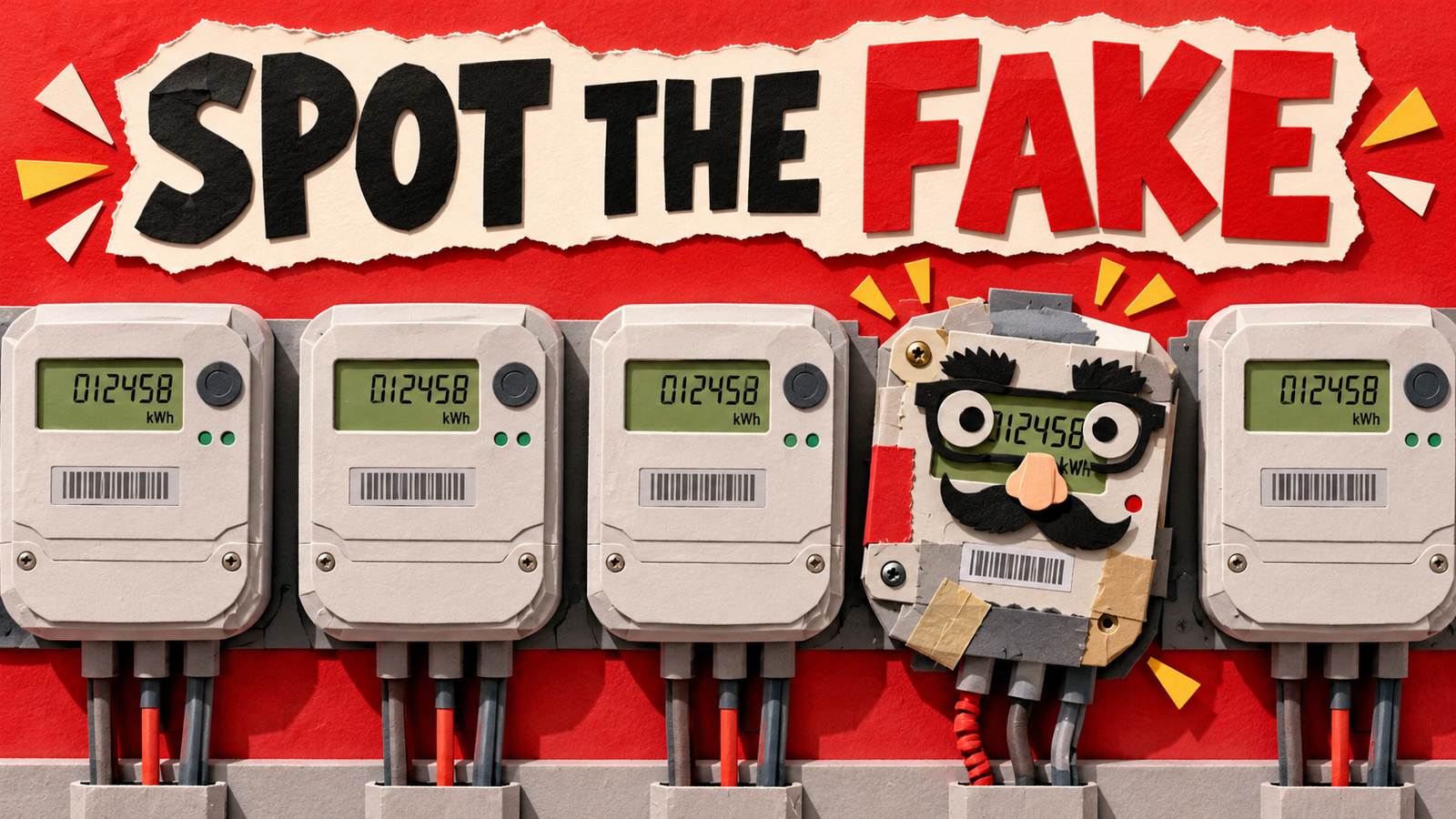
A false data injection attack is a cyberattack in which false or manipulated measurements are inserted into a system so that operators or analytics act on incorrect information.
Modern electricity networks depend on a growing flow of digital measurements. Sensors, smart meters, intelligent electronic devices, telemetry links and analytics platforms all report on voltage, current, power, status and time, and utilities use those reports to monitor the grid, forecast demand, raise alarms and make operational and planning decisions. That reliance creates a quiet dependency: the grid is only as well understood as its data is trustworthy. A false data injection attack is a class of threat in which measurement or status data is deliberately altered so that systems and people act on a misleading picture.
This guide explains what a false data injection attack is, how the threat works at a conceptual level, why it matters, and how utilities can detect and defend against it. It is written for utility cybersecurity teams, OT security professionals, engineers and critical-infrastructure leaders. It is deliberately defensive and educational. It gives no operational attack instructions, no methods for evading detection and no information about real vulnerabilities, and its one example is fictional. Architectures differ widely between utilities, so every practice should be evaluated against local conditions.
Key Takeaways
- A false data injection attack targets the integrity of measurements and status data, not necessarily the availability of a system.
- Faulty sensors and deliberate manipulation can look alike, so detection must combine technical checks with engineering context.
- No single validation method guarantees protection. Layered prevention, detection, validation and response work better.
- AI/ML can help find unusual patterns, but it complements rather than replaces fundamental security controls.
- Possible consequences are risks to assess, not demonstrated outcomes, and impact depends on the architecture and the controls in place.
What Is a False Data Injection Attack?
A false data injection attack is the deliberate insertion or alteration of measurement, status or control-related data so that systems and operators rely on information that does not reflect real conditions.
In a smart grid, the data in question might be meter readings, line measurements, equipment status or other telemetry. What distinguishes the threat is intent and plausibility: the aim is to mislead the systems and people who trust the data, rather than simply to interrupt it.
Faults and Errors Versus Manipulation
Inaccurate data is common in any large measurement system. Sensors drift, instruments fail, communication links drop packets, clocks lose synchronization and configuration mistakes occur. These are faults, and utilities already have processes to find and fix them. Deliberately manipulated measurements are different in origin but can resemble faults in effect. That overlap is the central difficulty: a bad reading does not tell you why it is bad.
Measurement Integrity, State Estimation and Decisions
Many utility applications turn raw measurements into a model of grid conditions, a process called state estimation. Operational decisions then rest on that model. If measurements lose integrity, the estimate and the decisions built on it can be affected. This guide explains that relationship in general terms only and does not describe how to exploit it.
How Smart Grid Data Supports Utility Operations
Different systems collect and use data for different purposes. Architecture and data availability vary by utility, so the roles below are typical rather than universal.
- Sensors and intelligent electronic devices measure electrical quantities and equipment conditions in the field. See IoT and connected sensors in smart grids.
- Smart meters record consumption and events at customer premises, and Advanced Metering Infrastructure (AMI) carries that data to utility systems. See advanced metering infrastructure.
- Telemetry and SCADA bring field measurements and statuses to control centers and allow supervisory control.
- Energy management systems (EMS) support monitoring and analysis of the transmission system.
- Distribution management systems (DMS) support monitoring and analysis of the distribution network.
Together these data sources support monitoring, forecasting, state estimation, alarms and planning. Operators watch live conditions, analysts forecast load, engineers study network behavior and planners decide where to invest. For a broader view, see power system automation and why smart grids need real-time electricity data.
How False Data Injection Threats Work Conceptually
At a high level, the threat is about misleading systems that depend on measurements. Utilities connect many data sources and automate much of the analysis, and automated systems generally trust the data they receive unless a check tells them otherwise. That trust is useful for efficiency but creates a security challenge: if the data is wrong in a believable way, downstream processing may treat it as genuine.
Three features of modern utility environments contribute to the challenge:
- Interconnected data sources. Data passes through devices, gateways, networks, historians and applications, giving many places where integrity matters.
- Automated analysis. Estimation, alarming and analytics run continuously and may influence decisions without line-by-line human review.
- Implicit trust in measurements. Many systems assume that data from an authorized source is accurate.
It also helps to distinguish this threat from others. A communication outage removes data. A denial-of-service event overwhelms a system so it cannot respond. An ordinary sensor fault produces inaccurate data without malicious intent. A data integrity attack instead supplies data that is wrong but may appear acceptable. This section stays conceptual by design. It does not explain how manipulated measurements are constructed or concealed.
Why False Data Injection Attacks Matter
The potential consequences below are risks to assess. They are not claims that these outcomes have occurred or that any particular impact is likely, and the real effect would depend on the system, its design and its safeguards.
- Incorrect situational awareness. Operators could form a mistaken view of grid conditions.
- Misleading alarms or analysis. Alarms could be raised or suppressed, and analysis could point the wrong way.
- Reduced confidence in estimation and forecasting. Even suspected data problems can make teams distrust results they would otherwise use.
- Poor asset or maintenance decisions. Condition and planning decisions rely on measurement history.
- Increased investigation workload. Distinguishing faults from manipulation takes engineering time.
- Possible reliability and safety implications. If incorrect data influences operational decisions, reliability and safety could be affected, although protections, procedures and human judgment typically stand between a bad data point and a physical outcome.
This article cites no incidents, financial losses or quantified impacts, because none are needed to explain why data integrity deserves attention. For related context see why grid modernization depends on better electricity data.
Smart Grid Systems and Data Sources at Risk
Security considerations apply wherever data is generated, moved, stored or consumed. The discussion below is architecture-neutral and does not identify weak configurations or exploitable targets.
| Data source or system | Role | Integrity consideration |
|---|---|---|
| SCADA and energy management environments | Supervisory monitoring and analysis | Trusted telemetry feeds decisions and estimation |
| Distribution management systems | Distribution monitoring and analysis | Depends on many field and meter data sources |
| Smart meters and AMI | Consumption, events and status | Large device populations and long data paths |
| Sensors, IEDs and telemetry sources | Field measurement and status | Device identity, configuration and calibration matter |
| Data concentrators, gateways and networks | Aggregate and carry data | Data may pass through several intermediate points |
| Historians, analytics platforms and dashboards | Store, analyze and display data | Stored data and views must be protected from alteration |
Each layer inherits the trust placed in the layer below it. Protecting the integrity of data therefore means looking at the whole path from sensor to screen, not only at the control center. See smart grid communication networks for background on how this data moves.
False Data Injection, State Estimation and Measurement Integrity
State estimation can be understood as a way of working out the most likely condition of the grid from many imperfect measurements. Some quantities are measured, some are not, and the measurements contain noise. An estimator combines them with a model of the network to produce a best guess of conditions, and it can flag measurements that fit poorly.
Several concepts determine how reliable that process is:
- Measurement quality. Accurate, well-calibrated, correctly time-stamped inputs produce better estimates.
- Source validation. Knowing that data really comes from the device it claims to come from.
- Observability. Whether there are enough measurements to determine conditions across the network.
- Redundancy. Having more than one way to measure or infer the same thing, which makes inconsistencies visible.
- Model assumptions. The network model has to be accurate and current, and model errors can look like data errors.
Conceptually, a single validation check may not be enough, because any one test looks at the data from one angle. Checks that look at the same data in the same way share the same blind spots, so defenders benefit from independent, complementary views such as source authentication, physical plausibility, redundancy and context. This article does not present mathematical attack formulations or describe how estimation could be bypassed.
Detecting Suspicious or Untrustworthy Data
Detection is about raising the chance that questionable data is noticed and examined by the right people. Common defensive approaches include:
- Data validation and plausibility checks. Confirm values are within physically and operationally reasonable ranges and formats.
- Time-series consistency checks. Compare new data with recent behavior and expected rates of change.
- Cross-checking independent or redundant sources. Compare measurements that should agree, such as readings from separate devices observing related quantities.
- Residual and estimation-quality monitoring. At a conceptual level, watch how well the estimator fits the measurements and investigate persistent poor fits.
- Rule-based alarms and thresholds. Simple and explainable, but they can be too rigid or too noisy.
- Statistical anomaly detection. Highlight departures from learned or expected statistical behavior.
- Machine-learning-assisted detection. Look for unusual patterns or relationships, discussed in the next section.
- Human review and operational context. Engineers and operators know what is normal for their system.
- Correlation with other information. Compare findings with device health, communication status, maintenance events and known system changes.
Every method has limits. Legitimate load changes, switching, failing sensors, missing readings, communication problems and model errors can all resemble suspicious activity, and a determined adversary may not trigger simple rules. No single method should be treated as sufficient, and each produces both false alarms and missed detections. See why smart meter data quality matters for the related data-quality side.
AI/ML for False Data Injection Detection
Machine learning can be useful where relationships between many measurements are too complex to capture in fixed rules. Models may learn typical patterns across time, locations and variables, and flag departures for review. Related ideas are covered in AI anomaly detection in electric utilities and AI-based anomaly detection for smart meter data.
Using AI responsibly for this purpose depends on several factors:
- Representative training data. Models only learn what their data shows, and labelled examples of genuine manipulation are scarce.
- Data quality. Noisy or incomplete inputs weaken results.
- Explainability. Analysts need to understand why something was flagged in order to judge it.
- Model drift. Operating conditions change, so models need monitoring and periodic review.
- Human oversight. People with engineering context should interpret and act on results.
Models produce false positives, which waste effort and cause alert fatigue, and false negatives, which miss real problems. Relying on a model without engineering context is risky. AI also needs its own security, including protection of training data and model access, a topic often grouped under AI security. AI detection complements, rather than replaces, access control, authentication, secure communication, monitoring and validated operating procedures. This article makes no claims about accuracy or benchmark performance.
Defensive Controls and Mitigation Strategies
Prevention reduces the chance that data is tampered with in the first place, and detection catches what prevention misses. Controls to consider include:
- Identity and access management with least privilege and regular privileged-access reviews.
- Secure authentication and authorization for people, services and devices.
- Encryption and authenticated communication where appropriate and supported.
- Device identity, integrity checks and secure configuration management.
- Network segmentation and controlled interfaces between zones.
- Secure logging, time synchronization and monitoring.
- Firmware and vulnerability management, planned around operational constraints.
- Data provenance, quality checks and auditability, so the origin and handling of data can be traced.
- Redundant measurement sources and independent validation where engineering design permits.
- Change management, incident response and recovery planning.
- Supplier and third-party security assurance.
No utility needs every control in the same form. Choices should follow the utility’s architecture, risk assessment, operational constraints and applicable standards, and they should be reviewed as systems change. For smart meter and AMI specifics, see head-end systems in AMI.
OT Security and IT/OT Coordination
Utility environments must balance cybersecurity with availability, safety and operational continuity. Actions that are routine in an office network, such as rapid patching or isolating a device, can have operational consequences in a control environment, so OT security takes those constraints into account.
Data integrity problems cut across organizational boundaries, which makes coordination essential. Typical participants include:
- IT security teams, who run identity, network and monitoring services.
- OT engineers, who understand devices, protocols and process behavior.
- Control-room personnel, who judge operational significance.
- Data and analytics teams, who manage validation, models and pipelines.
- Incident responders, who coordinate investigation and recovery.
Agreed roles, shared vocabulary and rehearsed escalation paths prevent delays when time matters. Protecting the whole data path also means looking at how smart grid technology works from field devices to control systems.
Incident Response for Suspected Data Integrity Problems
The workflow below is a high-level defensive outline for authorized personnel. It is not a procedure for real systems, and every step should follow the utility’s approved plans and safety requirements.
- Identify and validate the anomaly. Confirm the observation is real and not a display or reporting artifact.
- Assess operational significance. Work with authorized engineering and control-room personnel to understand what decisions could be affected.
- Correlate with other evidence. Compare independent measurements, device health, communication status and recent changes.
- Follow approved escalation procedures. Engage the incident-response process and notify the right people.
- Preserve logs and evidence. Retain relevant records according to policy.
- Apply authorized containment or fallback. Use only measures approved for the situation, with operational safety as the priority.
- Restore trusted data sources. Validate that data and system behavior are correct before returning to normal operation.
- Document and improve. Record findings and update controls and procedures.
This outline gives no instructions that could disrupt utility operations. Emphasis belongs on authorized personnel, approved procedures and safety.
Standards, Guidance and Governance
Several sources of guidance inform how utilities approach data integrity and OT security. None applies identically to every utility, and voluntary guidance differs from organizational policy and from binding legal or regulatory requirements. Check current versions and applicability with the issuing bodies and with legal and regulatory advisers.
- NIST Cybersecurity Framework (CSF) 2.0. Released on 26 February 2024, it adds a Govern function and is voluntary guidance.
- NIST SP 800-82 Rev. 3, Guide to Operational Technology (OT) Security. Published in September 2023, it addresses OT security while accounting for performance, reliability and safety requirements.
- NISTIR 7628 Rev. 1, Guidelines for Smart Grid Cybersecurity. Published in 2014, it offers background on smart grid cybersecurity strategy and is best read alongside newer guidance.
- IEC 62443 series. Standards for the security of industrial automation and control systems, relevant where a utility’s environment falls within that scope.
Governance turns guidance into practice through risk assessment, asset ownership, policies, training and periodic review. Frameworks work best as structured ways to ask questions, not as checklists to be ticked.
Common Detection and Defense Challenges
- Limited visibility across legacy and modern systems.
- Incomplete or noisy data that makes anomalies harder to judge.
- Changing operating conditions, such as new loads, distributed generation and switching.
- False alarms and alert fatigue that dull attention over time.
- Limited labelled data for training and testing models.
- Interoperability and vendor differences that complicate consistent monitoring.
- Resource constraints and long asset lifecycles, so older equipment stays in service for years.
- Coordinating detection with operational response, since an alert is useful only if someone can act on it.
- Maintaining security without compromising safety or availability.
A realistic approach starts with inventory and visibility, focuses on the most critical data sources, adds independent validation where design allows and improves iteratively. See grid digitalization for context on why these challenges grow as data increases.
Hypothetical Defensive Scenario
Hypothetical example. This scenario is fictional and uses simplified, illustrative information. It does not describe a real utility, incident or case study, and it does not explain how any data was produced.
Imagine a utility whose monitoring team notices that measurements from one area are inconsistent with other monitoring sources: a feeder reading does not match the aggregated meter data or the substation measurements that should relate to it.
- Validate the data. Analysts confirm the inconsistency persists and is not a display issue, and check data quality indicators and timestamps.
- Review device and communication health. They look at the status of the relevant devices and links, and at recent maintenance or configuration changes that might explain the difference.
- Correlate independent measurements. They compare other sources, such as neighboring measurement points and independent monitoring, to see which readings agree.
- Follow approved procedures. Engineers and control-room staff judge operational significance, and the incident-response process is engaged if the discrepancy cannot be explained.
- Improve controls. Whatever the cause, the team records findings and considers improvements such as additional validation, better logging or clearer escalation paths.
The scenario illustrates validation, correlation, coordination and improvement. It is not a procedure, and real steps depend on each utility’s systems, authorizations and safety requirements.
Practical Defensive Checklist
Use this list as a set of practices to evaluate. It is not a guarantee of protection or compliance.
- Critical data and inventory: Do you know which data sources and systems matter most, and who owns them?
- Measurement validation and provenance: Are plausibility checks in place and can data origin be traced?
- Access and authentication: Are identities unique, privileges minimal and reviews regular?
- Secure communication and configuration: Are communications authenticated where supported and configurations controlled?
- Independent validation and monitoring: Where design permits, can key measurements be cross-checked?
- Logging and alert review: Are logs time-synchronized and alerts owned and triaged?
- AI/ML governance, where used: Are models inventoried, validated, monitored for drift and overseen by people?
- OT-aware incident response: Are procedures coordinated across IT, OT and control-room teams?
- Vendor and supply-chain controls: Are supplier obligations and access defined and reviewed?
- Testing and lessons learned: Are exercises, reviews and improvements scheduled?
Future Outlook
Approaches to protecting data integrity continue to develop. Utilities may expand data integrity monitoring, pay more attention to secure interoperability between systems, apply analytics more widely and coordinate IT and OT security more closely, all with the aim of more resilient grid operations. How far and how fast this happens will differ between utilities and vendors, and none of it is certain. See future smart grid technology for the wider technology outlook.
Conclusion: Trustworthy Data Underpins Smart Grid Security
A false data injection attack is a reminder that the grid’s digital view of itself must be earned and verified, not assumed. Trustworthy measurements support safe and reliable decisions, so protecting their integrity is a core part of smart grid cybersecurity. Because no single check or model can guarantee protection, layered prevention, detection, independent validation and well-rehearsed incident response are more dependable than any one control. Utilities that know their critical data sources, coordinate IT and OT teams and keep improving are better placed to maintain trust in their data as the grid becomes more digital.
Frequently Asked Questions About False Data Injection Attacks
What is false data injection attack?
A false data injection attack is the deliberate insertion or alteration of measurement, status or control-related data so that systems and operators rely on information that does not reflect real conditions. In smart grids it targets the integrity of the data that monitoring, estimation and decision-making depend on.
How does false data injection attack work?
Conceptually, it works by supplying measurement-dependent systems with misleading data that may appear acceptable, taking advantage of the trust automated systems place in their inputs. Defenders counter it with source validation, plausibility and consistency checks, redundant measurements and monitoring. Operational details are intentionally not covered here.
Why is false data injection attack important?
Utilities rely on trustworthy measurements for situational awareness, alarms, state estimation, forecasting and planning. If data integrity is compromised, decisions based on it could be affected, so protecting data integrity supports reliable, safe operations. Possible impacts are risks to assess, and they depend on system design and safeguards.
What are the main components of false data injection attack?
At a conceptual level the main elements are the data sources and communication paths that carry measurements, the systems that consume them such as state estimation and monitoring applications, and the integrity weakness that lets misleading data be accepted. Defensive programs address each with validation, access control, monitoring and response.
What are the challenges of false data injection attack?
Challenges include distinguishing manipulation from faults and noise, limited visibility across legacy and modern systems, changing operating conditions, false alarms, scarce labelled data, vendor differences, long asset lifecycles and the need to protect systems without compromising safety or availability.
Where is false data injection attack used?
The term describes a threat category studied in cyber-physical systems, most often smart grids and other infrastructure that depends on measurements, including SCADA, state estimation and metering environments. Here it is discussed from a defensive perspective so that utilities can understand and reduce the risk. This article offers no target guidance.

I share real stories, practical ideas and honest perspectives on business, marketing and life. This blog is a space to learn, grow and connect.