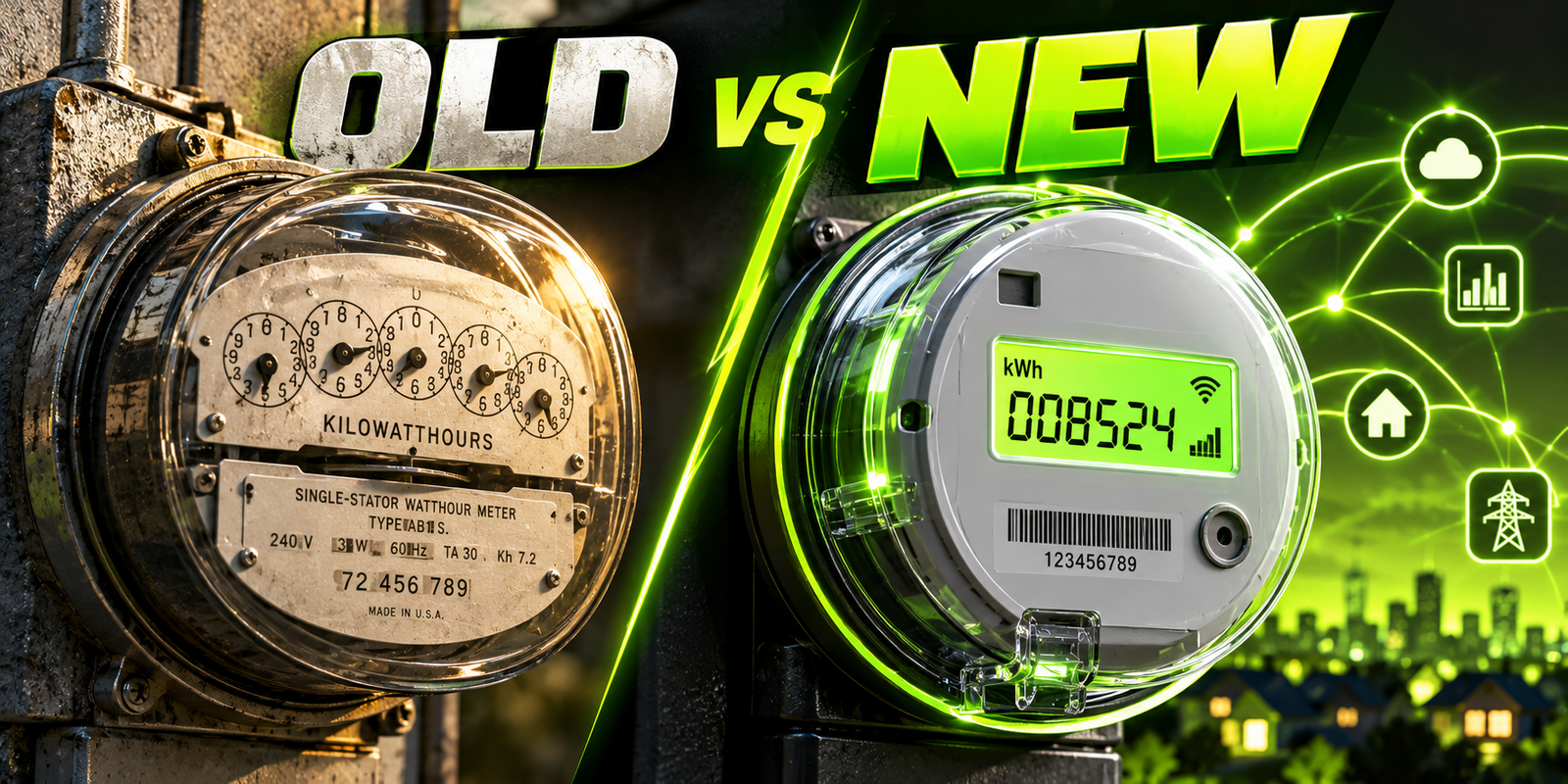
The smart meter vs traditional meter comparison comes down to more than “digital” versus “old.” A traditional electricity meter mainly measures cumulative energy and shows it on a register or display, and a person or local process reads it. A smart meter measures electricity digitally, can record data in intervals, logs events and can communicate with utility systems. The important differences are in data collection, communication, reading frequency, remote access, events, two-way communication, utility integration and operational visibility.
Exact capabilities depend on the meter model, its configuration and the utility’s architecture. Some smart meters send readings only once a day, and some support remote commands while others do not. Some “traditional” meters are electronic and some are electromechanical. The comparison in this article is therefore general, and it separates three things that are often blurred: the traditional meter, the smart meter and advanced metering infrastructure (AMI).
A smart meter is a field device. AMI is the broader infrastructure that connects smart meters to utility systems through communication networks, a head-end system and a meter data management system. See advanced metering infrastructure: architecture, components and data flow for the full system.
- Traditional meters generally provide basic measurement and rely on manual or local reading processes.
- Smart meters can collect more detailed information, depending on configuration.
- Smart meters can support automated communication.
- Many smart-meter deployments support two-way communication.
- Smart meters can provide event and status information.
- Smart meters become more powerful when integrated with AMI.
- Exact capabilities vary by deployment and technology.
What Is a Traditional Electricity Meter?
A traditional electricity meter is a conventional meter that measures cumulative electrical energy and shows it locally on a register or display, usually without continuous communication to the utility.
Traditional meters generally provide:
- Basic energy measurement of consumption over time.
- A register or display that shows the total.
- Local reading by a person at the site, or a periodic process.
- Manual meter-reading processes to bring the value into billing.
- Limited communication and limited data granularity.
- Limited remote functionality.
“Traditional meter” covers different technologies. Electromechanical meters use a rotating disc, and simple electronic meters use digital circuits but may still lack communication. Some meters have local ports or one-way automated meter reading (AMR) modules. Conventional meters are not all identical, and many remain accurate and reliable for basic measurement.
What Is a Smart Meter?
A smart meter is a digital electricity meter that measures consumption, can record it in intervals, logs events and communicates with utility systems.
Potential capabilities include:
- Digital measurement
- Interval data
- Meter events and status information
- Communication and remote data collection
- Two-way communication where supported
- Outage and restoration events
- Remote functions where supported
The exact feature set depends on the meter and the AMI deployment. A smart meter can be installed with a limited feature set, and a utility may enable only some functions.
Smart Meter vs Traditional Meter: Main Comparison
The table gives a general comparison. Entries describe typical differences, not guarantees for every product.
| Aspect | Traditional Electricity Meter | Smart Meter |
|---|---|---|
| Measurement | Cumulative energy, basic | Digital measurement, may include interval and other quantities |
| Display | Mechanical register or basic display | Digital display, with more information on some models |
| Data collection | Local or periodic | Automated, remote |
| Reading method | Manual or local | Remote through a communication network |
| Reading frequency | Periodic | More frequent, depending on configuration |
| Communication | Little or none, sometimes one-way | Built-in or attached communication |
| Two-way communication | Generally not available | Often supported, depending on architecture |
| Remote access | Limited | Possible where supported |
| Meter events | Limited, mostly local | Events can be logged and reported |
| Outage awareness | Mostly customer reports | Outage and restoration events where supported |
| Data granularity | Low | Higher, depending on configuration |
| Customer visibility | Customer reads the display | Usage history possible through utility systems |
| Utility analytics | Limited | Load and pattern analysis possible |
| Demand response | Limited measurement support | Data to support programs |
| Remote functions | Generally none | Possible where supported |
| Integration with AMI | Not applicable, or limited through AMR | Designed to work within AMI |
How Data Is Collected
The collection path is the most practical difference. For a traditional meter:
Meter
Accumulates energy.
Local reading
A person or device reads the register.
Manual or periodic process
The reading is recorded and transferred.
Utility system
Billing receives the value.
For a smart meter in an AMI environment:
Meter
Measures and records data.
Communication network
Carries it automatically.
Head-end system (HES)
Collects it from meters.
Meter data management system (MDMS)
Validates and manages it.
Utility applications
Billing, analytics and operations use it.
Actual architecture varies between utilities. For a full explanation, see AMI architecture and data flow.
Data Frequency and Granularity
Several data types are involved:
- Register reading: cumulative energy at a point in time.
- Periodic reading: readings collected at regular but infrequent times.
- Interval data: energy recorded for each fixed period, such as each half hour or hour.
- Event data: records of specific occurrences, such as an outage.
- Status data: information on meter health and configuration.
Smart meters may provide more granular data than traditional meters, depending on configuration. Not every smart meter records the same interval, and utilities choose settings based on needs, storage and network capacity.
| Data Type | Traditional Meter | Smart Meter |
|---|---|---|
| Register reading | Yes, read locally | Yes, can be read remotely |
| Periodic reading | Yes | Yes |
| Interval data | Generally no, except some advanced electronic meters | Yes, where configured |
| Event data | Limited | Yes, varies by model |
| Status data | Limited | Yes, varies by model |
One-Way vs Two-Way Communication
This is a key difference. A traditional meter is generally measurement-focused with little or no continuous communication capability. A smart meter can support communication with utility systems, depending on the AMI architecture. In a two-way design the path is:
Meter
Sends and receives messages.
Communication network
Carries traffic in both directions.
HES
Exchanges data and commands with meters.
Possible directions of information:
- Meter to utility: meter readings, events, status and outage information where supported.
- Utility to meter: configuration, commands and remote functions where supported.
Not every smart meter supports every remote command. Some meters communicate one way, some allow only certain commands, and policies may restrict which functions are enabled. For the networks behind this, see smart grid communication networks.
Smart Meter Events and Alerts
Smart meters may log and report events such as:
- Power outage and power restoration
- Tamper or event conditions
- Communication status
- Meter status
- Voltage-related events where supported
Event data improves operational awareness. An outage event, for example, tells the utility that supply was lost at a particular service point, and tamper events can prompt an investigation. Not all meters generate identical events, and event definitions and reporting depend on the model and configuration.
Smart Meters and AMI
The relationship is simple: the smart meter is the field device, and AMI is the complete infrastructure.
Smart meter
Field device.
Communication network
Carries data.
HES
Manages meter communication.
MDMS
Validates and manages meter data.
Utility applications
Use the data.
A smart meter without appropriate communication and backend infrastructure does not deliver the full value of AMI. The meter can measure and store data, but the utility cannot easily collect it, manage it or use it for billing and operations. That is why smart meters and AMI are not the same concept. Read what AMI includes for the system view.
Smart Meters and Billing
With traditional meters, billing relies on periodic readings. Manual processes may be involved, and interval information is limited. With smart meters, billing support can include automated data collection, more frequent readings, interval data where configured, automated data transfer and validation through downstream systems.
Smart meters can support billing processes, but they do not independently determine billing accuracy. Accuracy also depends on meter calibration, configuration, data management, account information and billing rules.
Smart Meters and Outage Awareness
A traditional meter has no way to report an outage, so utilities usually learn of one from customers or other systems. A smart meter may support outage awareness through outage events, restoration events, communication status and the geographic pattern of events.
| Aspect | Traditional Meter | Smart Meter |
|---|---|---|
| Outage detection | Customer reports or other utility systems | May report outage events where supported |
| Restoration verification | Field checks or customer reports | May report restoration events |
| Pattern analysis | Limited | Possible with many meters |
Smart-meter outage information complements other outage-management systems and does not necessarily replace them. A meter that loses power may be unable to send a last message, and a network fault can resemble a customer outage.
Smart Meters and Customer Energy Visibility
Smart-meter data can support consumption history, interval usage, usage patterns, time-of-use programs, customer portals where implemented and general energy awareness. A traditional meter lets a customer read a total, while smart-meter data can show when energy was used.
Not every customer receives real-time data. Visibility depends on the utility’s systems, collection and validation timing, and program design.
Smart Meters and Demand Response
Smart meters can support demand-response programs by measuring load profiles and consumption, measuring events, supporting program evaluation, recording time-based consumption and tracking customer participation. After a program event, interval data helps compare actual usage with expected usage.
AMI provides an important data foundation, but demand response may need additional systems and program infrastructure, such as enrollment, signaling methods and, in some programs, controllable devices.
Smart Meters and Grid Operations
Smart-meter data can support load analysis, distribution planning, demand forecasting, outage awareness, voltage analysis where supported, loss analysis, customer segmentation where appropriate and wider grid modernization.
These data sources should not be treated as interchangeable:
- AMI data: meter-level data from the customer edge, often interval-based and delivered with some delay.
- SCADA data: real-time measurements from substations and feeder equipment, used for supervision and control.
- DMS: the system that uses network models and data from several sources to manage distribution operations.
Each serves a different purpose, and utilities often combine them. See key smart grid components for how they fit together.
Smart Meter vs Traditional Meter: Maintenance
Traditional meter maintenance relies on physical inspection, manual reading, meter replacement and local diagnostics. Smart meters change this with remote diagnostics where supported, communication monitoring, firmware and device management, event monitoring and remote configuration where supported.
These capabilities can reduce some site visits, but smart meters add digital lifecycle-management requirements. Firmware needs controlled updates, devices need inventory and credentials, and communication health needs monitoring. A smart meter is a managed digital asset, not just a measuring device.
Smart Meter Deployment Challenges
Smart-meter-specific considerations include:
- Large-scale replacement of existing meters.
- Communication coverage at every service point.
- Device configuration that must be correct and consistent.
- Data integration with billing and other systems.
- Cybersecurity for a large fleet of field devices.
- Data quality across large volumes of readings.
- Customer communication about the change.
- Workforce training for field and back-office staff.
- Device lifecycle and vendor management.
The wider system challenges are covered in the AMI article rather than repeated here. For broader issues, see smart grid deployment challenges.
Cybersecurity Differences
A traditional meter with little or no connectivity has a different digital attack surface from a smart meter. Because smart meters communicate, they need defensive measures such as:
- Device authentication and device identity.
- Access control to the meter and to management systems.
- Secure communication and encryption.
- Firmware management through controlled, signed updates.
- Monitoring for unusual behavior.
- Network segmentation between AMI and other systems.
- Key and certificate management where applicable.
Security is part of design and operation, and it continues through the meter’s life in the field.
Smart Meter Data Quality
Common data issues include missing readings, communication gaps, invalid values, timestamp issues, configuration errors and duplicate data. Two systems manage them:
- HES: communicates with meters, collects data and monitors connectivity.
- MDMS: validates, stores and manages the data and delivers it to applications.
The MDMS commonly applies VEE: Validation (checking data), Estimation (filling gaps by approved methods) and Editing (correcting records with an audit trail). See the AMI foundation article for the detailed treatment.
Smart Meter vs Traditional Meter: Cost and Value
A traditional meter has lower digital complexity and needs little communication infrastructure, but more manual processes may be required. A smart meter requires more technology: a communication network, backend systems, cybersecurity, data management and operational processes. In return it offers potential operational benefits.
No prices or return-on-investment figures are given here, because they vary widely. Total cost depends on:
- Meter hardware
- Communication infrastructure
- Installation
- HES and MDMS
- Integration with utility systems
- Maintenance
- Cybersecurity
- Lifecycle management
The value depends on how well the utility uses the data and capabilities, not only on installing meters.
Traditional Meter to Smart Meter Migration
A practical migration process:
- Assess existing meters and their condition.
- Define requirements for data and functions.
- Select smart-meter capabilities.
- Select communication architecture.
- Design HES and MDMS integration.
- Run a pilot deployment.
- Validate data against expected values.
- Train teams.
- Deploy at scale.
- Monitor lifecycle performance.
Meter replacement alone is not a complete AMI transformation. Without communication, head-end, data management and integration, the new meters cannot deliver the full set of capabilities.
Illustrative Comparison Example
Illustrative Example — not a real utility case study.
A utility has a traditional meter at a customer location and wants to move to a smart-meter and AMI environment.
Traditional workflow:
Customer
Uses electricity.
Traditional meter
Accumulates the total.
Periodic or manual reading
The register is read.
Utility billing process
The reading enters billing.
Smart-meter workflow:
Customer
Uses electricity.
Smart meter
Records interval data and events.
Communication network
Carries data automatically.
HES
Collects it.
MDMS
Validates and manages it.
Billing, analytics and utility applications
Use the validated data.
Operationally, the first workflow depends on a person or periodic process, and the second depends on networks and software. The second adds more data and visibility but needs more infrastructure and data management. No costs or savings are implied.
Smart Meter vs Traditional Meter: Use-Case Matrix
“Possible” means the capability depends on the meter model, configuration and deployment.
| Use Case | Traditional Meter | Smart Meter |
|---|---|---|
| Basic energy measurement | Yes | Yes |
| Manual reading | Yes | Possible depending on deployment |
| Automated reading | No, except with AMR add-ons | Yes, where communication is available |
| Interval data | No, with some exceptions | Possible depending on deployment |
| Remote communication | No | Yes, where communication is available |
| Two-way communication | No | Possible depending on deployment |
| Outage awareness | No | Possible depending on deployment |
| Remote diagnostics | No | Possible depending on deployment |
| Demand response support | Limited | Possible depending on deployment |
| Customer usage visibility | Limited to the display | Possible depending on deployment |
| Grid analytics | No | Possible depending on deployment |
| Remote functions | No | Possible depending on deployment |
Future of Smart Meters
Current smart meters already provide interval data, events and remote communication. Emerging possibilities include:
- More granular data where networks and storage allow.
- Better communications and edge processing inside meters.
- Advanced event detection and improved power-quality visibility.
- DER integration and EV charging visibility.
- Advanced demand response.
- AI and analytics applied to meter data.
- Greater grid integration.
These are possibilities, and capabilities will differ by utility and product. See future smart grid technology for the wider outlook.
Conclusion
In the smart meter vs traditional meter comparison, traditional meters primarily provide basic measurement, while smart meters can provide digital, connected and more granular capabilities. Communication is the major differentiator, and two-way communication enables additional utility functions where supported.
Smart meters are part of AMI, not the entire AMI system. The HES and MDMS help turn meter data into usable utility information, which supports billing, outage awareness, customer visibility and grid analytics. Smart meters also introduce additional cybersecurity, data and lifecycle considerations. To continue, read advanced metering infrastructure and smart grid vs traditional grid.
Frequently Asked Questions About Smart Meters and Traditional Meters
What is the difference between a smart meter and a traditional meter?
A traditional meter measures cumulative energy and is usually read locally or periodically. A smart meter measures digitally, can record interval data and events, and can communicate with utility systems.
Exact capabilities depend on the meter model, configuration and utility deployment.
How does a smart meter work compared with a traditional meter?
A traditional meter accumulates energy on a register, and a person or periodic process reads it. A smart meter records data digitally and sends it over a communication network to a head-end system. A meter data management system then validates it for use in billing and other applications.
The architecture varies between utilities.
Why are smart meters important for modern utilities?
Smart meters provide more frequent, remotely collected data and event information. This supports billing, outage awareness, load analysis, demand response and planning.
Their full value depends on the surrounding AMI infrastructure, data quality and security.
What are the main differences between smart meters and traditional meters?
The main differences are data collection, communication, reading frequency, remote access, event reporting and integration with utility systems. Smart meters can support automated, two-way communication and interval data, while traditional meters generally focus on basic measurement.
Smart meters also bring added cybersecurity and lifecycle management needs.
What are the challenges of replacing traditional meters with smart meters?
Challenges include large-scale replacement, communication coverage, device configuration, data integration and cybersecurity. Data quality, customer communication, workforce training, device lifecycle and vendor management also matter.
Utilities typically use pilots and phased deployment to manage these issues.
Where are smart meters used?
Smart meters are used by electric utilities for residential, commercial and industrial customers. They support billing, outage awareness, demand response and customer usage information.
Adoption and features differ by utility, region and regulation.
Do smart meters support two-way communication?
Many smart meters and AMI systems support two-way communication, meaning the meter can send data to the utility and receive commands or configuration. Not every smart meter or deployment supports it, and not every meter supports every remote command.
The capability depends on the meter, the communication network and utility policy.
Can smart meters provide more data than traditional electricity meters?
Yes, smart meters can provide more data, such as interval readings, events and status information, depending on configuration. Some models also report voltage-related information.
The amount of data collected is set by the utility and is limited by network capacity and data management practices.

I share real stories, practical ideas and honest perspectives on business, marketing and life. This blog is a space to learn, grow and connect.