
IoT in smart grids means connecting physical grid assets, such as transformers, feeders, switches, meters and substations, to sensors and communication networks so utilities can monitor them remotely and use the resulting data. An IoT smart grid does this at scale. Connected sensors measure conditions, gateways and networks move the data, platforms and analytics interpret it, and utility control systems and operators act on it.
Traditional monitoring concentrates on major substations and relies on periodic readings, inspections and customer reports. IoT-enabled monitoring adds many more measurement points and more frequent data, so utilities can see conditions that used to be invisible. That visibility matters because modern networks carry more renewable generation, distributed energy resources (DERs), electric vehicles (EVs) and ageing equipment. IoT is the layer that connects field assets with digital utility systems. This article follows the full chain, from asset to sensor to platform to field response. For the broader definition, see what is a smart grid.
- What IoT does: It connects grid assets and field devices to digital systems so they can be monitored and managed remotely.
- Why sensors matter: Utilities can only manage conditions they can measure, and connected sensors extend measurement across the network.
- How data moves: Sensors send readings through gateways and communication networks to data platforms and control systems.
- How analytics and AI help: They turn raw data into trends, alerts and forecasts that support decisions, with engineers validating the results.
- What improves: Monitoring, reliability awareness and grid intelligence, depending on data quality, integration and security.
What Is IoT in a Smart Grid?
The Internet of Things (IoT) is a network of physical devices that sense conditions, communicate data and can sometimes be controlled remotely. In a smart grid, IoT means connected electrical assets and connected sensors that feed utility systems.
A smart grid is an electricity network with a digital layer of sensing, communication, control and analytics. An IoT-enabled smart grid is one where much of that sensing comes from connected devices spread across the network. Real-time monitoring means observing conditions with little delay, although the actual delay depends on the device, network and architecture.
| Aspect | Traditional Approach | IoT-Enabled Approach |
|---|---|---|
| Monitoring | Major sites and periodic checks | Wider, more continuous |
| Data frequency | Scheduled or occasional | Frequent, interval or event-based |
| Sensor coverage | Limited | Extended to feeders and equipment |
| Communication | Mainly to key sites | Extended to many field devices |
| Fault visibility | Protection plus customer reports | Sensor and device alerts |
| Analytics | Manual or periodic | Data-driven and ongoing |
| Maintenance | Time-based and reactive | Increasingly condition-based |
| Operator awareness | Partial | Broader |
| Automation | Limited | More options where configured |
For the wider contrast, see smart grid vs traditional grid.
Why IoT Matters for Modern Power Systems
Utilities adopt connected devices because grid operation is getting harder. Several pressures act together:
- Complexity: More equipment, more interconnections and more data sources.
- Renewables and DERs: Variable generation changes voltage and power flow on feeders.
- EVs and battery storage: They add large, flexible and sometimes clustered loads.
- Ageing infrastructure: Older assets need better condition information.
- Growing demand: Networks run closer to their limits.
- Reliability goals: Faster fault detection and better maintenance planning.
IoT helps utilities move from periodic monitoring toward continuous, data-driven operations. It does not remove the need for physical reinforcement or good engineering. It supports grid modernization by supplying the data other tools depend on.
The shift is practical rather than abstract. A feeder that once reported only through a substation meter can now show conditions at several points along its length. A transformer that was inspected every few years can report temperature and loading daily. A recloser can report operations as they happen. Each added data point reduces the guesswork in planning and operation, provided the utility can store, interpret and act on it. That last condition is why the rest of this article follows the whole chain and not just the sensors.
How IoT Smart Grid Architecture Works
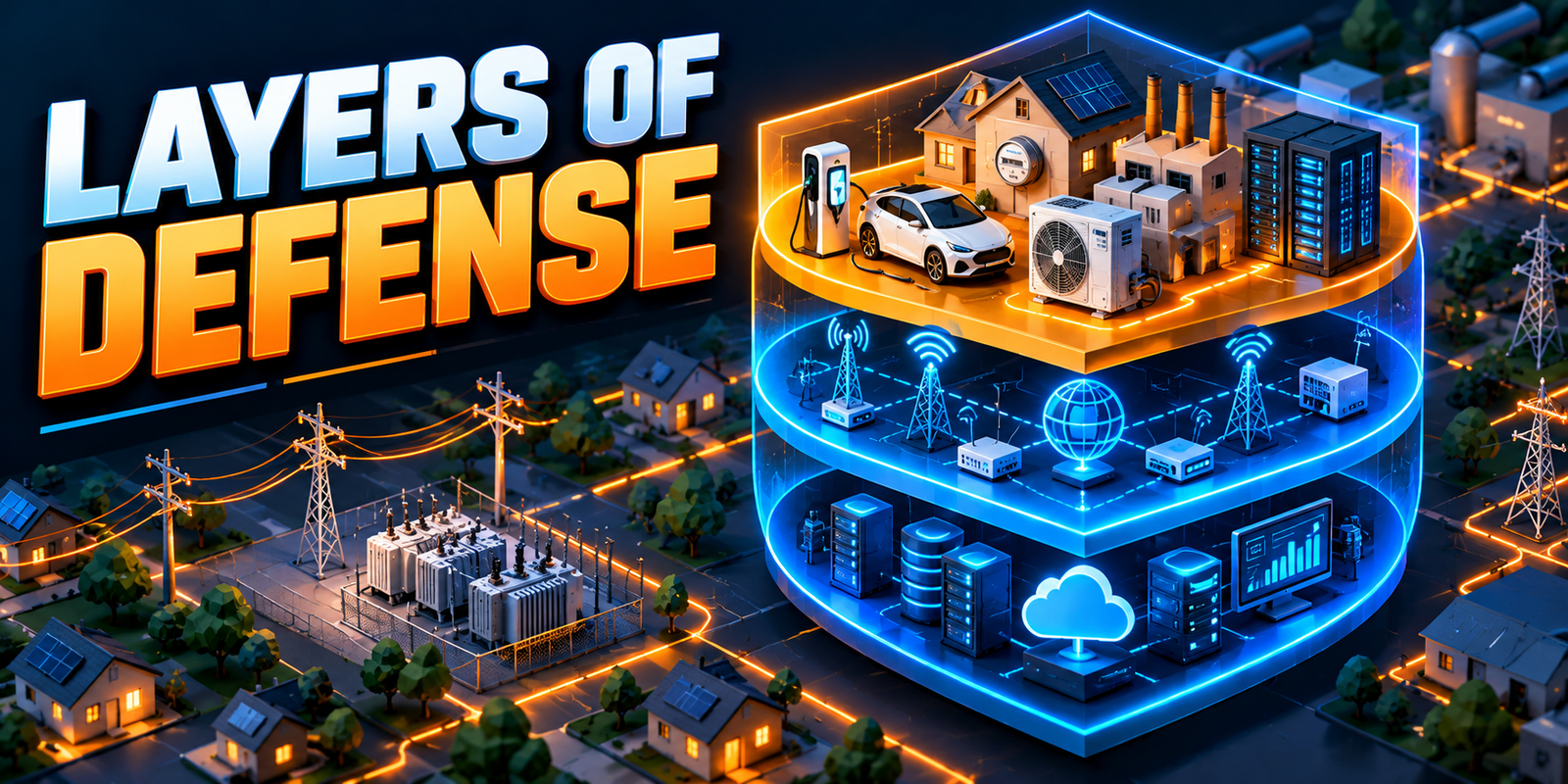
An IoT smart grid can be described in eight layers, each feeding the next.
Physical grid assets
Lines, transformers, switchgear, substations, meters and DERs.
Sensors and IoT devices
Convert physical conditions into electronic data.
Edge devices and gateways
Collect, filter and translate data near the source.
Communication network
Carries data to and from central systems.
Data collection and processing
Platforms validate, store and organize the data.
Analytics and AI/ML
Find trends, anomalies and forecasts.
SCADA, DMS, EMS and control systems
Present the network and support operation.
Operator and automated control
People or configured logic choose and apply actions.
The simple workflow is: asset, sensor, IoT gateway, communication, data platform, analytics, control system, operator or automation, field action. New measurements then confirm the result, which creates continuous feedback.
Connected Sensors in Smart Grids
Sensors are where the data begins. Each type provides different information.
| Sensor Type | Typical Measurement | Utility Application | Operational Benefit |
|---|---|---|---|
| Voltage sensors | Voltage level | Feeder voltage monitoring | Earlier awareness of voltage problems |
| Current sensors | Current flow | Loading and fault detection | Better loading visibility |
| Temperature sensors | Equipment temperature | Thermal monitoring | Early signs of stress |
| Transformer monitors | Loading, temperature, condition indicators | Asset health tracking | Maintenance prioritization |
| Power-quality sensors | Sags, harmonics, disturbances | Quality monitoring | Diagnosis of quality issues |
| Fault indicators | Fault current passage | Fault location | Narrower search area |
| Line sensors | Line current, conductor conditions | Overhead line monitoring | Visibility along lines |
| Equipment condition sensors | Vibration, gas or other indicators | Condition-based maintenance | Planned work |
| Environmental and weather sensors | Temperature, wind, humidity | Operating context and forecasting | Better interpretation of data |
| Substation sensors | Status, temperature, electrical values | Substation monitoring | Site awareness |
| Smart meters | Usage, events, some voltage data | Customer-edge visibility | Edge-of-network insight |
Availability of each measurement depends on the specific device. Our article on how sensors, IoT devices and intelligent monitoring are changing grid operations goes deeper.
IoT Devices and Smart Grid Field Equipment
Several device types are often confused, so the differences are worth stating clearly.
- Sensor: Measures a physical quantity and outputs a signal or reading.
- IoT device: A sensor or equipment unit with communication, so it can send data over a network.
- Gateway: Collects data from many devices, translates protocols and forwards it. Data concentrators serve a similar role for meters.
- IED: An intelligent electronic device that protects, measures, monitors and controls equipment, such as a digital relay.
- RTU: A remote terminal unit that gathers field data and receives commands for a control center.
- PLC: A programmable logic controller that runs local control logic.
- Edge computing device: Processes data close to its source.
These roles overlap in practice, and one product may combine several. See key components of a smart grid for a full reference.
How IoT Data Moves Through the Grid
The data journey is: sensor, local device, gateway, communication network, data platform, analytics, SCADA, DMS or EMS, and operator. Along the way several functions occur:
- Acquisition: Sensors take measurements.
- Filtering and aggregation: Gateways remove noise and combine readings.
- Transmission: Networks carry the data.
- Storage and processing: Platforms keep and organize it.
- Visualization: Dashboards and control displays present it.
- Analytics: Tools find patterns and abnormal conditions.
Data quality and timing both matter. A reading that is inaccurate, missing or wrongly timestamped can mislead analytics and operators, and some uses, such as protection and fast control, need low delay while others tolerate it.
Two practical points follow. First, timestamps must be consistent, because events recorded by different devices can only be compared if their clocks agree. Second, edge processing can reduce load on the network by sending only changes or summaries instead of every raw reading, but it also means some detail is discarded before reaching the platform. Utilities therefore decide, for each use case, what is processed locally, what is sent centrally and how long the raw data is kept for later analysis and investigation of events.
IoT Communication in Smart Grids
From the device perspective, the question is which link suits each device, location and data need. The full topic is covered in smart grid communication networks.
| Communication Technology | Typical IoT Use | Main Strength | Main Consideration |
|---|---|---|---|
| RF mesh | Meters and distribution devices | Self-forming local networks | Limited bandwidth |
| Cellular | Scattered field sensors | Wide coverage | Dependence on a provider |
| Fibre | Substations and backbones | High capacity, low latency | Installation cost |
| Ethernet | Devices inside substations | Reliable local connectivity | Limited to wired sites |
| Private utility networks | Critical field data | Utility control of performance | Cost and spectrum |
| LPWAN | Low-power, low-data sensors | Long range, low power use | Low data rates |
| Power line communication | Some meter and device links | Uses existing lines | Noise and range limits |
| Microwave | Point-to-point links | Reaches sites without fibre | Needs line of sight |
| Satellite | Remote, specialized sites | Reaches isolated locations | Latency and cost |
IoT and AMI
Advanced metering infrastructure (AMI) is the broader system built around smart meters. It typically includes meters, a communication network, head-end systems, meter data management systems (MDMS) and utility analytics. IoT concepts, meaning connected devices sending data to central platforms, underpin it.
AMI can support remote meter reading, outage awareness, consumption monitoring, demand analysis, customer visibility and operational planning. Meter architectures differ between utilities, in networks, vendors and capabilities, so no single design applies everywhere. Data from AMI becomes more valuable when it is shared with operational systems.
For example, meter event data can help confirm the extent of an outage, and interval data can show how demand changes through the day on a feeder. Where meters report voltage, it adds a customer-edge view of voltage quality that feeder sensors alone cannot provide. Each of these uses depends on the specific meter capabilities and the utility’s configuration.
IoT and SCADA Systems
IoT does not simply replace SCADA. SCADA is a supervisory system built around RTUs, IEDs and PLCs, with a human-machine interface (HMI) for operators and historians that store data. It is designed for dependable control of critical equipment.
IoT architectures can complement this operational technology. They can bring additional devices and data sources, such as extra sensors, into monitoring and analytics environments without changing core control functions. Utilities decide carefully which data flows into which system and how it is secured. For the full workflow, read how smart grid technology works.
IoT, Real-Time Monitoring and Grid Visibility
Connected sensors improve visibility into voltage, current, equipment condition, feeder status, transformer health, power quality, environmental conditions, outage indicators and DERs. Operators gain a clearer, more frequent picture of the network, and that supports faster awareness of problems.
Not every IoT system delivers instant data. Latency depends on the device sampling rate, the communication network and the architecture behind it. Some readings arrive in seconds, others in minutes or at set intervals. Utilities should match data speed to the use case.
IoT for Fault Detection and Grid Reliability
IoT data can support fault detection, fault localization, outage awareness, equipment monitoring, abnormal-condition detection, faster operator response and reliability analysis. Four ideas are often mixed up:
- Detection: Noticing that something abnormal has occurred.
- Diagnosis: Working out what and where the cause is.
- Prediction: Estimating the risk of a future problem.
- Automated response: Taking action within configured rules.
IoT mainly improves detection and supports diagnosis. It does not automatically solve faults. Protection systems still clear faults, and crews still repair equipment.
IoT for Predictive Maintenance
Connected sensors support condition-based and predictive maintenance by tracking transformer temperature, vibration, thermal conditions and electrical measurements. Historical trends and anomaly detection then help utilities prioritize maintenance. Predictions are estimates of risk, not guarantees.
| Approach | Trigger | Typical Strength | Main Limitation |
|---|---|---|---|
| Reactive | Failure | No monitoring effort | Unplanned outages |
| Preventive | Calendar or usage | Planned and predictable | May service healthy equipment |
| Condition-based | Measured condition | Targets work to need | Needs monitoring data |
| Predictive | Modelled risk of future failure | Earlier planning | Needs good data and validated models |
This approach is a key part of grid modernization and better electricity data.
IoT and AI/ML for Grid Intelligence
IoT data becomes useful through analytics. The flow is: IoT data, data processing, historical data, analytics, AI/ML, insight, operator decision and action.
Possible applications include anomaly detection, load forecasting, equipment health assessment, predictive maintenance, renewable forecasting, demand analysis, asset prioritization and operational optimization. The three layers differ:
- IoT: Enables connected data collection and communication.
- Analytics: Processes data into measures, trends and alerts.
- AI/ML: Learns patterns from data to classify, forecast or flag anomalies.
IoT collects data and analytics and AI turn it into insight. Results depend on data quality, model validation and engineering oversight.
IoT and Distribution Automation
On distribution feeders, IoT-enabled devices can support feeder monitoring, reclosers, switches, voltage regulation, fault indicators, distribution management and automated switching. The relationship is: sensors, communication, distribution management system (DMS), automation, field devices.
Sensors and fault indicators supply the data, the network carries it, the DMS analyzes it, and automation operates switches or regulators according to configured logic. Automation always works within protection and operating rules. See power system automation for the control side.
IoT in Digital Substations
Digital substations rely on connected devices. IEDs, sensors and digital measurements sit at the process level, while station-level systems handle protection, control and monitoring. Communication follows IEC 61850, with GOOSE messages for fast event exchange and Sampled Values for digital measurements.
The IoT contribution is visibility and intelligence: more equipment data, available in a common digital form, can reach analytics and control systems. The architecture itself is covered in digital substations: architecture, automation, communications and operational benefits.
IoT for Renewable Energy and Distributed Energy Resources
IoT is used across solar PV, wind generation, battery energy storage, microgrids, DERs and EV charging infrastructure. It supports monitoring, production data, equipment health, forecasting, grid coordination and operational visibility.
DER growth increases the need for distributed monitoring because many small resources, often behind the meter, change voltage and power flow locally. A central view of only major assets is no longer enough. Connected devices fill that gap.
IoT and Electric Vehicles
Connected EV charging infrastructure can provide charging status, energy consumption, charger health, demand information and other operational data. Utilities can use this for planning, load forecasting and grid management, for example by seeing where charging clusters. Managed charging is an established approach. Vehicle-to-grid, where vehicles export energy, is still emerging and is not universally deployed.
IoT and Grid Modernization
IoT is one enabling technology within a larger set of ideas that are related but not identical.
| Term | Meaning | Relationship to IoT |
|---|---|---|
| IoT | Connected devices that sense and communicate | An enabling technology |
| Grid digitalization | Adding digital data and control to the grid | IoT supplies much of the data |
| Grid modernization | Broad upgrade of equipment, practices and data | IoT is one component |
| Smart grid | Grid with sensing, communication, control and analytics | IoT is a major part of its sensing layer |
See why traditional power grids are becoming digital and data-driven for more.
Cybersecurity and Data Protection
Large numbers of connected devices increase the attack surface, so security must be designed in. Defensive practices include:
- Device authentication and access control: Verify devices and users and limit privileges.
- Encryption and secure communication: Protect data in transit.
- Network segmentation: Separate operational networks from other systems.
- Firmware and patch management: Apply tested updates under control.
- Monitoring and logging: Detect unusual activity and keep records.
- Incident response: Prepare and rehearse plans.
- Device lifecycle management: Track devices from installation to retirement.
Data Quality and IoT Challenges
Adding more sensors does not automatically create better intelligence. The data must be reliable and actionable. Major challenges include:
- Interoperability and standards: Many suppliers and protocols.
- Data quality and calibration: Drifting or faulty sensors mislead.
- Connectivity, reliability and latency: Data must arrive when needed.
- Cybersecurity: More endpoints to protect.
- Device lifecycle management: Batteries, firmware and replacement.
- Legacy integration: Older systems may not connect easily.
- Scalability and data volume: Storage and processing needs grow.
- Cost and workforce skills: Investment and cross-disciplinary expertise.
Traditional Monitoring vs IoT-Enabled Monitoring
| Aspect | Traditional Monitoring | IoT-Enabled Monitoring |
|---|---|---|
| Data collection | Manual or periodic | Automated, remote |
| Sensor coverage | Key points | Wide, down to equipment |
| Communication | Limited links | Many connected devices |
| Data frequency | Low | Higher, interval or event-based |
| Visibility | Partial | Broader |
| Analytics | Manual review | Data-driven |
| Maintenance | Time-based and reactive | Condition-based |
| Fault awareness | Often after reports | Alerts from devices |
| Automation | Limited | More options where configured |
| Scalability | Limited by manual effort | Scales with good design |
| Integration | Separate systems | Integrated platforms |
| Operational decision-making | Experience and periodic data | Supported by continuous data |
Illustrative Example: Transformer Monitoring
Illustrative example — not a real utility case study.
A utility monitors a distribution transformer with connected sensors.
A sensor measures equipment condition
Temperature and loading are recorded.
An IoT device collects the data
It timestamps and packages the readings.
A gateway processes and forwards it
It filters the data and sends it onward.
The communication network transmits it
The data reaches the utility platform.
The platform stores the data
History builds up for comparison.
Analytics identifies abnormal trends
Temperature rises faster than expected for the load.
An operator receives an alert
The operator reviews the trend.
A maintenance team investigates
Crews inspect and test the unit.
The utility reduces outage risk
Repair or load changes may prevent or reduce an unplanned outage.
How Utilities Can Implement IoT
Utilities should begin with clear operational use cases rather than installing sensors without a defined purpose.
Identify the operational problem
Such as outages or overloaded transformers.
Select a measurable use case
Define what success looks like.
Choose sensors and devices
Match them to the measurements needed.
Design the communication architecture
Pick suitable links, with redundancy where needed.
Integrate with existing systems
Connect to SCADA, DMS and data platforms.
Establish cybersecurity controls
Build security in from the start.
Validate data quality
Check accuracy, timing and completeness.
Add analytics
Apply tools to validated data.
Pilot the solution
Test on a limited set of assets.
Scale across assets, feeders and substations
Expand what proves useful.
Future of IoT in Smart Grids
These are trends, not guaranteed outcomes, and they will vary by utility and region.
- More connected grid assets: Coverage is expected to widen.
- Edge computing: More processing may happen near devices.
- AI-assisted monitoring: Decision support could grow, with human oversight.
- Digital twins: Virtual models are emerging for planning and operations.
- Advanced sensors: New sensing methods may improve measurement.
- More DERs and EV integration: More local resources will likely need monitoring.
- Automated distribution systems: More defined tasks could be automated.
- Improved interoperability: Standards work could ease integration.
- Greater visibility: More data-driven operations are likely. See the electric grid in 2035.
Conclusion
An IoT smart grid connects physical grid assets to digital systems. Sensors provide operational data, communication networks move it, and platforms process it. Analytics and AI turn the data into insight, utility control systems and operators use that insight, and automation can convert it into field actions.
IoT in smart grids is an important enabling layer for smart grids and grid modernization, but it works only as part of a complete chain that includes reliable data, secure communication and engineering judgment.
Frequently Asked Questions About IoT in Smart Grids
What is IoT smart grid?
An IoT smart grid is an electricity network that uses connected sensors and devices to monitor assets and feed data into utility systems. It combines the Internet of Things with smart grid sensing, communication, control and analytics.
The result is wider visibility than traditional monitoring provides.
How does IoT smart grid work?
Sensors measure conditions on grid assets, and gateways collect and forward the data. Communication networks carry it to data platforms and control systems, where analytics interpret it.
Operators or configured automation then act, and new measurements confirm the result.
Why is IoT smart grid important?
It gives utilities more detailed, frequent information about network and equipment conditions. That matters as renewables, DERs, EVs and ageing assets make operation more complex.
Benefits depend on data quality, integration and cybersecurity.
What are the main components of IoT smart grid?
The main components are:
- Sensors, smart meters and other IoT devices
- Gateways and edge devices
- Communication networks
- Data platforms and analytics
- Control systems such as SCADA, DMS and EMS
- Cybersecurity controls
What are the challenges of IoT smart grid?
Key challenges include interoperability, data quality, sensor calibration, connectivity and cybersecurity. Device lifecycle management, legacy integration, scalability, cost and workforce skills also matter.
Utilities address these through clear use cases, standards, phased deployment and strong data governance.
Where is IoT smart grid used?
It is used across transmission, substations, distribution feeders, customer metering, renewable generation, storage and EV charging. Typical uses include transformer monitoring, feeder visibility, AMI and DER monitoring.
Adoption varies by utility and region.
How do connected sensors support smart grid monitoring?
Connected sensors measure voltage, current, temperature, power quality and equipment condition, and send the readings to utility systems. This gives operators a broader and more frequent view of the network.
Data speed depends on the device, network and architecture.
How does IoT work with AI and analytics in smart grids?
IoT collects and transports the data, while analytics and AI/ML find patterns, trends and anomalies in it. Together they support forecasting, asset health assessment and decision support.
Outputs need data validation, model validation and engineering review before operators rely on them.

I share real stories, practical ideas and honest perspectives on business, marketing and life. This blog is a space to learn, grow and connect.