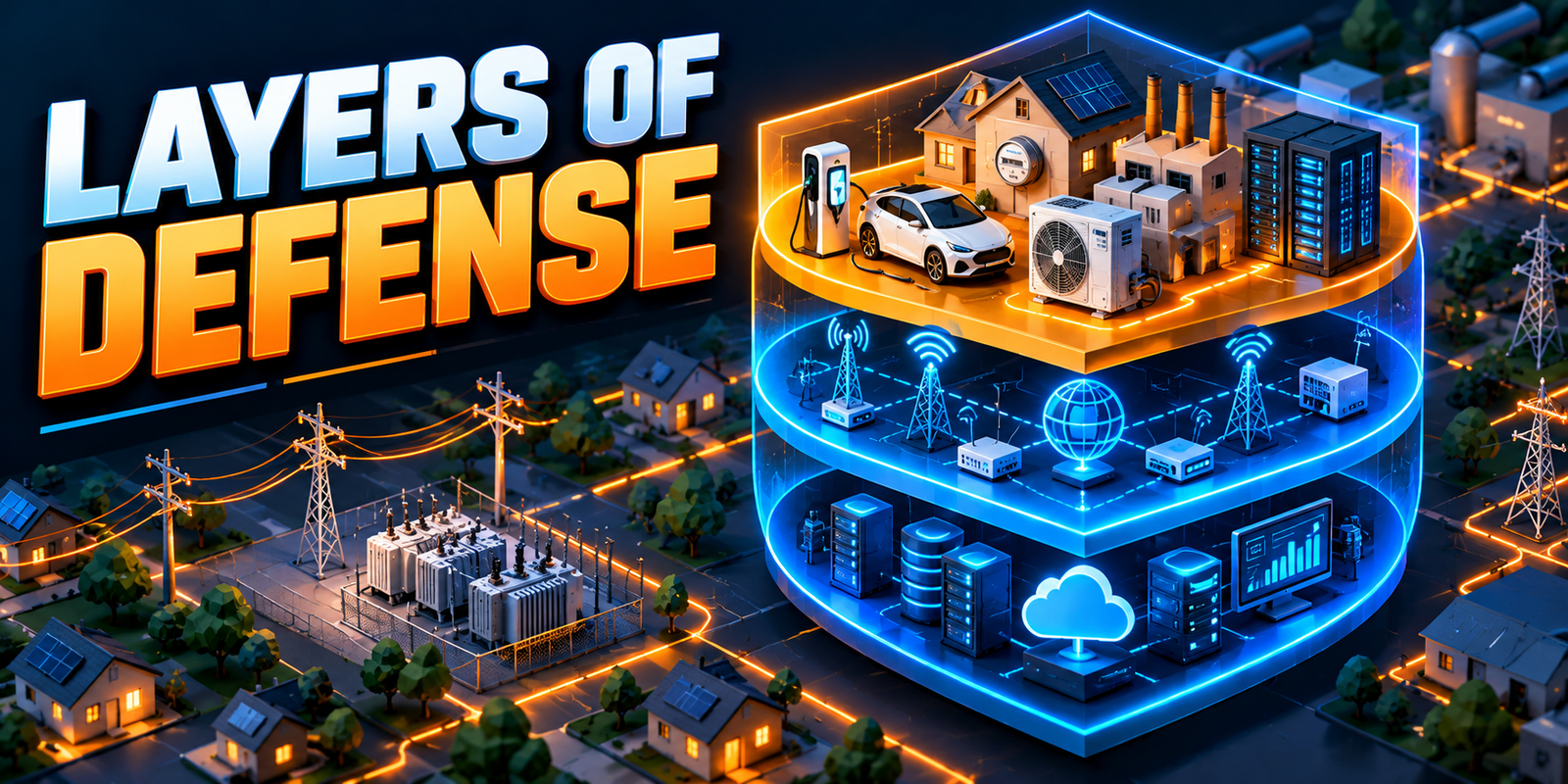

An AI smart grid is an electricity network in which artificial intelligence and machine learning analyze data from meters, sensors, SCADA and other sources to support forecasting, fault detection, maintenance and optimization. Utilities use AI in smart grids because modern networks produce more data than people can review manually, and because renewable generation, EV charging and aging assets make operating conditions harder to predict. AI turns that data into predictions, alerts and recommendations. It does not replace physical infrastructure, protection systems, control systems or engineering judgment.
The opportunity comes from data. A smart grid measures conditions continuously and carries them through communication networks to utility platforms, creating the history that machine learning needs to find patterns. Forecasting helps utilities plan. Fault and anomaly detection help them notice problems sooner. Optimization helps them use equipment and flexible resources more effectively. In every case, AI supports utility engineers and operators rather than taking their place.
This article focuses on practical AI applications. For the basics, read what is a smart grid and how smart grid technology works. Here the question is what AI does with the data once it exists.
- AI uses grid data to identify patterns and support decisions.
- Forecasting improves planning and operational awareness.
- AI can help detect abnormal conditions and potential faults.
- Machine learning can support predictive maintenance.
- AI can help optimize renewable integration and grid operations.
- AI works alongside sensors, IoT, SCADA, DMS and EMS, and depends on reliable data.
What Is AI in a Smart Grid?
AI in a smart grid is the use of artificial intelligence, especially machine learning, to analyze grid data and produce predictions, detections and recommendations that support utility operations.
Artificial intelligence is the broad field of software that performs tasks normally needing human judgment. Machine learning is a subset in which models learn patterns from data instead of following only hand-written rules. A smart grid is a power network combined with sensors, communication, control systems and analytics. An AI-enabled smart grid adds learning-based analytics to that stack, and grid intelligence is the resulting ability to interpret conditions and anticipate change.
The practical difference is between rules and learned patterns. Rule-based operation applies fixed thresholds written by engineers. Data-driven operation also learns from history.
| Aspect | Traditional Approach | AI-Assisted Approach |
|---|---|---|
| Data analysis | Manual review, fixed reports | Automated pattern analysis across many data streams |
| Forecasting | Statistical or experience-based methods | Learned models using weather, history and other inputs |
| Fault detection | Threshold and protection logic | Adds pattern-based anomaly detection |
| Maintenance | Time-based schedules | Condition-based and predictive analysis |
| Decision support | Operator experience and displays | Ranked alerts and recommendations |
| Optimization | Fixed operating rules | Models that evaluate many options |
| Scalability | Effort grows with data volume | Scales better with data, with computing cost |
| Adaptability | Rules updated manually | Models can be retrained as conditions change |
Why AI Matters for Modern Power Systems
Utilities now operate under several pressures at once:
- Growing electricity demand from electrification and new loads.
- Renewable variability: solar and wind output follows weather.
- Distributed energy resources (DERs) that change local power flows.
- EV charging that adds large, clustered demand.
- Battery storage that must be scheduled.
- Aging infrastructure that needs targeted attention.
- Large data volumes from smart meters, sensors and IoT devices.
These pressures create a need for faster decisions. Operators cannot manually examine every data stream from thousands of devices at short intervals. AI can screen that data, highlight what changed and rank what needs attention. Operators still decide, because they understand switching constraints, safety rules and context that models may not capture. This is part of broader grid modernization, which depends on good data and visibility.
How AI Smart Grid Architecture Works
The architecture is a pipeline from the physical grid to a field response and back:
Physical grid
Lines, transformers, substations and customer loads.
Sensors and smart meters
Measure voltage, current, temperature and usage.
IoT and communication
Connected devices and networks carry the data.
Data collection and storage
Platforms gather and keep real-time and historical data.
Data processing
Cleaning, validation and time alignment.
AI/ML models
Learn patterns and generate outputs.
Insights and predictions
Forecasts, anomaly scores and risk rankings.
SCADA, DMS, EMS and analytics tools
Present results in operational systems.
Operator decision
A person reviews and chooses.
Automation and control
Approved actions go to field equipment.
Five layers are often confused:
- Data collection: gathering raw measurements from devices.
- Data processing: cleaning, validating and organizing that data.
- AI/ML: learning patterns and producing predictions.
- Decision support: presenting results so people can act.
- Automated control: executing actions under configured rules and protection limits.
AI mainly sits in the middle. It rarely sends commands by itself, and control stays inside established utility systems. The communication layer is covered in smart grid communication networks.
Data Sources for AI in Smart Grids
AI quality depends on data quality. Common sources include the following. Data volumes and performance vary widely by utility, so none are quoted here.
| Data Source | Example Data | Potential AI Application |
|---|---|---|
| Smart meters | Interval usage, events | Load forecasting, outlier detection |
| Grid sensors | Voltage, current, temperature | Anomaly detection, condition monitoring |
| IoT devices | Equipment and environment readings | Asset health analysis |
| SCADA | Status, measurements, alarms | Pattern analysis, event correlation |
| IEDs | Relay events, disturbance records | Event analysis, fault classification |
| RTUs | Field status and analog values | Operational pattern analysis |
| PMUs (where deployed) | Time-synchronized phasor measurements | Stability and dynamic event analysis |
| Weather data | Temperature, wind, irradiance | Load and renewable forecasting |
| Renewable generation data | Solar and wind output | Output forecasting |
| Historical load data | Past demand profiles | Forecasting, planning |
| Asset condition data | Test results, inspections | Predictive maintenance |
| Outage data | Outage records and causes | Outage pattern analysis |
| Power-quality data | Sags, harmonics, interruptions | Disturbance analysis |
| Customer load profiles | Aggregated usage patterns | Segmentation, demand response (with privacy controls) |
Much of this data comes from connected devices. See IoT in smart grids for how those devices work.
AI for Load Forecasting
Load forecasting is one of the most established AI applications. It predicts electricity demand over different horizons:
- Short-term: hours to days, for operations and scheduling.
- Medium-term: weeks to months, for maintenance and procurement.
- Long-term: years, for network and capacity planning.
Models use demand patterns, weather, seasonal behavior, historical consumption and special events such as holidays. Common approaches, explained conceptually:
- Regression: relates demand to drivers such as temperature.
- Time-series models: learn trends and repeating cycles in past demand.
- Neural networks: learn complex, non-linear relationships.
- Ensemble models: combine several models to reduce error.
Better forecasts support generation planning, distribution planning, demand response, energy procurement, grid balancing and asset planning. Forecasts always carry uncertainty, so planners use them as ranges and compare them with actual results.
AI for Renewable Energy Forecasting
Solar and wind output depends on weather, which is variable and imperfectly predictable. AI supports solar forecasting, wind forecasting, renewable output prediction, weather-informed forecasting and variability management. The workflow is:
Weather, historical and generation data
Inputs from forecasts, past output and plant measurements.
AI model
Learns how conditions relate to output.
Renewable forecast
Expected output with uncertainty.
Utility planning and operations
Scheduling reserves, storage and flexible resources.
Forecasts cannot be perfect. Sudden cloud cover, wind shifts and local effects create errors, and accuracy varies by site, season and horizon. Utilities therefore keep reserves and flexible resources rather than relying on a single forecast. AI improves preparedness, not certainty.
AI for Fault Detection
AI can help identify abnormal behavior in voltage, current, equipment, feeders, transformers, power quality and outage patterns. Four related terms mean different things:
| Term | What It Answers |
|---|---|
| Anomaly detection | Is this behavior unusual compared with normal patterns? |
| Fault detection | Has a fault actually occurred? |
| Fault classification | What type of fault is it? |
| Fault localization | Where on the network did it occur? |
An anomaly is not always a fault. A model may flag unusual but harmless behavior. AI-based fault detection can support each step, but it operates within protection and operational frameworks. Protective relays still trip equipment on engineered settings. AI adds analysis, such as helping crews narrow down likely locations or recognizing precursors to repeated events.
AI for Predictive Maintenance
AI can analyze equipment data to identify possible degradation in transformers, switchgear, circuit breakers, distribution equipment, transmission assets and auxiliary equipment such as motors. Four maintenance strategies are commonly compared:
| Strategy | Trigger | Strength | Limitation |
|---|---|---|---|
| Reactive | Failure or fault | No planning effort | Unplanned outages and higher risk |
| Preventive | Fixed schedule | Predictable planning | May service healthy equipment |
| Condition-based | Measured condition crossing a limit | Targets actual condition | Needs monitoring and limits |
| Predictive | Modeled trend toward degradation | Can anticipate issues earlier | Needs quality data and validated models |
Machine learning can combine historical and real-time measurements, such as loading, temperature and test records, and recognize patterns that precede problems. Predictions estimate risk and do not guarantee outcomes, so engineers verify before acting.
AI for Grid Optimization
Optimization means choosing better operating decisions. Applications include load balancing, power flow awareness, voltage management, asset utilization, distributed energy coordination, demand response, renewable integration and storage coordination. Three ideas should be separated:
- Prediction: estimating what is likely to happen.
- Optimization: choosing the best option among alternatives under constraints.
- Control: carrying out the chosen action on equipment.
AI may recommend or optimize decisions, while actual control stays within established utility control systems that enforce limits, interlocks and protection. A recommendation is not a command.
AI and SCADA
SCADA collects real-time operational data from field equipment, shows it on the human-machine interface (HMI), raises alarms and allows supervisory control. A historian stores the time-series data.
AI does not simply replace SCADA. SCADA remains the operational system of record for monitoring and control. AI analyzes historical and streaming SCADA data to identify patterns, anomalies and predictions, and results can be shown back to operators through existing displays or alarm tools. Power system automation is explained further in our automation guide.
AI With DMS and EMS
A distribution management system (DMS) focuses on distribution networks: feeder monitoring, switching, fault management and voltage control. An energy management system (EMS) focuses on transmission and generation: system monitoring, forecasting and dispatch support. AI complements both through:
- Load forecasting
- Network condition analysis
- Renewable forecasting
- Asset monitoring
- Decision support and operational optimization
These systems hold network models and operating rules, and AI adds learned patterns and predictions on top of them.
AI and Smart Meters and AMI
Advanced metering infrastructure (AMI) provides interval consumption data and meter events. AI can use it for load forecasting, consumption pattern analysis, outlier detection, demand response, customer segmentation where appropriate, outage awareness and planning.
AMI architectures differ between utilities, in meter capabilities, communication networks and data platforms, so what AI can use varies. Meter data can reveal household behavior, so privacy, aggregation and access controls matter.
AI and Grid Sensors
Sensors create the data foundation for AI. They measure voltage, current, temperature, equipment condition, line conditions, weather and power quality. The chain is:
Sensors
Measure physical conditions.
Data
Readings are transmitted and stored.
Analytics
Data is validated and organized.
AI
Models find patterns.
Insight
Engineers receive findings.
Poorly placed or uncalibrated sensors limit what AI can learn. See IoT in smart grids and grid sensors and intelligent monitoring for the device layer.
AI for Distribution Automation
On distribution feeders, AI can support fault detection, feeder analysis, load prediction, voltage optimization, switching recommendations and distributed energy coordination. For example, a model might suggest a switching sequence that limits the number of customers affected by a fault, and an operator or configured automation then applies it. AI recommendations must operate within utility protection, safety and control frameworks, including switching procedures and equipment limits.
AI for Digital Substations
Digital substations generate rich data from IEDs, sensors and equipment monitors, often in IEC 61850 environments. AI can support condition monitoring, event analysis and substation automation by analyzing relay event records, equipment trends and disturbance data. It can help engineers review events faster and spot developing equipment problems. Protection and control functions remain with the IEDs and substation systems. For the architecture itself, read digital substations.
AI for EVs, Storage and Distributed Energy Resources
Electric vehicles: AI can forecast charging demand, support load management and optimize charging schedules to ease peaks. Battery storage: it can predict demand, optimize charging and discharging, and monitor asset condition. DERs: it can forecast solar and wind output and help coordinate distributed generation and microgrids.
As resources multiply, coordinating them manually becomes harder, and AI can help utilities see and schedule them together. Vehicle-to-grid remains an emerging capability limited to pilots and specific programs, and should not be assumed to be widely deployed.
AI for Power Quality and Anomaly Analysis
Power-quality monitors produce large records of events. AI can help recognize patterns in voltage disturbances, harmonic-related measurements, abnormal operating patterns, equipment behavior and power-quality events, for example grouping similar events to reveal a recurring source. AI assists analysis and does not replace engineering validation, since root causes need on-site knowledge and measurement review.
AI and Grid Modernization
These concepts overlap but play different roles:
| Technology / Concept | Primary Role |
|---|---|
| AI | Intelligence and analytics layer that finds patterns and predicts |
| IoT | Connected devices that supply measurement data |
| Smart grid | The overall system combining the physical grid with digital technology |
| Grid digitalization | Converting grid operations and data into digital form |
| Grid modernization | Broader transformation including equipment, practices and data |
AI is one layer in this picture. For definitions, see what is a smart grid, IoT in smart grids and grid digitalization.
AI, IoT and Smart Grid: How They Work Together
The end-to-end flow connects all three technologies:
Physical grid
Equipment and loads create conditions to measure.
Sensors
Convert conditions into data.
IoT
Connects devices and manages them at scale.
Communication
Carries data to utility systems.
Data platform
Stores and prepares it.
AI/ML
Learns patterns.
Prediction and detection
Produces forecasts and alerts.
Utility control system
SCADA, DMS or EMS presents and manages them.
Operator
Reviews and decides.
Automation
Executes approved or preconfigured actions.
Field action and feedback
New measurements show the result and restart the loop.
The smart grid provides the physical and operational context, IoT provides data, communication provides transport, and AI provides interpretation. Remove any layer and the others become less useful. The loop is also continuous: field results become new training and monitoring data.
AI Model Types and Methods
Common methods, in practical terms:
- Supervised learning: learns from labeled examples. Useful for fault classification and forecasting.
- Unsupervised learning: finds structure without labels. Useful for grouping load profiles.
- Classification: assigns categories, such as fault type.
- Regression: predicts numeric values, such as demand.
- Time-series forecasting: predicts future values from ordered history, such as load or solar output.
- Clustering: groups similar items, such as feeders or customers.
- Anomaly detection: flags unusual behavior, such as abnormal transformer trends.
- Neural networks: learn complex patterns in large datasets.
- Ensemble methods: combine models for more stable predictions.
- Optimization algorithms: search for the best decisions under constraints, such as storage scheduling.
No method fits every problem. Simpler models are often easier to explain and validate, so utilities choose complexity only when it adds value.
Challenges of AI in Smart Grids
- Data quality, missing data and sensor errors: models learn from flawed data.
- Model bias: training data may under-represent some conditions.
- Model drift: performance degrades as the grid, weather or load patterns change.
- Explainability: engineers need to understand why a model flagged something.
- Cybersecurity and privacy: data and models need protection.
- Legacy-system integration and interoperability: older systems may not exchange data easily.
- Computing requirements: training and running models costs resources.
- Workforce skills: teams need power-system and data expertise.
- Model validation: results must be tested against real conditions.
- False positives and false negatives: too many false alarms waste attention, while missed events carry risk.
- Operational safety: recommendations must respect protection and safety rules.
Models need continuous validation because the grid keeps changing. New DERs, load growth, equipment replacement and climate patterns can all make an older model less accurate.
AI Cybersecurity and Responsible Deployment
AI expands the systems that need protection: data pipelines, models and the platforms around them. Defensive practices include:
- Access control and authentication for users, devices and services.
- Secure data pipelines and encryption for data in transit and at rest.
- Network segmentation between operational and business networks.
- Model security: controlling who can change, retrain or replace models.
- Monitoring and logging of data flows, model outputs and access.
- Firmware and device security for connected equipment.
- Governance and human oversight with clear accountability.
Critical infrastructure needs strong governance because errors or manipulated inputs can have physical consequences. Utilities define what AI may recommend, what needs approval and how results are audited, and validate models before operational use. See also what causes power grid failures for why reliability matters.
Traditional Grid Analytics vs AI-Enabled Grid Intelligence
Traditional analytics remain valuable. Engineering studies, protection coordination and rule-based logic are proven and explainable, and AI complements them rather than replacing them. AI is not always better, and its benefit depends on data and use case.
| Aspect | Traditional Approach | AI-Enabled Approach |
|---|---|---|
| Data analysis | Periodic studies, defined reports | Continuous pattern analysis of large datasets |
| Forecasting | Statistical and expert methods | Learned models using many inputs |
| Fault detection | Protection settings, thresholds | Adds anomaly and pattern-based detection |
| Maintenance | Time-based, inspection-based | Predictive, condition-aware |
| Asset monitoring | Periodic tests and readings | Continuous trend analysis |
| Renewable integration | Fixed margins, basic forecasts | Weather-informed forecasting |
| Optimization | Rules and engineering studies | Models that compare many options |
| Decision support | Displays and procedures | Ranked alerts and recommendations |
| Scalability | Limited by manual effort | Scales with data, with computing cost |
| Adaptability | Manual rule updates | Retraining, with validation |
| Human involvement | Humans analyze and decide | Humans review, validate and decide with AI support |
Illustrative Example: AI for Transformer Monitoring
Illustrative Example — not a real project or case study.
A utility collects temperature, load and condition data from a distribution transformer.
Sensors collect measurements
Temperature and loading are recorded.
Data is transmitted
Readings reach the utility platform.
Historical data is stored
Past behavior provides a baseline.
The AI model identifies patterns
It learns normal temperature behavior at given loads.
The model detects an abnormal trend
Temperature rises faster than expected for similar loading.
A utility system generates an alert
The asset is flagged for review.
An engineer reviews the condition
The engineer checks data, history and inspection records.
Maintenance is scheduled if appropriate
A planned inspection is arranged.
Risk is reduced
The utility lowers the chance of an unexpected equipment problem.
The model supplies an early signal, and the engineer makes the maintenance decision.
How Utilities Can Implement AI
Utilities should start with a clear use case, not with AI for its own sake. A practical roadmap:
- Define the operational problem and success measures.
- Identify required data and its owners.
- Check data quality for gaps, errors and consistency.
- Select an appropriate AI/ML approach, favoring simplicity.
- Build and validate the model.
- Test against historical data, including unusual events.
- Pilot in a controlled environment with limited scope.
- Integrate with utility workflows and existing systems.
- Add human review and governance.
- Monitor model performance for drift and errors.
- Scale after validation.
Future of AI in Smart Grids
This outlook describes possibilities, not guaranteed outcomes, and progress will vary by utility and region.
- AI-assisted grid operations may grow, with human oversight.
- Renewable forecasting is expected to keep improving as data and methods advance.
- More autonomous distribution could emerge for defined, well-validated tasks.
- Digital twins are emerging as virtual network models for planning and operations.
- Edge AI may move some analysis closer to devices.
- Advanced anomaly detection and AI-assisted predictive maintenance may mature.
- DER coordination and EV load optimization are likely to grow in importance.
- AI-supported planning and tighter IoT integration could follow.
For the wider outlook, see the electric grid in 2035.
Conclusion
Smart grids generate large amounts of operational data, and IoT devices and sensors provide much of it. AI and machine learning can find patterns in that data and generate predictions. Forecasting supports planning, fault and anomaly detection help utilities notice problems sooner, predictive maintenance can improve asset management, and optimization can support more efficient operation.
An AI smart grid works alongside SCADA, DMS, EMS, IoT and utility engineering processes, not in place of them. It also depends on good data, secure communication and validated models. Human oversight remains important for critical operational decisions. To see how the pieces fit, explore key smart grid components and smart grid vs traditional grid.
Frequently Asked Questions About AI in Smart Grids
What is AI smart grid?
An AI smart grid is an electricity network that uses artificial intelligence and machine learning to analyze data from meters, sensors, SCADA and other sources. It supports forecasting, fault detection, predictive maintenance and optimization.
AI does not replace the physical grid, protection systems or engineers. It adds an analytics layer on top of them.
How does AI smart grid work?
Sensors, smart meters and IoT devices collect data, and communication networks carry it to a data platform. Machine learning models analyze it to produce forecasts, anomaly alerts and recommendations.
Those results appear in systems such as SCADA, DMS and EMS, where operators decide. Approved actions can be executed by automation, and new measurements feed back into the models.
Why is AI smart grid important?
Modern grids face variable renewable output, DERs, EV charging, aging assets and very large data volumes. AI helps utilities analyze that data faster and anticipate changing conditions.
Its value depends on data quality, validation and integration with utility workflows, and it supports rather than replaces human operators.
What are the main components of AI smart grid?
The main components are sensors, smart meters and IoT devices, communication networks, and data platforms. On top of these sit AI/ML models, utility systems such as SCADA, DMS and EMS, operators, and automation and control.
Cybersecurity and governance protect and oversee the whole chain.
What are the challenges of AI smart grid?
Key challenges include data quality, missing data, sensor errors, model drift, explainability, cybersecurity and privacy. Legacy-system integration, workforce skills and false alarms also matter.
Utilities respond with data governance, continuous model validation, pilots, security controls and human review.
Where is AI smart grid used?
AI is used in load and renewable forecasting, fault and anomaly detection, predictive maintenance, distribution automation and DER coordination. It also supports AMI analysis, substation monitoring, EV charging management and storage optimization.
Adoption varies widely by utility, region and use case.
How does AI help with smart grid forecasting and fault detection?
For forecasting, models learn from historical demand, weather and generation data to predict load and renewable output. Forecasts support planning, scheduling and balancing, though they always carry uncertainty.
For fault detection, models learn normal behavior and flag unusual voltage, current or equipment patterns. They can help classify and locate events, while protection systems and engineers retain responsibility for safe operation.
How do AI, IoT and smart grid technologies work together?
IoT devices and sensors supply measurements, communication networks carry them, and the smart grid provides the operational systems and physical context. AI analyzes the data to produce predictions and detections.
Operators or configured automation then act through control systems, and new measurements close the loop. Each layer depends on the others.

I share real stories, practical ideas and honest perspectives on business, marketing and life. This blog is a space to learn, grow and connect.